

Approximately 10.2 billion Pokémon cards were printed in the twelve months before March 2025, according to Statista's Pokémon Trading Card Game overview. That scale reframes the search for the best Pokémon booster box to buy for profit: popularity alone isn't scarcity, and a rising resale price isn't the same as money you'll keep.
The stronger question is which sealed box offers a defensible entry price, enough buyers when you exit, and room for profit after every cost. That calls for comparing buying strategies rather than declaring the latest hyped set an automatic winner.
Table of Contents
- Top Pokémon Booster Box Picks at a Glance
- How Booster Box Profit Works in Practice
- Scarcity and Liquidity Checks Before You Buy
- Opening Value Versus Sealed Hold Value
- Reprint Risk and Staged Buying Plans
- Net Return After Fees, Storage and Exit Costs
- Confirm Your Buy Plan Before Ordering
Top Pokémon Booster Box Picks at a Glance
Quick-pick comparison of booster box types
| Box type | Best for | Profit logic | Main risk |
|---|---|---|---|
| Older discontinued set | Long-hold investors | Limited print run and proven scarcity | Thin sales volume at exit |
| Recent set with strong chase cards | Shorter resale windows | Premium driven by sought-after alternate-art cards | Reprint wave and price pullback |
| Recently restocked set | Buyers who can wait | Lower entry price after supply rises | Further downside if the reprint is large |
| Standard current-release box | Budget-limited buyers | Lower price and steady demand, when verified | Wide supply and weak sealed premium |
Older discontinued boxes deserve priority for buyers who can leave capital untouched and tolerate a slower sale. Recent chase-card sets suit buyers prepared to monitor demand actively, while restocked products require patience and current-release boxes require especially strict entry-price discipline.
These are conditional picks, not a performance ranking. Without comparable acquisition prices, completed-sale histories, and packaging details, naming a single winning box would imply more precision than the evidence supports.
Match the box to your constraint
Start with the constraint you can't change. If you might need the money back quickly, an expensive older box with occasional transactions is a poor fit, even if collectors consider it desirable. If your budget is limited, buying a current-release box cheaply can be more practical than stretching for a discontinued product whose premium already reflects its scarcity.
A recently restocked set is the most interesting contrarian category. You're looking for a supply-driven discount in a product that collectors still want, not a falling price. Prismatic Evolutions and Destined Rivals provide useful pullback examples for this distinction, but neither name alone establishes an attractive entry.
Selection rule: Choose the profit mechanism before choosing the set. Scarcity, chase-card demand, and a post-restock discount require different holding and selling plans.
Keep product formats separate, too. A booster bundle, an Elite Trainer Box, and a standard booster box aren't interchangeable comparisons. Record the exact language, edition, product format, and sealed condition before comparing listings.
Shortlist a few candidates that match your available capital and intended holding period. Keep an older scarce product only if its exit looks workable, a recent chase-card set only if its premium is defensible, and a restocked candidate only if buyers continue completing purchases.
How Booster Box Profit Works in Practice
Profit is the difference between your all-in acquisition and holding costs and what you receive from a completed sale. A seller's listing isn't proceeds, and an unsold price increase isn't a realized return.
The boom provides a useful warning: CNBC's Pokémon resale-market reporting describes some modern sealed products reaching approximately $400–$600 before later falling to roughly $120–$180 as supply increased and speculative demand cooled. That's evidence of volatility, not a benchmark return you should expect to reproduce.
The mechanism matters more than the excitement. When production and distribution end, buyers may gradually have fewer unopened boxes to choose from. But scarcity only supports a profitable sale if collectors still want the product at a price above your costs.
Separate durable demand from launch enthusiasm
Recognizable characters and desirable chase cards give buyers reasons to return after release excitement fades. Test that demand through completed transactions, not social-media attention or a brief run of ambitious listings. Compare equivalent products across marketplaces, excluding damaged boxes and mismatched editions.
Older sealed boxes can offer more evidence of persistent demand, but the acquisition price may already incorporate that history. Newer boxes can offer a lower entry cost while leaving you exposed to additional supply. Neither age nor affordability resolves the investment case by itself.
Use our Pokémon booster-box retail-price guide to distinguish the retail baseline from the secondary-market premium you're being asked to pay. Then decide what justifies that premium rather than assuming it will expand.
Keep purchase receipts, photographs of the seal, and clear condition records. Authentication and packaging documentation help a future buyer evaluate what you're selling, but they don't remove price risk.
A sealed box can become more expensive while remaining a poor investment for the buyer who paid too much.
Profit = completed net sale price minus (purchase price + tax + shipping + holding costs).
Scarcity and Liquidity Checks Before You Buy
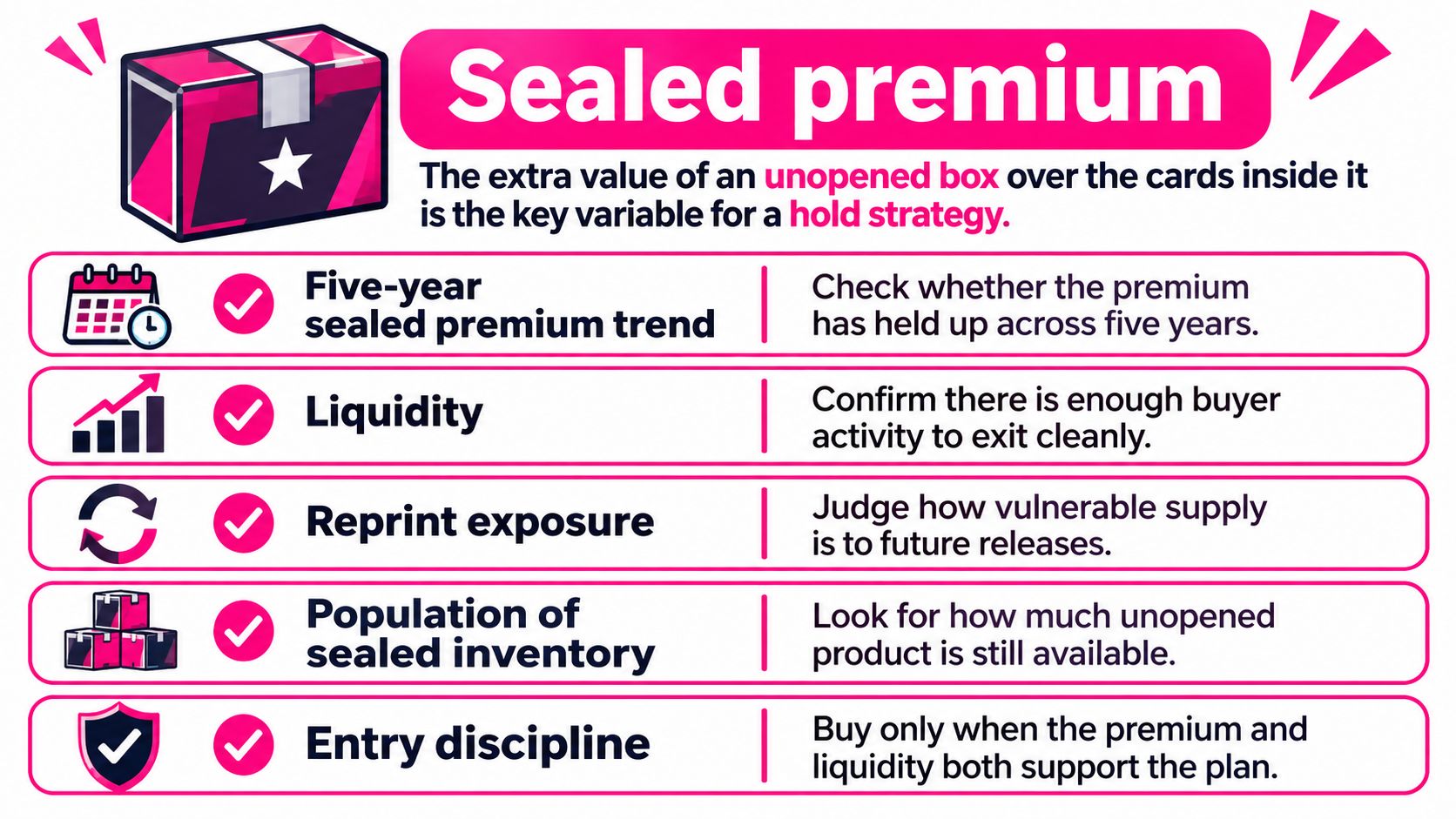
The sealed premium is the extra value buyers assign to an unopened box relative to the cards inside it. For a hold strategy, you're evaluating whether collectors will continue paying for the unopened product, not merely adding up today's valuable singles.
PokeInvest's booster-pack investment analysis identifies scarcity, trading activity, chase-card demand, and the distinction between opening value and sealed value as key considerations; it also notes that top alternate-art cards in some sets average fewer than one pull per roughly 280 packs. That difficulty can support interest in unopened inventory without making an individual opening economically attractive.
Score evidence rather than enthusiasm
Five-factor scoring checks for a sealed booster box
| Factor | Strong signal | Weak signal |
|---|---|---|
| Five-year sealed-price history | Steady sealed prices across several years | Single spike with no sustained history |
| Current transaction frequency | Frequent completed sales | Few listings and rare completed sales |
| Age and reprint exposure | Older set with no announced reprint | New set with an announced restock |
| Concentration of value in top chase cards | Premium backed by widely wanted chase cards | Premium tied to one obscure card |
| Spread between acquisition cost and verified market price | Purchase price near recent completed sales | Asking price well above completed sales |
Price history: Look for sustained completed prices across different market conditions. If the product doesn't have the requested history, mark the evidence incomplete rather than treating a shorter chart as equivalent.
Transaction frequency: Count genuine completed sales for the exact product you're considering. Numerous unsold listings show seller availability, not buyer willingness to pay.
Age and reprint exposure: Prefer documented distribution information over assumptions based on age. No announced reprint is a stronger signal than an announced restock, but it isn't proof that additional supply can't appear.
Chase-card concentration: Check whether collectors want a broad group of cards or whether the box's appeal rests on a narrow attraction. Concentrated demand gives you less room for disappointment if that attraction weakens.
Entry spread: Compare your delivered purchase price with credible completed transactions. Buying near those prices prevents an obvious overpayment, but you still need enough potential appreciation to cover selling costs.
Use a spreadsheet with separate columns for evidence, assessment, and unresolved questions. Score a shortlist of three boxes as strong, weak, or incomplete on each factor, and don't let an attractive chart cancel out missing liquidity evidence.
Opening Value Versus Sealed Hold Value
Opening statistics for a Scarlet & Violet 36-pack box
The following figures are community-derived estimates from PokéLoot's pull-rate dataset, not official Pokémon odds, and can differ by product and print run.
| Measure | Estimate | What it means |
|---|---|---|
| Typical MSRP | Approximately $144 | Retail baseline, not necessarily your delivered cost |
| Expected raw card value | About $300–$400 | Mean, influenced by rare valuable hits |
| Boxes returning below $100 | About 25% | Downside when major hits miss |
| Boxes exceeding $800 | About 5% | Upside associated with an ultra-rare top hit |
| At least one Special Illustration Rare | About 50% | Statistical estimate, not official odds |
| At least one Mega Hyper Rare | About 15% | Estimate that can differ by print run |
Expected value isn't a promised box outcome. A mean combines low-value openings with unusually valuable ones, so it doesn't tell you what you'll pull from the box in front of you. The estimates also don't establish that most boxes finish below the mean, because they don't provide a median.
That distinction prevents a common analytical mistake: treating an attractive average as evidence of a repeatable margin. Before using an opening estimate, check how the dataset defines card value, whether its prices are current, and whether it matches the exact product you're buying.
Raw card value isn't cash proceeds
Say you open a box and identify several cards with attractive listed prices. You still have to inspect condition, find buyers, package orders, and account for selling friction before those valuations become proceeds. Unsold cards remain inventory.
Use our Pokémon card-rarity guide to distinguish rarity labels before comparing potential hits. A rarity designation identifies a category, not a guaranteed selling price or profit.
Opening more product can spread exposure across additional pulls, but it also commits more capital. It doesn't turn uncertain odds into certainty, and it doesn't repair a purchase price that's too high.
Budget test: If an opening that misses the major hits would leave you needing another purchase to recover the loss, don't treat ripping as your investment plan.
Sealed holding is a different decision. You're preserving the unopened product and accepting uncertainty about its future premium, rather than accepting immediate pull variance. Compare that strategy with opening only after writing down an acceptable downside, a realistic selling process, and the amount you can afford to leave unsold.
Reprint Risk and Staged Buying Plans
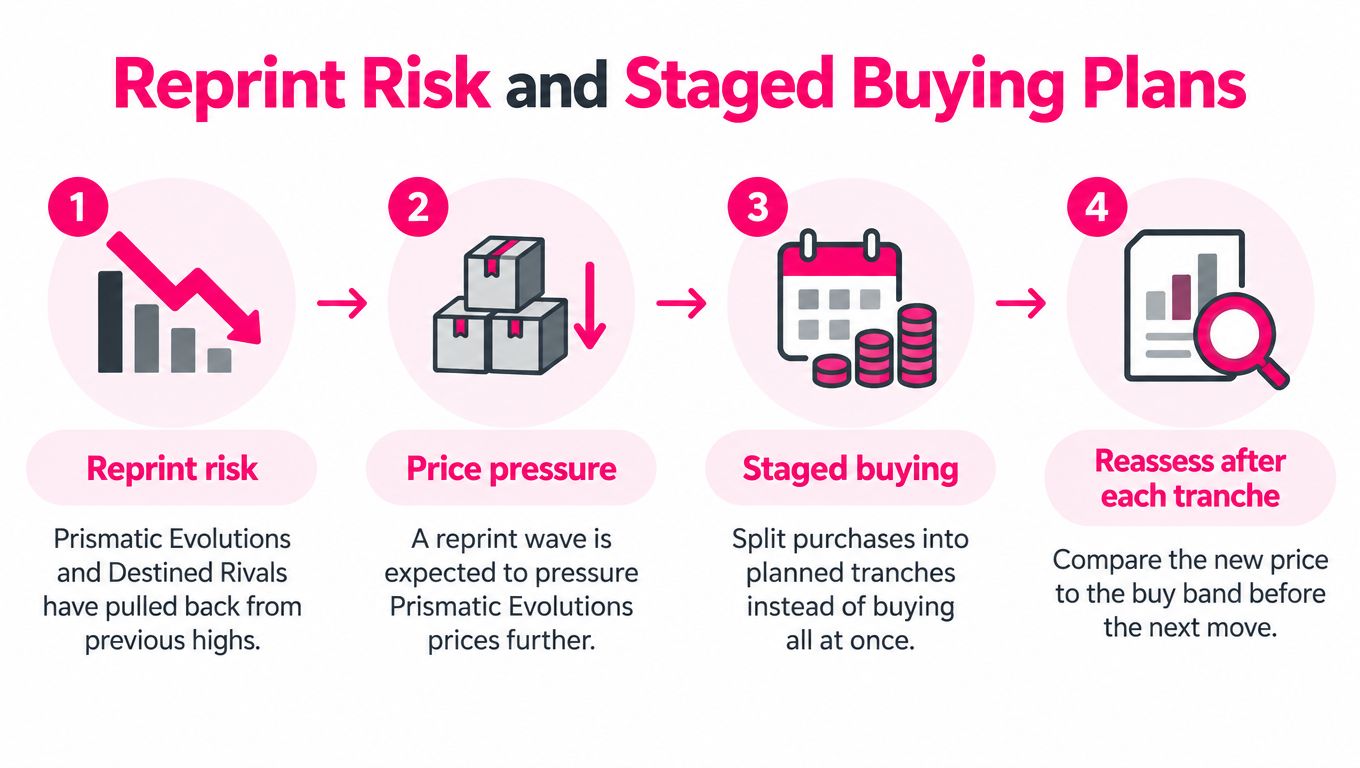
Additional supply can undermine an expensive entry before long-term collector demand has a chance to matter. Dated market commentary from TCG Card Investor describes Prismatic Evolutions and Destined Rivals pulling back from previous highs and discusses an expected Prismatic Evolutions reprint wave as a further source of pressure. Treat that expectation as commentary tied to its publication, not confirmation of today's inventory or an official supply announcement.
An official restock means more product is becoming available through distribution. Genuine long-term scarcity requires a different judgment about remaining supply and persistent demand. Don't mistake a temporary stockout at a familiar retailer for the end of availability.
Define your buy band before placing an order
A buy band is the price range within which your purchase remains acceptable after considering the sealed premium, reprint exposure, and estimated exit proceeds. Its upper boundary is a limit, not a target you raise whenever sellers increase their prices.
Set the lower boundary as a reassessment trigger as well. A price falling below your expected range can indicate a better opportunity, but it can also mean your assumptions about supply or demand need revision.
Historical winner lists don't settle this judgment. A tracker that follows selected surviving products can't establish what every buyer earned, especially after differences in entry timing and costs.
Use a written staged-entry process
Set the total budget and divide it into three tranches. Keep uncommitted cash available so a supply shock doesn't affect your entire planned purchase immediately.
Compare the current premium with reprint exposure. A large premium deserves more scrutiny when additional distribution could give collectors cheaper alternatives.
Buy the first tranche only inside your buy band. Passing on an otherwise desirable box is preferable to discarding the price discipline that made the plan viable.
Review completed sales before the next tranche. Choose an observation period in advance and check both prices and transaction frequency, rather than treating a lower listing as confirmation that demand has stabilized.
Pause the final tranche if a restock is announced. Recalculate the acceptable entry using the new supply information instead of buying automatically.
Write down the total budget, tranche amounts, buy-band boundaries, and release condition for each purchase. Staging limits exposure at entry; it doesn't guarantee that later purchases will be cheaper or that the completed position will be profitable.
Net Return After Fees, Storage and Exit Costs
Costs that reduce net return on a sealed booster box
| Cost | How it reduces return | What to record |
|---|---|---|
| Purchase tax and shipping | Raises the cost basis | Total paid per box |
| Platform fees | Lowers the net sale price | Applicable fee percentage and charges at exit |
| Storage and insurance | Adds costs while held | Monthly allocation multiplied by holding months |
| Currency conversion | Changes cross-border proceeds | Exchange rates and conversion charges at purchase and sale |
| Asking-to-sale spread | Achieved price may fall below the listing | Recent completed prices for matching products |
| Exit time | Keeps capital committed until payment arrives | Expected selling period and cash requirement |
Gross appreciation can conceal a weak cash outcome. A box that appears valuable on a price chart still needs a buyer, acceptable packaging condition, and a sale price that survives deductions.
Ravaver's sealed-portfolio framework characterizes meaningful sealed appreciation as typically requiring five to fifteen years and describes case-level liquidity as moderate. That isn't a promised holding period or a guarantee of appreciation; it's a reason not to fund sealed purchases with money you'll need on a fixed near-term date.
A hypothetical sale that loses money
Consider an illustrative purchase, using assumed tax, shipping, and selling charges rather than market benchmarks:
- Acquisition: A box costs $144, with an assumed 8% purchase tax and $12 inbound shipping, producing a $167.52 cost basis before storage.
- Completed sale: You list it at an assumed $200 but accept 10% less, completing at $180.
- Platform deduction: An assumed 10% selling fee leaves $162 before any outbound shipping or other costs.
- Result: You're $5.52 below acquisition cost, approximately a 3.3% loss before storage, even though the asking price divided by the original box price suggests a 1.39x multiple.
The example isn't a forecast. It demonstrates why the comparison must use completed net proceeds, not a listing divided by an incomplete purchase cost.
Rank the quality of your exit
Compare transaction volume, the number of completed sales, price dispersion, and the condition buyers require. A wide gap between recent achieved prices should make your proceeds estimate more conservative, particularly if only pristine examples reach the top of the range.
Choose an exit route before buying. Our guide to where you can sell a card collection can help frame that decision, but use the actual fees and terms applicable when you sell.
A rarer box isn't automatically better for someone who needs flexibility. A lower projected return with deeper buyer demand can be more useful than a higher theoretical return you can't realize on schedule.
Confirm Your Buy Plan Before Ordering
A box deserves an order only when its price, evidence, and exit plan work together. Don't allow confidence in a popular set to substitute for checking the specific product and transaction.
Complete the pre-order check
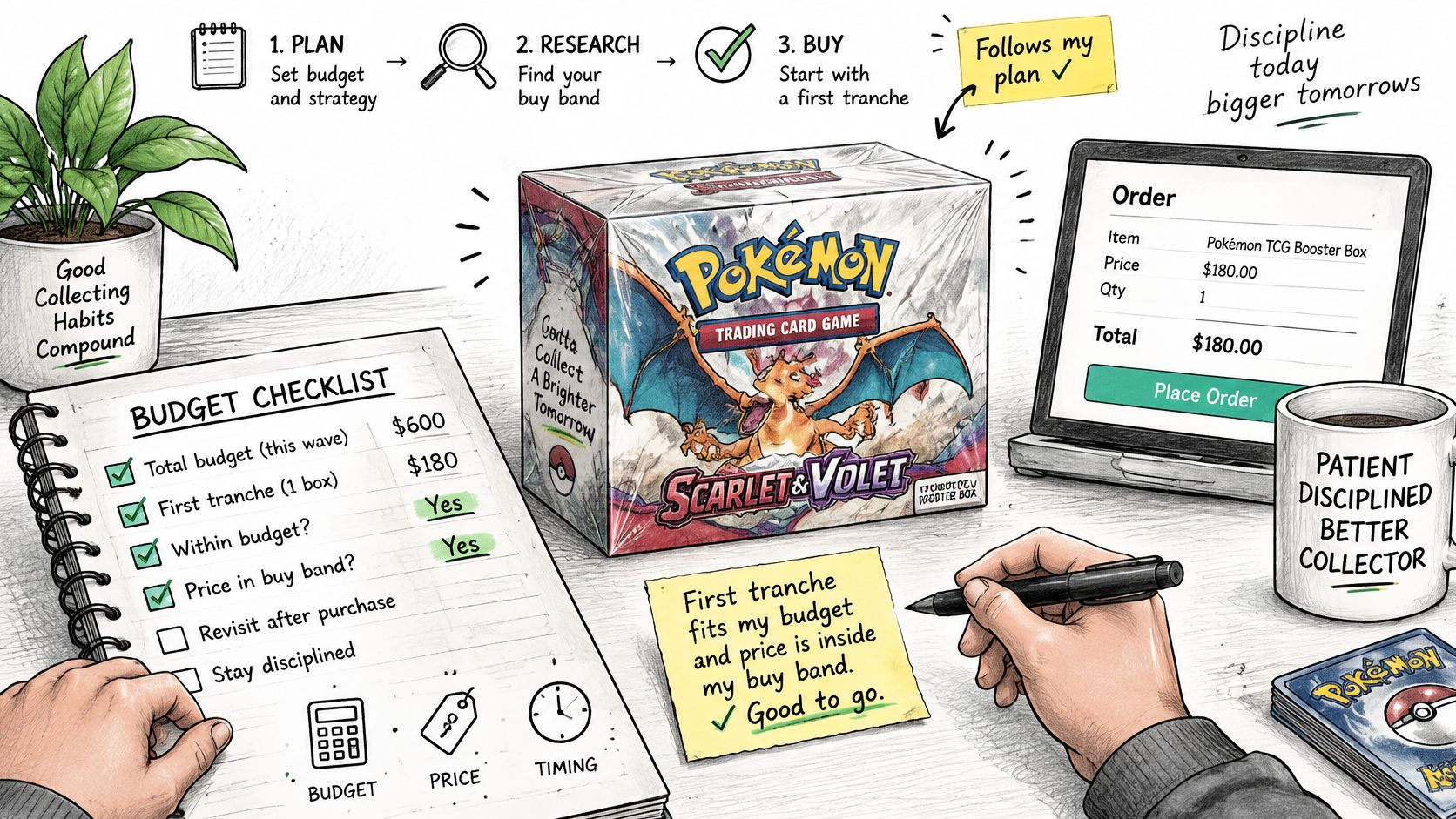
- Budget fit: Confirm that the first tranche leaves your reserved cash untouched and doesn't require an early resale to meet other commitments.
- Price discipline: Check that the delivered price falls inside your written buy band.
- Exit viability: Recalculate proceeds using conservative completed prices, current selling charges, holding costs, and a realistic selling period.
- Evidence quality: Confirm that buyer activity remains credible for the exact language, edition, and format.
- Sealed condition: Inspect photographs for intact shrink wrap, suspicious resealing marks, and corner damage, then document the box on arrival.
Visual checks aren't conclusive authentication. At Lucardio Collectibles, all cards we sell are guaranteed authentic, and we offer secure shipping with insured delivery. Keep the written guarantee and delivery terms with your order records, and confirm the applicable return process before paying.
A clean box and reliable fulfillment protect different parts of the purchase. Neither establishes that the future selling price will justify your investment.
Make a buy, hold, or pass decision
Buy the first tranche if every test passes. Hold a box you already own while its premium, supply exposure, and expected proceeds remain consistent with your plan. Pass if selling costs erase the opportunity at your intended horizon or completed transactions are too thin to support a credible exit.
Write down what would change that decision: a restock announcement, declining completed-sale volume, damage to the packaging, or an entry price above your buy band. Those triggers should prompt reassessment, not an automatic purchase or panic sale.
The best Pokémon booster box to buy for profit is a candidate supported by a workable transaction, not a certainty supported by a compelling story.
Visit Lucardio Collectibles to explore sealed booster boxes, trading cards, and PSA-graded cards while applying your buy-band and net-proceeds checks. Our free subscription gives you access to free giveaways, early access to new drops, and collector updates, so you can monitor opportunities without committing your buying budget.