
Most advice about a box of Pokémon starts with nostalgia: buy sealed, keep it somewhere safe, and wait. That advice ignores the expensive part. A sealed box can be resealed, its contents are probabilistic, and its market price can move independently of the cards inside. Treat the purchase as both a collectible product and a small financial decision, and you'll make fewer emotional mistakes.
The Pokémon Trading Card Game began in Japan on October 20, 1996, with the first set released by Media Factory. The English-language launch followed on January 9, 1999, through Wizards of the Coast, so Japanese print history still matters when collectors compare scarcity and set chronology across markets (history of the Pokémon TCG). By March 2026, the game had produced more than 85 billion cards worldwide, expanding from a 102-card first set into a global collecting market (Pokémon Trading Card Game production history).
The practical question isn't whether a box looks exciting. It's whether the source is trustworthy, the expected value makes sense, the variance fits your budget, and your storage plan protects the seal.
Table of Contents
- The Sealed Box Problem Nobody Talks About
- What a Box of Pokémon Actually Contains
- Pull Rates and the Math Behind Every Box
- How to Verify a Sealed Box Is Real
- Are Sealed Boxes an Asset or Just Cardboard
- Should You Open It or Leave It Sealed
- Storing Sealed Pokémon Boxes the Right Way
- A Repeatable Framework for Every Box You Buy
The Sealed Box Problem Nobody Talks About
A sealed box of Pokémon is a probability position wrapped in cardboard. Buyers often pay a premium for a hyped release, photograph the unopened product, and place it on a shelf. Months later, the shrink wrap may look wrong, the seams may fail to line up, or the corners may feel unusually soft. Opening it can reveal that desirable packs were removed and the box was reassembled.
The loss reaches beyond the chase cards. A resealed product destroys the trust that gives sealed inventory its value.
Fast-moving releases create more opportunities for bad decisions. Retail and distributor stock can disappear quickly, pushing buyers toward secondary marketplaces with weak photos and vague descriptions. Clean outer cardboard does not prove that the contents or seal are original.
The contrarian rule: A sealed box is not automatically safer than singles. It is safer only when the seal, source, and chain of custody are credible.
Start with authentication. Inspect the wrap, seams, folds, barcode, and overall box geometry before paying a sealed premium. PSA's unopened-pack process reinforces the right standard: authenticity depends on the seal's originality and integrity, not on how the contents appear (PSA unopened-pack authentication standards).
Then treat the box as a sampling unit, not a guaranteed bundle of hits. Typical modern-box hit counts vary by set and are covered in detail below. A strong or weak opening does not establish the true distribution, and one box cannot remove that uncertainty.
The financial decision follows. Compare the sealed asking price with the likely value of its contents, then subtract selling friction, taxes, shipping, and the time needed to convert cards into cash. Your break strategy should match that calculation. Open only when the expected experience or card value justifies giving up sealed optionality. Keep it sealed when authenticity is strong, storage is controlled, and the market price pays you for waiting.
Store the product as inventory, not decoration. Protect the seal from heat, moisture, pressure, and careless handling, because a buyer later will judge condition before they care about your purchase story. The box earns its value through credible provenance, controlled storage, and a deliberate choice between opening and holding.
What a Box of Pokémon Actually Contains
“Box of Pokémon” can mean several very different products. A booster box is built around repeated pack opening. An Elite Trainer Box, or ETB, combines packs with accessories and usually a promotional layer. A themed product may package fewer packs with beginner-friendly materials, promotional cards, or a presentation designed for gifting rather than statistical sampling.
The format determines what you're buying. Booster boxes generally make the most sense for breakers who want many packs from one expansion. ETBs suit collectors who value presentation, accessories, and exclusive components alongside the packs. Theme-oriented products are better for newer players or gift buyers who care about the experience more than maximizing pack volume.
Retail prices vary by release, retailer, and region, so don't treat a generic MSRP as a guaranteed current market value. Use the product page, compare sealed listings, and separate the value of the packs from the value of the promo and accessories.
| Box Type | Pack Count | Typical MSRP (USD) | Pack Type | Best For |
|---|---|---|---|---|
| Booster Box | Often 36 packs for modern standard releases | Varies by set | Expansion booster packs | Breakers and collectors seeking pack volume |
| Theme Box | Varies by product | Varies by product | Expansion or themed packs | Gifts, beginners, and casual play |
| Elite Trainer Box | Often 8 to 10 packs, depending on release | Varies by release | Expansion booster packs | Collectors who want accessories and presentation |
A 36-pack booster box gives you more observations than a smaller collection box, but it doesn't turn chase-card odds into a promise. Theme products can have a stronger non-pack identity, while ETBs may carry sleeves, dice, condition markers, storage, and a featured promo. Those extras matter to some buyers and add little value to others.
Match the format to the objective
If you want cards for a deck, start with singles or a product designed around playable contents. A sealed box offers entertainment and discovery, but it rarely gives you precise control over the cards you need.
If you want a display piece, inspect the box design, promo, and seal quality before comparing pack count. If you want sealed inventory, prioritize the product's liquidity and source history over the number of packs printed on the front.
The most common mistake is buying an ETB while thinking like a booster-box breaker. You pay for accessories and presentation, then judge the purchase only by the cards pulled. Decide what the product is supposed to do before you compare prices.
Pull Rates and the Math Behind Every Box
A sealed box is a probability decision, not a promise of a chase card. A 36-pack booster box gives you 36 attempts, yet the result can sit far from the long-run average. As noted earlier, a modern box usually produces a single-digit number of major hits, with the exact mix changing by set. Treat those figures as a broad reference, not a contract.
Suppose a chase card has a hypothetical 1-in-10 pack rate. Across 36 packs, the average expectation would be 3.6 copies across a very large group of comparable samples. Your box could still contain none, one, several, or an unusually strong result. The average describes repeated openings, not the contents sitting on your desk.
A box gives you an outcome. A tracked sample gives you information.
That distinction explains why two boxes from the same case can feel completely unequal. One may contain several desirable hits, while another delivers lower-rarity cards and no major chase. The products can be identical at manufacture, yet each buyer receives a different combination because the packs are independent samples from a variable distribution.
Expected value isn't the same as certainty
Expected value combines possible outcomes with their probabilities. It does not predict the exact contents of one box. If you need a specific card, buying that single directly is usually more rational than paying for repeated chances. Opening makes sense when you are also paying for entertainment, discovery, and the possibility of a strong result.
For a product-specific comparison, review the pack experience and contents of a Silver Tempest Elite Trainer Box before opening. Apply the same accounting to any sealed product. Separate the expected value of desirable cards from bulk, promos, accessories, and the sealed box itself. Storage and condition also belong in the calculation if you might keep the product sealed.
Seasoned breakers budget for variance. They do not use one opening to call a set “loaded” or “dead,” and they do not confuse luck with an investment thesis. Set a maximum opening budget, define the cards that would justify the risk, and accept the disappointing outcome before you break the seal. If that outcome would bother you more than the opening would entertain you, keep the box sealed or buy singles instead.
How to Verify a Sealed Box Is Real
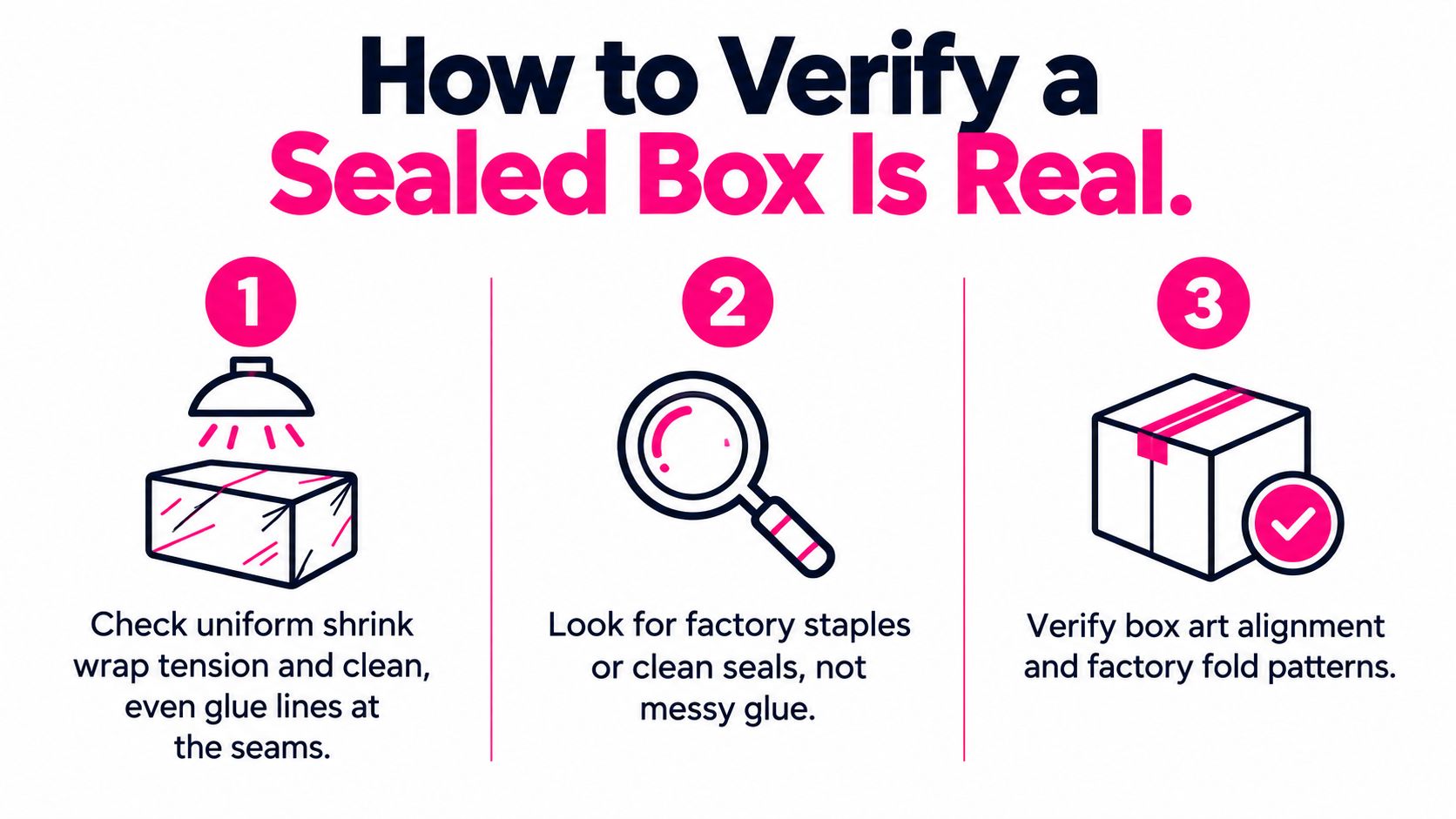
A sealed premium is a bet on authenticity before it is a bet on pulls or future value. Do not pay it until the physical product earns your trust. Factory wrapping should show even tension, consistent seams, and clean folds. Irregular looseness, messy adhesive, rough cuts, or a seam that appears applied afterward are reasons to stop.
Inspect the wrap and structure
Use strong, even light. Examine both primary side seams, the end folds, the shrink tension, and how the wrap sits against the printed artwork. Factory packaging usually has repeatable heat application and clean geometry. A knife-like cut, excess glue, or plastic that peels in an unusual direction deserves a pause and closer comparison.
Cellophane texture can support your judgment, but one tactile test cannot authenticate a box. Compare it with a known genuine product from the same product line, since packaging may differ across releases and regions. Inspect the corners as well. Internal packs help retain the box shape, so crushed or unusually soft corners may point to mishandling or tampering.
Cross-check the identity
Match the UPC, product name, box art, and expansion branding. A barcode mismatch or an SKU that does not match the pictured release is a strong reason to walk away. Request photographs of the exact box, never stock images, including every seam and corner.
Weighing can provide one supporting signal. A stripped and resealed booster box may be materially lighter after packs are removed, but product and packaging variation makes weight unreliable on its own. Treat it as a clue, not a verdict.
Use this documented Pokémon booster box buying guide alongside the physical inspection. If a seller refuses clear photos, acquisition context, or a workable return policy, the discount does not cover the authentication risk.
This video provides a visual supplement to the inspection process:
A slab reduces some risks, but judgment still matters. PSA reported a more than 45% increase in cards flagged overall in 2025 and a 125% increase in fake Pokémon cards compared with 2024, while TCGs represented more than 56% of detected counterfeits in that reporting (PSA counterfeit card reporting). Verify certification through the grading company, compare the slab and label with known examples, and question any price far below the market. Authentication protects the financial decision, while careful storage and a defined opening strategy protect what happens after you buy.
Are Sealed Boxes an Asset or Just Cardboard
A sealed Pokémon box is a speculative collectible, not a conventional investment. Its value depends on buyer demand, condition, authenticity, and your ability to sell at a realistic net price. It produces no cash flow, has no guaranteed floor, and can lose attention when reprints or newer releases change collector priorities.
Market breadth makes the risk clear. One tracker listed 2,042 Pokémon products and 901 live market prices on September 17, 2026, while another tracked 2,133 sealed products on the same day (sealed Pokémon market tracking). A catalog this broad does not make every listing liquid. The displayed price may exclude fees, shipping, taxes, and negotiation.
Treat quoted prices as snapshots. A booster box shown at C$417.38 with a +10.35% move demonstrates how quickly sealed pricing can shift. That number is a reference point, not a guaranteed sale price.
Three forces shape the premium
Nostalgia supports demand for memorable eras, characters, and artwork. Anniversary attention can revive older themes, but buyers may move on after the excitement fades.
Scarcity matters when available sealed inventory tightens. Rotation and competitive relevance can influence demand, yet a playable set and a collectible set often follow different paths.
Condition ceilings restrict the supply of desirable examples. Clean corners and an intact factory seal inspire more confidence than dents, cloudy wrap, or repaired edges. Authenticity is part of the asset calculation, not a separate detail.
Liquidity determines whether a paper gain becomes usable money. A popular booster box may attract buyers quickly, while an awkward ETB or niche collection product can remain listed for a long time. Storage also affects the outcome. Poor handling creates damage that narrows your buyer pool and lowers the price you can defend.
Before buying, record three answers: what you would pay today, what you could sell for after costs, and how long you can hold without needing the cash. Then choose a break strategy that matches the same objective. Open only when the expected enjoyment or card access justifies giving up sealed optionality. If the numbers and timeline remain unclear, classify the purchase as speculation rather than a store of value.
Should You Open It or Leave It Sealed
Open the box when your goal is the opening experience, deck construction, trading, or time with friends. Leave it sealed when your goal is to preserve the product as a collectible and you can tolerate uncertain resale timing. The correct answer has less to do with the set's hype than with what you want from the purchase.
Singles usually offer better control for a player chasing specific cards. Opening packs adds entertainment, surprise, and the possibility of finding something valuable, but it also exposes you to the full range of outcomes described earlier. That entertainment has a cost, and you should accept it before you break the seal.
| Goal | Recommended Action | Expected Outcome |
|---|---|---|
| Deck-building | Buy singles or open with a specific deck plan | Faster access to needed cards, with less random inventory |
| Long-term sealed speculation | Keep the box sealed and store it correctly | Exposure to future sealed demand, with market and liquidity risk |
| Fun with friends | Open it and divide the packs or cards | Shared entertainment, with no expectation of financial efficiency |
| Testing a set | Open a limited amount and track results | A personal experience, not proof of official pull rates |
Two ways to break
A group break spreads the pack variance among participants. It can make an expensive opening more accessible, but participants pay for the organizer's work and accept that someone else controls the opening and fulfillment process. Verify the host, rules, shipping terms, and allocation method first.
A personal break keeps every card and every piece of upside with you. It also leaves you holding the bulk, the weaker pulls, and the full downside when the box misses.
My recommendation is simple. If you want cards, buy cards. If you want the ritual, open a box and call the difference an entertainment expense. If you want sealed exposure, don't open a product merely because you're bored. Boredom is a poor investment thesis.
Storing Sealed Pokémon Boxes the Right Way
Storage protects the seal first and the cardboard second. Keep sealed boxes at 35 to 50% relative humidity and a stable temperature around 65 to 70°F, away from attics, basements, radiators, and exterior walls. Humidity swings can warp cardboard and stress adhesive seams, while heat accelerates packaging deterioration.
Keep direct UV light away from the product. Sunlight can fade artwork and weaken the appearance of shrink wrap, which matters because collectors and authenticators inspect the unopened seal before they care about the contents. A dark closet with stable climate control beats a bright display shelf.
Prevent physical damage
Store boxes upright where possible, with support that doesn't press into the shrink wrap. If you stack them, keep the stack no more than three boxes high so the lower product doesn't develop crushed edges or visible compression marks. Don't place heavy objects on top, and don't slide boxes across rough shelving.
Use acid-free silica packets to help manage moisture, but replace them when they become saturated. Avoid sealing cardboard inside an airtight plastic tote for long periods without considering off-gassing and trapped moisture. A tote can protect against dust while still creating a poor microclimate if the room fluctuates.
For a product-specific reference, the Pokémon 151 Ultra Premium Collection Box guide covers condition, buying, authenticity, and storage considerations.
Tape this short rule set inside the closet:
- Measure: Keep a hygrometer and thermometer near the inventory.
- Shade: Block direct UV exposure.
- Support: Keep boxes upright and avoid crushing pressure.
- Inspect: Check seams, wrap, corners, and moisture periodically.
- Document: Photograph condition before storage and after any move.
The original factory shrink wrap is the priority. A beautiful box with damaged or questionable sealing won't inspire the same resale confidence as a less glamorous product with an unquestionably intact seal.
A Repeatable Framework for Every Box You Buy
Use the same four decisions every time. Consistency matters more than enthusiasm because new releases are designed to make impulse buying feel urgent.
Verify the source
Buy from sellers who can show the exact product, explain where it came from, and provide a sensible return policy. Anonymous marketplace listings with stock photography deserve extra scrutiny. A third-party-graded or authenticated item can reduce uncertainty, but verify the certification independently and inspect the physical slab or packaging.
Record the seller, listing, purchase date, condition photos, and price. That file helps if the product arrives damaged, if you later sell it, or if your memory turns a questionable purchase into a “good deal.”
Model the value
Write down two separate values:
- Sealed value, based on comparable current listings and the product's condition.
- Contents value, based on realistic outcomes rather than the highest chase card.
Then subtract selling fees, shipping, taxes, payment costs, and the value of your time. Don't count every bulk card at an optimistic price. Don't treat an unsold listing as market value.
Practical rule: If the purchase only works when you pull the best card or sell at the highest listing, it doesn't work.
Declare the purpose
Choose one label before checkout:
- Investor: Hold sealed and accept market volatility.
- Player: Open for cards, play, and trading.
- Hybrid: Open selectively, sell or trade excess cards, and retain products you want to collect.
The hybrid approach is fine, but it still needs a boundary. Decide how much you'll open and what will happen to the remaining cards before the excitement starts.
Store and reassess
Put the box into the climate-controlled, low-light storage system immediately. Photograph the seal, corners, and barcode, then review comparable tracker data periodically rather than reacting to every price movement.
Sealed Pokémon inventory is both a product and a small financial bet. The framework doesn't remove risk, but it prevents nostalgia, fear of missing out, and one lucky pull from making the decision for you.
Before your next purchase, compare the exact product, inspect the seal, calculate the downside, and decide whether you're buying an experience or inventory. Lucardio Collectibles offers authenticated Pokémon singles, sealed products, PSA-graded items, live breaks, auctions, and collection tools, so visit Lucardio Collectibles to review options that fit your stated goal.