
You're holding a PSA-graded card that looks right at first glance. The grade is attractive, the seller's photos are clean, and the price feels just low enough to create urgency. Then you rotate the slab under a lamp. The label seems slightly off, the holder feels different from the examples you've handled, or the card's centering doesn't quite match what you expected from the certification record.
That moment of doubt is useful. It's much safer than letting excitement make the decision for you.
Learning how to spot a fake PSA slab isn't about memorizing one logo, font, hologram, or seam pattern. Counterfeiters can copy visible features, and they can reuse legitimate certification numbers on fraudulent holders. A reliable check combines the PSA database entry, cert photos, label era, holder construction, tilt response, UV behavior, and the card's physical details. Each layer answers a different question, and no single layer should carry the whole decision.
The process below is designed for real buying situations, whether you're inspecting a Pokémon slab at a show, reviewing a sports card listing, or checking an item that has already arrived. Detection is a sequence, not a single glance.
Table of Contents
- The Moment You Start to Doubt the Slab
- Running the PSA Cert Lookup the Right Way
- Reading the Holder and Label Like Evidence
- The Tilt and UV Sequence That Catches Copies
- Why a Clean Lookup Is Not a Final Answer
- What to Do Before You Buy or After You Suspect a Fake
- Your Five-Minute Slab Authentication Routine
The Moment You Start to Doubt the Slab
The buyer had already decided the card was probably coming home. It was a high-grade example, the listing looked polished, and the price was clean enough to feel like an opportunity without appearing absurd. In hand, though, the label font seemed thinner than the PSA labels on nearby slabs. The difference was subtle, the kind of detail that's easy to dismiss when you want the purchase to work.
That's where many bad buys happen. The buyer tells themselves the lighting is different, the phone camera is distorting the label, or PSA must have changed its printing. Those explanations might be true, but they're not evidence. A suspicious detail shouldn't trigger panic, and it shouldn't be ignored. It should trigger a repeatable inspection.
Practical rule: Excitement is a reason to slow down, not a reason to skip verification.
The first question is whether the certification number exists in PSA's official database. PSA's public verification system is used to confirm that the serial number corresponds with the exact card and grade recorded for that certification, and PSA describes its verification ecosystem as connected to labeling and tamper-evident case features. That makes lookup a foundational anti-counterfeit check, but it doesn't make the lookup a complete verdict. Real certification numbers can be copied and placed on a different card or fake holder, as independent slab-detection guidance explains in its PSA slab inspection guide.
Physical inspection then gives the database evidence context. Look at the holder's weld, label layering, raised markings, and internal fit. Tilt the security elements under controlled light, use UV where appropriate for the slab generation, and compare the card itself with any images attached to the certification record.
The scale of the problem also explains why a casual visual impression isn't enough. A 2026 industry report attributed more than $200 million in counterfeit and altered collectibles intercepted before they reached PSA slabs to PSA's authentication ecosystem, as reported by Sports Illustrated's collectibles coverage. The figure includes a broader fraud problem, not just fake holders, but that distinction is exactly the point. Altered cards, reused cert numbers, mislabeled slabs, and counterfeit cases overlap.
Running the PSA Cert Lookup the Right Way
A PSA lookup should begin with the number printed on the slab in front of you. Don't copy it from the seller's title, listing description, screenshot, or QR destination. Type the certification number into PSA's official certification lookup yourself so you're checking the physical item rather than the seller's presentation of it.

Start with the identity fields
The returned record should agree with the label across the important identity fields:
- Card identity: Confirm the player or character, set, year, card number, and variation.
- Grade: Check that the numerical grade matches exactly.
- Qualifier: Read any qualifier rather than assuming the number tells the whole story. A grade with a centering or other qualifier describes a different record from an unqualified grade.
- Label relationship: Look at whether the holder and label style make sense for the record's apparent era.
- Record status: Note any visible status information, including whether the record appears paid, removed, or reholdered.
A result that is close isn't good enough. A card with the correct character but the wrong set, language, parallel, or grade can still represent a different certification entirely. Treat every mismatch as a stop signal until PSA or a qualified specialist resolves it.
Use the image as a card fingerprint
If the certification record includes front or back images, compare them with the actual card through the slab. Don't compare only the general artwork. Look for centering, corner shape, edge whitening, print marks, surface scratches, holo placement, and unusual defects. These details can distinguish the exact graded card from another copy of the same issue.
Hold the slab at a similar angle to the database photograph where possible. A glare line can hide a surface mark, while a different angle can make centering appear misleading. If the photograph shows a distinctive flaw that the card in hand lacks, or the card in hand has a mark absent from the record, document the discrepancy before proceeding.
Treat the result as a dataset
A successful lookup confirms that PSA has a matching record. It doesn't independently prove that the physical holder, label, and card are the same objects represented by that record. The database is your starting evidence. The slab in front of you must still pass the physical comparison.
Reading the Holder and Label Like Evidence
Not every visible detail deserves equal weight. Beginners often focus on the PSA logo because it's easy to recognize, but logos and familiar branding are among the features counterfeiters can reproduce convincingly. The most useful inspection asks whether the whole holder has been constructed, sealed, and printed consistently.
Rank the physical checks
| Feature | What genuine looks like | Diagnostic reliability |
|---|---|---|
| Perimeter seam | An even, rigid ultrasonic weld around the holder, with no glue, gaps, frosting, or flexible sections | High |
| Label layering and translucency | Consistent construction, clean spacing, and no suspicious opacity suggesting a hidden or doubled label | High |
| Card fit | The card sits securely in the inner well without obvious rocking or an improvised fit | Medium to high |
| Label alignment | Fields, barcodes, and spacing remain consistently positioned across the label | Medium to high |
| Printing | Crisp type, sharp edges, and uniform barcode lines appropriate to the label era | Medium |
| PSA logo and familiar marks | Correct-looking branding and registration details | Lower on their own |
The seam deserves the first close inspection. Authentic PSA holders use an ultrasonic weld that should feel and appear even around the perimeter. A seam with visible separation, rough flashing, glue residue, frosting, or a section that flexes differently from the rest deserves serious caution. Don't assume one clean edge cancels out another suspicious edge. Resealing attempts often leave inconsistencies rather than a single obvious failure.
The label comes next. Inspect the type, spacing, barcode, color, and layering under direct light. A counterfeit may copy the overall layout while missing the small relationships between fields. Look at whether the cert number sits correctly in its line, whether the barcode lines remain uniform, and whether the back label is aligned with the rest of the design.
The inner well provides useful supporting evidence. The card should sit naturally inside a clear, rigid holder, with the back visible through the appropriate window. An awkward fit, excessive movement, trapped residue, or construction that looks improvised can support concerns raised by the seam or label.
A convincing logo can create confidence. A consistent weld, label construction, and card fit create evidence.
Older and newer PSA holders shouldn't be judged by an identical checklist. PSA's security features and label designs have changed, so compare a questionable slab with known genuine examples from the same general generation. For presentation ideas after authentication, see this guide to PSA graded card display, but don't mistake display advice for an authentication test.
The Tilt and UV Sequence That Catches Copies
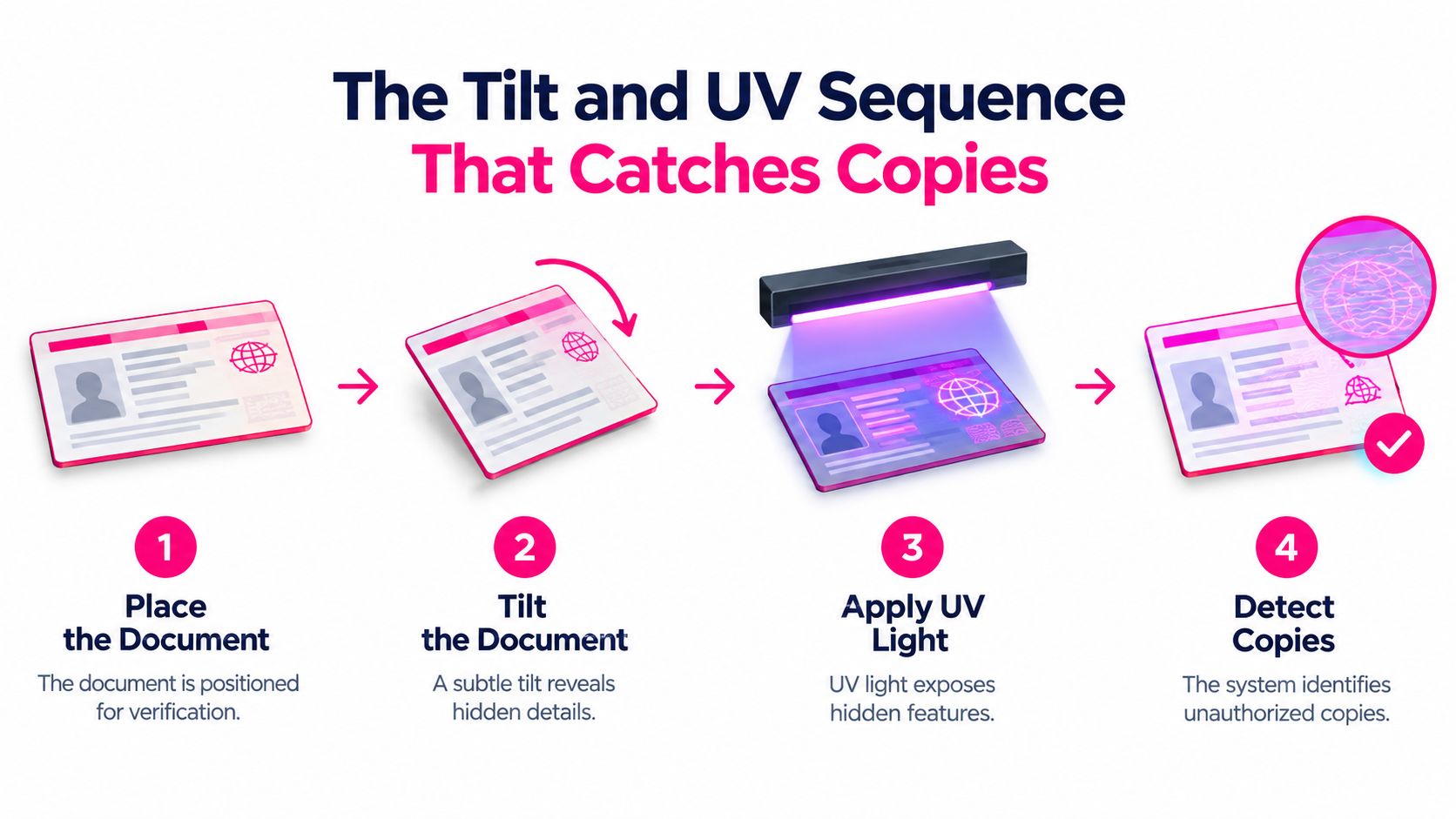
Lighting tests work best as a sequence, not as a dramatic pass or fail moment. A genuine security feature can look different depending on the slab generation, viewing angle, room light, and camera exposure. Use the same routine each time so you notice behavior rather than chasing a single color.
Start with a single bright LED and tilt the slab gradually, around a shallow angle rather than waving it randomly. Watch the PSA security area for a controlled illumination or color response. Authentic PSA Lighthouse-era labels are described as showing a distinct effect under tilt and UV, while copies may look overly bright, static, or wrong in color response. Don't reject an older slab because it doesn't behave like a modern one. First establish which label era you're examining.
Use UV as supporting evidence
Move to a 365nm UV flashlight in a dim environment. Hold it close enough to illuminate the label without creating unnecessary glare, then compare the reaction across the printed area, security element, and surrounding plastic. A genuine Lighthouse-era label can show a distinct, restrained illumination effect, including a faint blue ghost of the certification number across the front. A fake may glow uniformly, fluoresce too strongly, show the wrong color behavior, or remain unnaturally flat.
UV isn't a universal authenticity certificate. Plastic, paper, inks, printing layers, and label generations vary. A slab that fails your expectation under UV should move into a “do not buy until resolved” category, not automatically into a definitive counterfeit category.
Finish at the weld
Use raking light at a low angle along the holder's perimeter. Look for an even weld pattern, consistent rigidity, and corners without gaps or lifted sections. Hidden relabeling or a resealed holder can leave signs at the seam even when the front label looks polished.
Avoid testing only one feature. Skilled copies may reproduce the PSA logo or approximate the font while missing micro-features such as raised embossing, label opacity, or seam consistency. If you collect foil cards, the same habit applies to surface inspection, and this foil trading card guide offers relevant context for reading reflective surfaces without confusing glare for damage.
Why a Clean Lookup Is Not a Final Answer
A certification result can load correctly and still leave the slab unresolved. The most dangerous fraud often borrows something genuine, because the borrowed detail creates reassurance. A real cert number on a fake holder is more persuasive than a completely invented number that fails immediately.
The three lookup failure modes
Cert reuse is the clearest example. A counterfeiter copies a legitimate certification number and applies it to a different card or holder. The PSA database returns a real record, but the object in your hand isn't the object represented by that record.
Card swapping takes the problem further. The slab may use a genuine holder or a copied label, while the card inside has been replaced with a different copy, altered card, or counterfeit. The lookup can't see through the plastic. Only image-level comparison and physical inspection can expose the mismatch.
A fake holder with a guessed or harvested number creates a different pattern. The database result might not match, or it might match enough to mislead a hurried buyer. In either case, the holder's seam, label construction, translucency, and security behavior still matter.
PSA's own communication about certificate verification emphasizes checking that the number corresponds to the exact card and grade, while independent guidance warns that counterfeiters can reuse legitimate numbers. That is why the lookup should be treated as necessary but not sufficient.
Match each field to its job
| Lookup element | Catches cert reuse | Catches card swap | Catches fake holder |
|---|---|---|---|
| Certification number exists | Sometimes, if the copied number doesn't belong to the claimed card | No | Sometimes |
| Card name, set, and grade | Yes, when the label claim differs from the record | No | Sometimes |
| PSA record images | Often, when distinctive card details are visible | Yes, when the images are clear and current | No |
| QR or cert destination | Helps confirm the linked record | No | Limited |
| Physical seam and label inspection | No | Sometimes | Yes |
| UV and tilt behavior | No | No | Supports the physical assessment |
The important distinction is simple: database fields verify the record, while the slab inspection verifies the object. A record can be genuine even when the holder is not. A holder can look convincing even when the card inside isn't the one PSA recorded.
If images are low resolution, absent, or too old to support a confident comparison, record that limitation. Don't fill the gap with optimism. Ask for better evidence, obtain a specialist opinion, or walk away.
What to Do Before You Buy or After You Suspect a Fake
A buyer accepts a high-grade card because the cert lookup resolves. Later, while comparing the record image with the card under the plastic, the centering looks different and a distinctive print mark is missing. The number is real, but the evidence no longer describes the same card.
That situation calls for documentation, not argument. Before purchase, ask the seller for the certification number, clear front and back images, edge photos, and a short video showing the security area under changing light. Compare the seller's item with the PSA record yourself, and avoid relying on a screenshot supplied by the seller.
Before money changes hands
Use a simple evidence request:
- Cert number: Ask for the number printed on the physical label, not just a database link.
- Record match: Confirm the card identity, grade, qualifier, and available images.
- Holder photos: Request close views of all edges, corners, label surfaces, and the back.
- Lighting video: Ask for a tilt demonstration under direct light, especially when the label's behavior is difficult to judge in still images.
- Transaction protection: Prefer a marketplace or dealer process with its own authentication or buyer-protection pathway.
A seller who refuses basic verification may have an innocent reason, but you don't need to accept that risk. A rushed deal removes your opportunity to compare evidence, and urgency is a poor substitute for provenance.
For buyers browsing inventory, the same discipline applies to PSA graded cards for sale. The listing should make verification easier, not force you to infer authenticity from a polished photograph.
If the slab is already in hand
Stop the chain of transactions first. Don't resell a suspicious slab, crack it, alter it, or send it to another buyer while you're still uncertain.
Then create a record:
- Photograph the entire slab from front, back, edges, label, and corners.
- Capture the certification result and save the corresponding record details.
- Document mismatches between the database images and the card in hand.
- Contact PSA through its verification or support channels with the certification information and evidence.
- Open a dispute with the selling platform or payment provider within the applicable process.
- Ask a reputable third-party grader or experienced dealer for an independent opinion.
Keep the original listing, seller messages, payment details, and shipping materials. A timestamped evidence trail is more useful than a message saying the slab “looks fake.” Describe exactly what fails, such as a seam gap, mismatched centering, incorrect label construction, or a record image that shows a different card.
Your Five-Minute Slab Authentication Routine
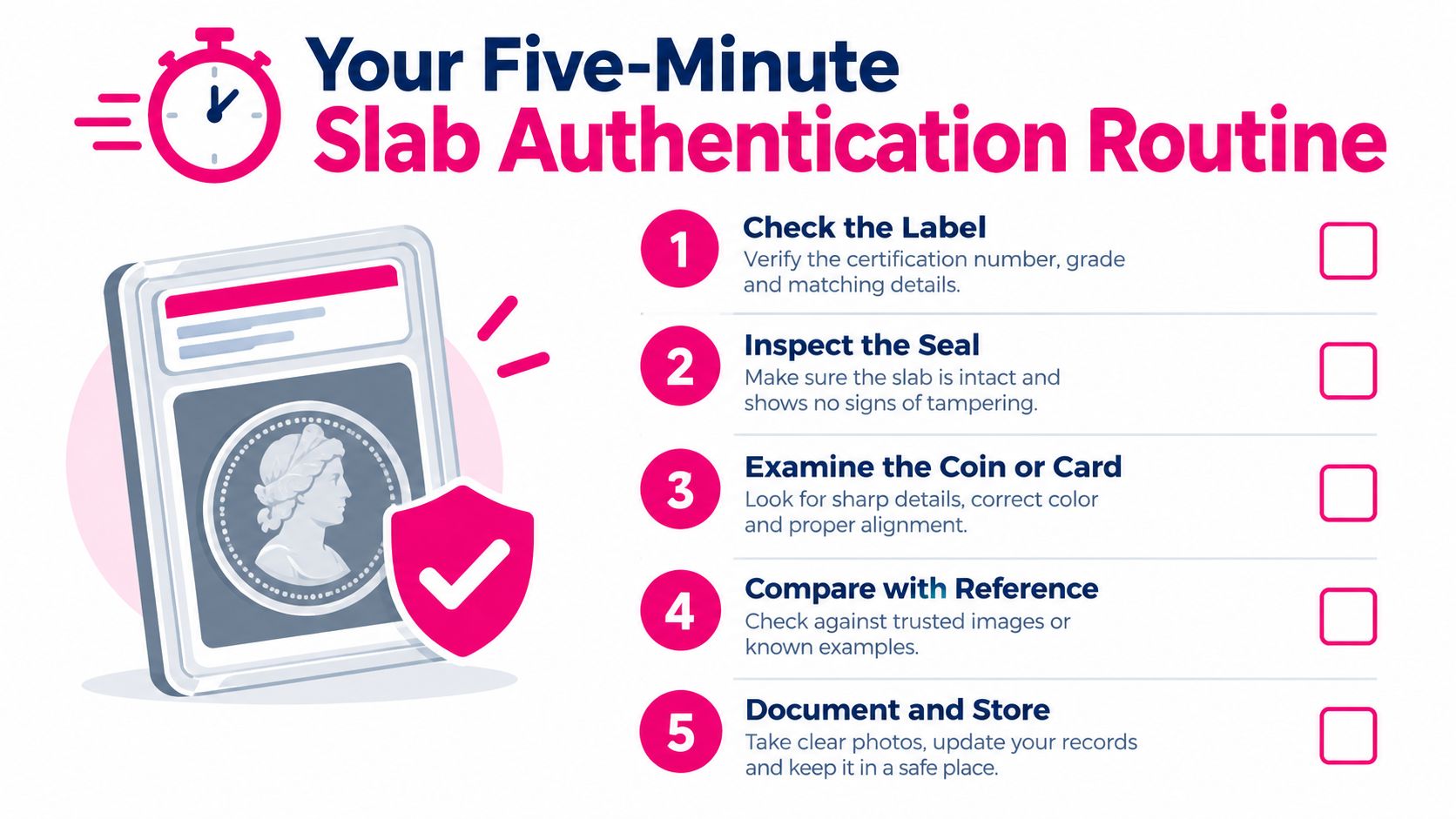
A practical routine should be fast enough to use at a show but careful enough to stop a rushed purchase. The order matters. Begin with the information that costs nothing, then move to physical and image evidence.
- Scan the label. Read the certification number, card description, grade, qualifier, and label format. Look for obvious spacing, alignment, or printing concerns.
- Run the official lookup. Enter the number from the slab and confirm that the record matches the label. A failed lookup stops the purchase immediately.
- Inspect the holder under direct light. Tilt the security area, then trace the perimeter seam. Watch for inconsistent illumination, gaps, residue, frosting, or flexibility.
- Compare the exact card. Open the certification record's available images and compare centering, corners, edge wear, print marks, surface details, and back characteristics.
- Apply UV support. Use a 365nm light to examine the label's response, taking the slab generation into account. Look for an unnaturally uniform glow, missing expected behavior, or stray fluorescent ink.
- Judge the combined evidence. One convincing logo or a clean database result shouldn't outweigh a mismatched image and suspicious weld. If the evidence conflicts, don't commit funds.
Third-party authentication, escrow, and marketplace inspection can add a structural backstop that an individual buyer can't fully replace. They don't eliminate the need to inspect the certification record, but they can reduce the consequences of a missed detail, particularly for expensive cards or unfamiliar slab generations.
Lucardio Collectibles brings authenticated singles, sealed products, and PSA-graded items into one platform, with detailed condition visibility, insured fulfillment, live auctions, breaks, and collection management through its Card Vault. Visit Lucardio Collectibles to review its verified-collectibles marketplace and follow upcoming buying opportunities with a clearer authentication process.