
You've just pulled a clean Charizard from a pack, slid it into a penny sleeve, and reached for a top loader before sending it in a trade. You tape the opening, place it in a mailer, and assume the card is protected. That small choice can decide whether the buyer receives a sharp-cornered card or one with a soft edge, a corner ding, or a surface mark.
A rigid card holder is excellent at resisting bends and handling damage, but it isn't automatically the right choice for every card or every stage of collecting. Standard singles, shipping, and home display usually benefit from rigidity. Grading submissions, thick relics, patch cards, and long-term archival storage require more judgment.
Table of Contents
- Why Rigid Card Holders Matter More Than Most Collectors Realize
- What a Rigid Card Holder Actually Is
- Three Jobs a Rigid Holder Does Best
- Materials That Decide Whether Your Card Stays Pristine
- Matching Holder Thickness to Card Type
- Rigid Holders Versus Semi-Rigid Savers for Grading
- When a Rigid Holder Is the Wrong Choice
- Building Your Long-Term Storage and Care Workflow
Why Rigid Card Holders Matter More Than Most Collectors Realize
A card needs a rigid holder when it leaves controlled storage. During a trade or shipment, it can pass between hands, shift inside a mailer, or sit under other items. A soft sleeve blocks fingerprints and light abrasion, but it cannot stop pressure from flexing the card.
Rigid top-loaders became a mainstream format as collectible card games expanded in the 1990s. Sleeves protect surfaces. Rigid holders resist bending and handling damage. Use both when the card's condition matters. Cardboard Gold's history of card holders identifies 1987 as the introduction point for Card Savers at the National Sports Collectors Convention.
The cost of choosing badly
Three situations show why format matters:
- The inexpensive single: A base card may be replaceable, yet a corner bump can make it unsellable or weaken buyer confidence.
- The valuable raw card: An oversized holder allows a sleeved card to shift during transport, repeatedly exposing its corners and edges to impact.
- The grading candidate: A rigid case does not solve every preservation problem. An unsuitable plastic or poor storage environment can still create concerns before submission.
Choose the holder for the card's next job. Standard singles usually suit rigid holders for storage, display, and shipping. Grading workflows often favor semi-rigid card savers because their slight flexibility makes removal easier and reduces the need to pry a card from a fixed channel. Thick relic and patch cards need a correctly sized thicker holder, not a standard toploader forced around an oversized card.
A rigid holder is a tool, not a universal default.
Collector's rule: If the card can move inside the holder, the holder is too large. If you have to force the card inside, it's too small.
The format remains basic equipment for collectors, sellers, and graders. Card Savers reportedly sold more than 500 million holders since launch, as noted in Cardboard Gold's holder history. That scale reflects a practical point: cards need physical protection, but the right format depends on what happens next.
What a Rigid Card Holder Actually Is
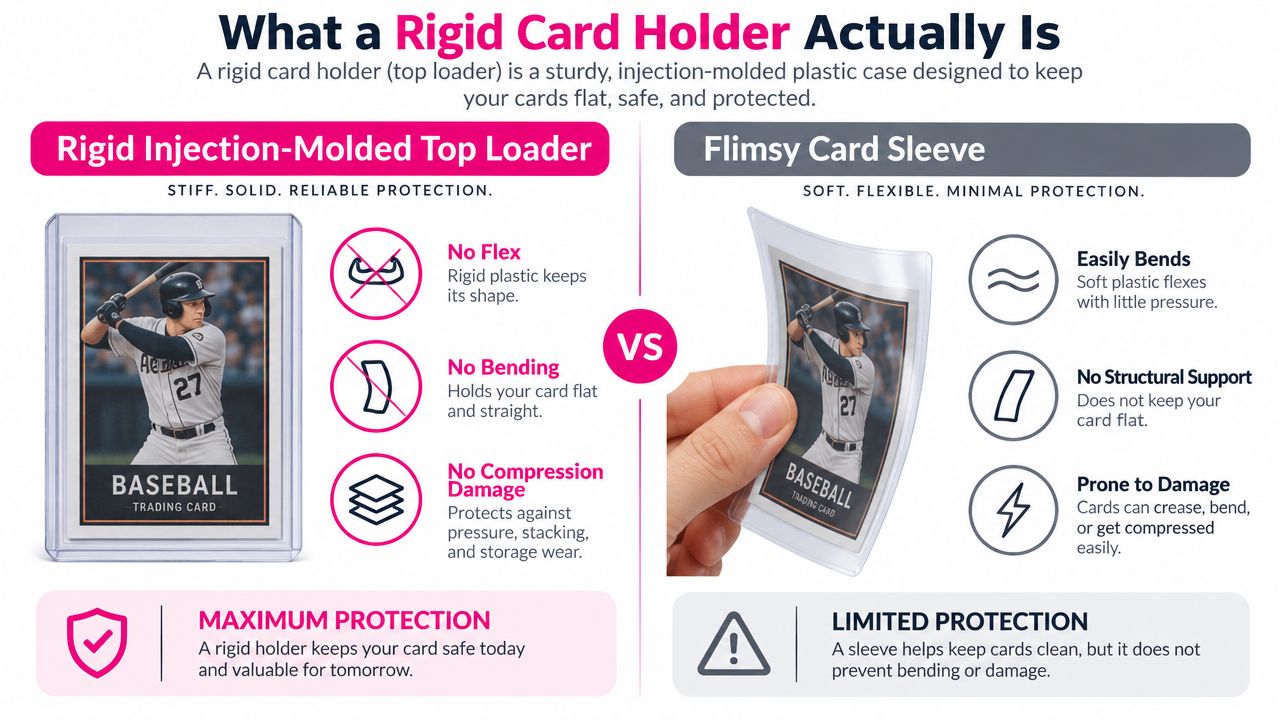
A rigid card holder is a stiff plastic enclosure loaded from the top. Its walls resist flexing, which helps keep a standard trading card flat and shields its corners from ordinary handling, pressure, and transport impacts.
The common 35pt toploader is built around the standard trading-card format. A typical internal pocket measures about 2 3/4 inches by 3 7/8 inches, while the exterior profile is about 3 inches by 4 inches, according to BCW's rigid toploader specifications. That geometry accommodates standard 2.5 inch by 3.5 inch cards, usually with a penny sleeve between the card and holder.
Three formats, three jobs
Penny sleeves are thin, flexible polypropylene bags. They keep fingers, dust, and light surface abrasion away from the card, but they provide almost no structural support. They're appropriate for binders, deck boxes, sorting, and the inner layer beneath a rigid holder.
Semi-rigid card savers are firmer than sleeves but still bend slightly under pressure. Their flexibility makes removal easier and reduces the need to pry a card from a fixed plastic channel. Grading workflows commonly use this format because the card can be extracted with less operational stress.
Rigid top-loaders don't bend under normal handling. That stiffness protects standard cards during shipping, storage, and display, but it also creates a limitation. A rigid holder has a fixed opening, so a thick, textured, or unusually shaped card can be damaged if the fit is wrong.
Use the penny sleeve as the contact barrier, then choose either a rigid or semi-rigid outer holder based on the card's next destination. Don't treat “harder” as a synonym for “safer.”
Three Jobs a Rigid Holder Does Best
A rigid holder earns its place in a collection through three jobs: shipping, display, and storage. Each job rewards rigidity for a different reason.
Shipping and trading
For a raw standard card, the dependable setup is a clean penny sleeve inside the correct rigid holder, followed by a team bag or another closure that prevents the card from sliding out. Place that protected unit between stiff inserts or inside an appropriately protective mailer. The holder keeps the card from bending when the package is handled or compressed.
A 35pt holder is the normal choice for a standard sleeved card. It works for the raw single you're sending to a trade partner, the Pokémon card you sold online, or a sports rookie moving between collectors. Tape shouldn't touch the card. If you use tape near the opening, make removal easy with a pull tab or keep the tape on the outer bag.
Display and handling
Rigid holders also make casual inspection safer. You can pick up the plastic, rotate the card for photographs, and show the front and back without repeatedly touching the card itself.
For a card intended to stand on a shelf, a thicker magnetic case can be more practical than a basic top-loader. A raw vintage star, a premium rookie, or a favorite insert may look better in a properly sized magnetic holder, provided the card sits without pressure and the display protects it from harsh light and unstable conditions.
Long-term raw storage
Collectors often store valuable raw cards that aren't ready for grading. A rigid holder can keep a standard card flat inside a dedicated storage box, safe, or other organized container. Vintage cards, unopened-value collections, and raw cards awaiting a future sale benefit from that physical stability.
The holder alone isn't a vault. Dust, humidity, heat, and poor stacking can still create problems. For long-term preservation, use clean sleeves, archival-compatible materials, stable storage, and a system that prevents the cards from leaning or rattling.
Best use: Reserve rigid holders for cards that need to stay flat while moving, being handled, displayed, or stored.
Materials That Decide Whether Your Card Stays Pristine
Plastic chemistry matters because the holder may remain in contact with the card for years. Rigid construction protects against physical damage, but a poor material choice can introduce a separate preservation risk.
PVC appears frequently in rigid-holder construction. The concern isn't the word “PVC.” The important questions are whether the formulation is non-migrating, whether it contains plasticizers or stearates, and whether the card has a clean sleeve barrier. BCW's semi-rigid holder information describes high-quality holder materials in terms of non-migrating PVC and formulations made without plasticizers or stearates.
What to look for before buying
Polypropylene and other archival-compatible plastics are commonly selected for card storage because they can provide a stable barrier without relying on questionable additives. Premium product descriptions may use terms such as archival-safe or plasticizer-free. Treat those terms as buying criteria, not decoration, but still read the actual specification rather than trusting attractive packaging.
Poor storage can show up as clouding, residue, surface changes, or problems on foil finishes. A foil card deserves particular care because the surface can reveal small changes more readily than a simple matte card. For additional context on protecting reflective finishes, see this guide to foil trading card care.
| Material | Plasticizer Risk | Cost Tier | Best For |
|---|---|---|---|
| Standard rigid PVC | Depends on formulation and additives | Budget to mid-range | Shorter-term shipping and ordinary handling with a penny sleeve |
| Non-migrating PVC | Lower concern when the specification is clear | Mid-range | Rigid protection where fit and physical resistance matter |
| Polypropylene or archival-compatible plastic | Generally chosen for stable card contact | Budget to premium | Sleeves, semi-rigid holders, and long-term protection |
| Plasticizer-free archival formulation | Designed to reduce chemical migration concerns | Premium | Valuable cards held for grading, vaulting, display, or resale |
Don't put a valuable card directly into an unknown rigid holder and assume thickness is the only issue. Use a clean penny sleeve, verify the manufacturer's material description, and avoid holders that arrive cloudy, sticky, strongly odorous, or visibly warped.
Material doesn't replace environmental control. Keep cards away from heat, moisture, and direct display exposure. A chemically suitable holder in a poor room can still leave the collection vulnerable.
Matching Holder Thickness to Card Type
The most common sizing mistake is forcing a thick card into a standard holder. The second is putting a thin card into an oversized case where it can slide, rub, and strike the interior walls.
Holder thickness is measured in points. The 35pt holder is the workhorse for standard cards, while thicker options accommodate cards with additional stock, foil layers, memorabilia, or folded construction. BCW's thickness guide explains why thicker cards require holders designed for their actual depth.
| Holder Thickness | Typical Card Type | Example Cards | Fit Risk if Mismatched |
|---|---|---|---|
| 35pt | Standard base cards and ordinary rookies | Pokémon, Magic: The Gathering, sports base cards | A thick card can catch corners or bow during insertion |
| 55pt | Slightly thicker inserts and hits | Premium stock, thin autograph or relic cards | A loose fit allows movement and edge rubbing |
| 75pt | Mid-thickness relic cards | Cards with embedded memorabilia or added layers | A tight fit can compress surfaces and corners |
| 100pt | Thick relics and patch cards | Multi-layer memorabilia cards | Pressure may bend edges or distort raised elements |
| 130pt and above | Very thick memorabilia and booklet-style cards | Patch constructions, medallions, folded or unusual cards | A fixed channel can damage fabric, stitching, or folded sections |
Measure instead of guessing
A caliper or card-thickness gauge gives you a more reliable starting point than visual inspection. Compare the card with a known reference only as a rough check, then test the fit with a spare holder.
The correct holder lets the sleeved card enter smoothly without force. It shouldn't rattle aggressively, and you shouldn't need to flex the plastic, push against a corner, or use a tool to remove the card. If the card stops partway, take it out and choose a larger size.
Relic and patch cards deserve extra caution because fabric and stitching can sit above the card plane. A holder that technically accepts the card's thickness may still press against a raised section. Never reuse an old 35pt holder for a modern hit just because the card's overall dimensions look standard. The opening is fixed, and the surface geometry may not be.
Rigid Holders Versus Semi-Rigid Savers for Grading
Grading changes the recommendation. A rigid top-loader is excellent for getting a card from your desk to a buyer or storage box, but a semi-rigid card saver is often the cleaner format for submission handling.
The saver bends slightly, giving the person handling the submission more room to remove the card without prying against a corner. A rigid holder creates a fixed channel. If the card fits tightly, removal can place stress on the edges. If the holder is too loose, the card can shift during transit.
Use a two-format workflow
- Inspect and sleeve the card. Work on a clean surface and check for dust, grit, and obvious edge or corner issues.
- Use a rigid holder for temporary transport. This is useful when the card is moving to a show, trade partner, or grading preparation station.
- Transfer to the requested semi-rigid format. Follow the grading company's current submission instructions rather than relying on old hobby advice.
- Package the saver securely. Keep the card from moving inside the submission package without applying pressure to the card itself.
PSA submissions commonly favor semi-rigid holders, particularly Card Saver-style formats. BGS and SGC also publish their own submission requirements, so check their current instructions before packing cards. Acceptance policies can change, and a holder that protects a card in your collection isn't automatically the format a facility wants at intake.
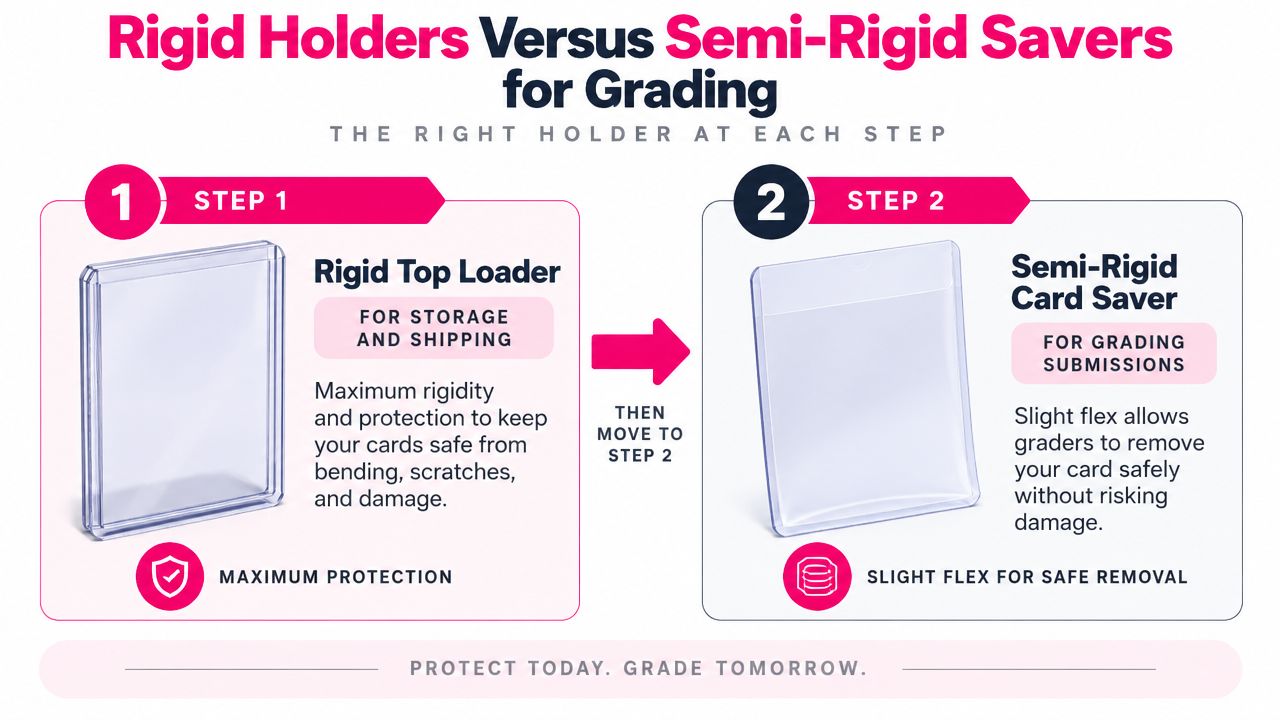
A practical setup keeps both formats available. Rigid holders handle shipping and everyday protection. Semi-rigid savers handle the final submission stage, where safe access and efficient processing matter more than maximum stiffness.
For a visual walkthrough of the distinction, watch this grading-preparation video:
When a Rigid Holder Is the Wrong Choice
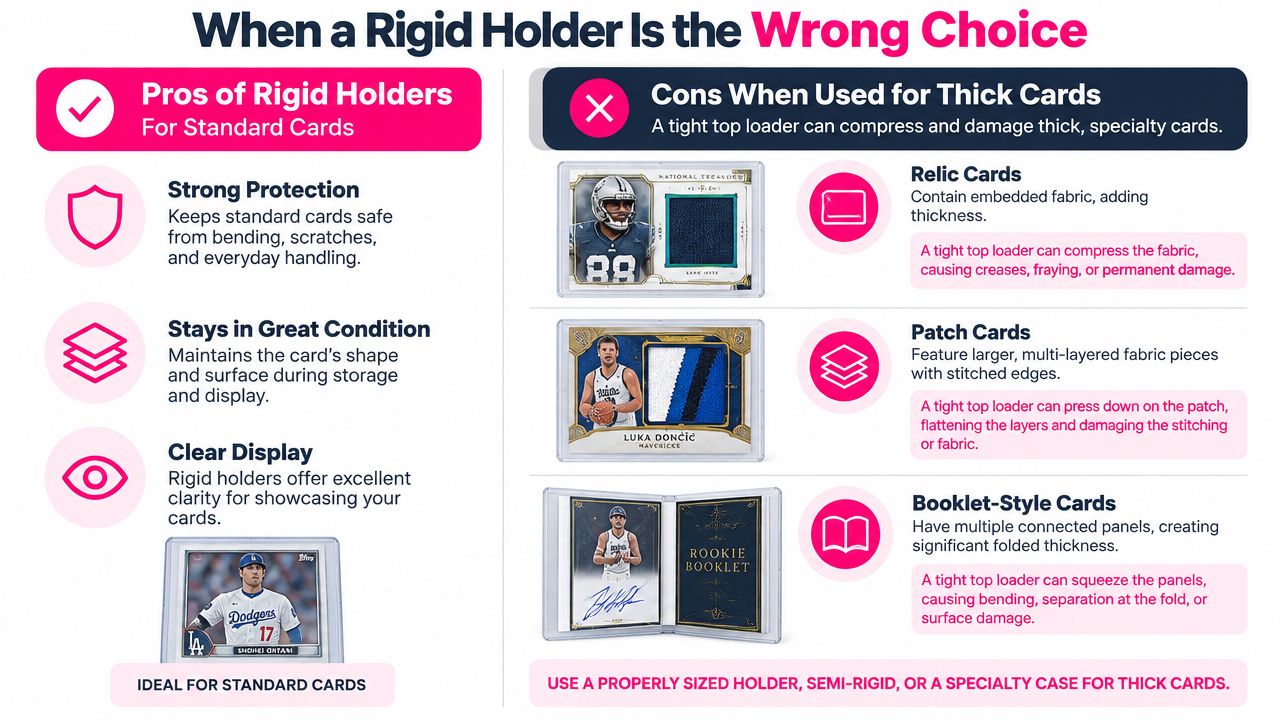
A thicker card can make a rigid holder actively dangerous. Relics, patch cards, and booklet-style cards don't always present a flat, uniform surface. Fabric, stitching, layered stock, and folded sections can protrude into the exact space a fixed holder expects to remain clear.
A semi-rigid saver accommodates variation more naturally. It still protects the card from casual bending, but it doesn't force every surface into a rigid channel. That makes it a better operational choice for many grading candidates and unusual cards.
Cards that deserve a deliberate step down
- Relic cards: Embedded material can press against the holder wall or catch during insertion.
- Patch cards: Layered or stitched edges may need more clearance than the nominal card thickness suggests.
- Booklet-style cards: Folded construction doesn't behave like a flat standard single.
- Grading candidates: Semi-rigid formats can make removal easier for intake and imaging.
- Oddly shaped cards: A rigid channel may hold the dimensions but damage a raised or irregular section.
The practical cutoff isn't a universal law, but cards above 75pt deserve a fit test before you choose rigidity. Any card with a raised relic, thick patch, or folding section deserves even more caution. If the card doesn't slide freely, stop. Don't force the holder and hope the plastic will accommodate it.
Collectors protecting Pokémon cards for display may also prefer purpose-built cases rather than squeezing an unusual card into a generic format. A relevant example is this Pokémon protection cube guide.
More rigid isn't automatically safer. The safest holder is the one that protects the card without compressing, scraping, or complicating its next handling step.
Building Your Long-Term Storage and Care Workflow
A good collection uses holders by stage, not by habit. Start with a clean penny sleeve for every raw card that matters, then route the card according to its next job.
Shipping: Use the sleeve, correctly sized rigid holder, team bag, protective inserts, and a suitable mailer. Keep the card from moving, but don't seal it in a way that forces the buyer to pry against the holder.
Grading: Use the sleeve and the semi-rigid saver requested by the grading service. Store the submission upright and protected inside a box that prevents shifting.
Display: Choose a rigid holder or magnetic case that fits without pressure. Use a cabinet or display location that limits harsh light, heat, dust, and humidity changes. For graded-card presentation and organization, see this PSA-graded card display guide.
Vaulting: Keep valuable slabs and raw cards in archival-compatible containers with stable environmental conditions. A rigid holder can reduce bend risk, but it can't correct poor humidity control or direct exposure.
Label your storage boxes by format and purpose. Mark grading candidates, relics, and standard singles separately so you don't accidentally return a thick card to a 35pt holder. Lucardio Collectibles offers authenticated singles, sealed products, graded collectibles, live buying formats, insured fulfillment, and a Card Vault for organizing and showcasing owned items, giving collectors another place to manage cards after protection and storage decisions are made.
Audit your collection this week. Pull out every relic, patch, booklet, and grading candidate, check the fit, and move unsuitable cards into properly sized or semi-rigid holders. Keep rigid card holders for standard raw singles, shipping, and display situations where their stiffness is an advantage.
Visit Lucardio Collectibles to browse authenticated singles, sealed products, and PSA-graded collectibles while organizing your own cards through its Card Vault. If you're buying or selling cards that need dependable handling, compare the holder, grading, and fulfillment choices before the next item changes hands.