
A holographic Charizard can be worth anywhere from about $80 to $150 raw for an Unlimited Base Set copy to $550,000 for a PSA 10 1st Edition Shadowless Base Set Charizard. If you don't lock down the exact print variant and grade first, the question “charizard card worth holographic” doesn't have a real answer.
That's the mistake many make. They ask for one number, hear one number, and price the wrong card off the wrong comp. In this market, that's how you overpay for an Unlimited, underprice a Shadowless, or send a scratched raw copy to grading and burn money.
The way to value a holographic Charizard is tiered. You identify the print. You assess the card raw. Then you decide whether the slab premium is real or fantasy. A 1st Edition Shadowless in PSA 10 lives in a different universe from an Unlimited holo with whitening, even though both say Charizard on the top line.
Table of Contents
- Why a Holographic Charizard Has No Single Price
- Identifying the Print Variant
- Grading Condition by Eye
- How PSA Grades and Population Drive Value
- Comparing Major Holographic Charizard Variants
- Reading Comparable Sales Without Getting Fooled
- Hidden Risks That Quietly Destroy Value
Why a Holographic Charizard Has No Single Price
A holographic Charizard can sit in an under-$200 raw tier or a six-figure trophy tier. That gap is the whole point. If you ask for one number, you are already asking the wrong question.
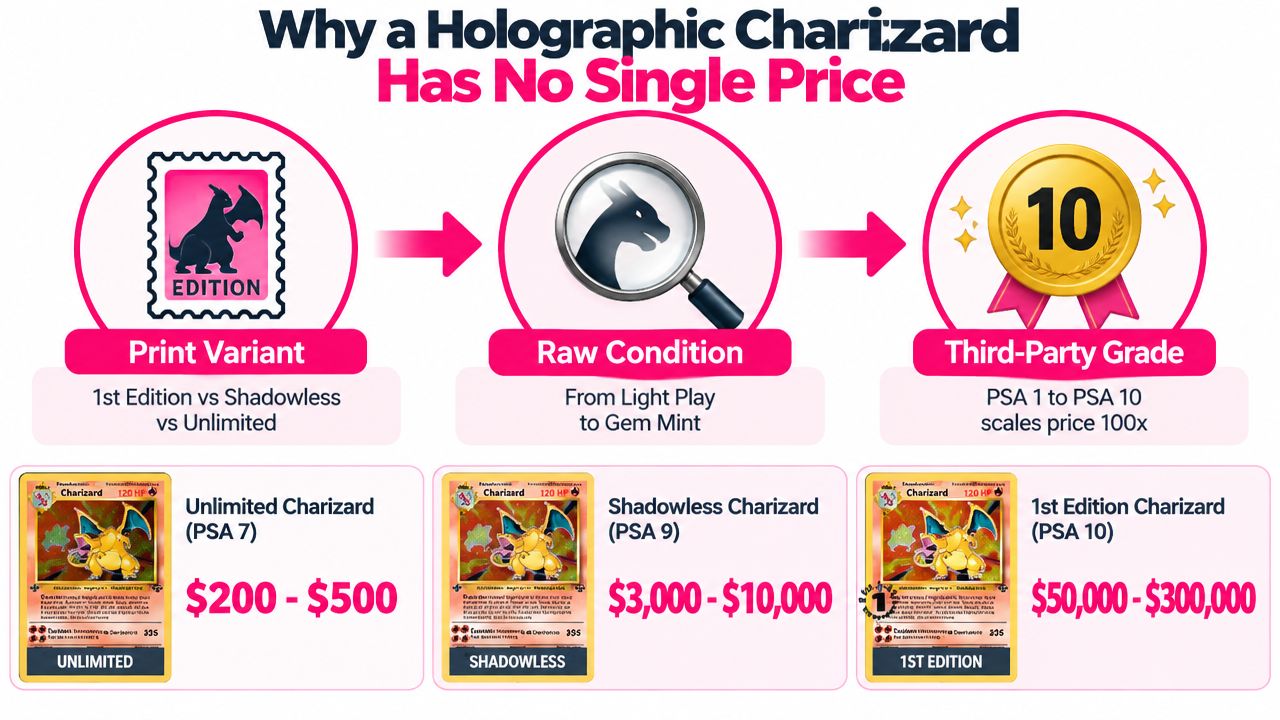
Grand Screen's Charizard price guide shows why the “single price” approach fails. A raw near-mint Unlimited Base Set holo sits around $80 to $150, while a PSA 10 1st Edition Shadowless holo reaches roughly $300,000 to $550,000. Those are not small differences. They are different markets wearing the same name.
Use a tiered valuation system instead of chasing headline prices. Start by placing the card in the right bucket, then work upward:
- Variant tier determines the price ceiling. A 1st Edition Shadowless Charizard and an Unlimited holo do not belong in the same conversation.
- Condition tier determines whether the card is binder stock, gradable material, or dead-on-arrival for premium value.
- Grade tier determines whether buyers treat it like raw cardboard or high-end inventory.
Collectors lose money. They hear “holo Charizard” and grab the highest comp they saw on social media. Then they apply that comp to the wrong print, the wrong condition, or a raw copy with surface scratches and edge wear. That is how you overpay fast.
The grade spread gets brutal at the top. For 1st Edition Base Set holo Charizard, PSA 10 copies trade in the $300,000 to $500,000-plus range, PSA 9 typically lands around $25,000 to $50,000, and PSA 8 falls closer to $8,000 to $15,000, according to Foil Case's Charizard value guide. One point on the label can wipe out tens of thousands of dollars.
Use one rule and stick to it. If a seller, buyer, or content creator quotes a Charizard price before locking down the exact print variant and the realistic grade, ignore the number.
The right question is never “What is a holographic Charizard worth?” The right question is “Which holo Charizard, in what condition, and in which grade tier?” Until those three answers are clear, every price is noise.
Identifying the Print Variant
A holographic Charizard price means nothing until the print variant is locked down. Get that wrong, and every comp you pull after that is useless.
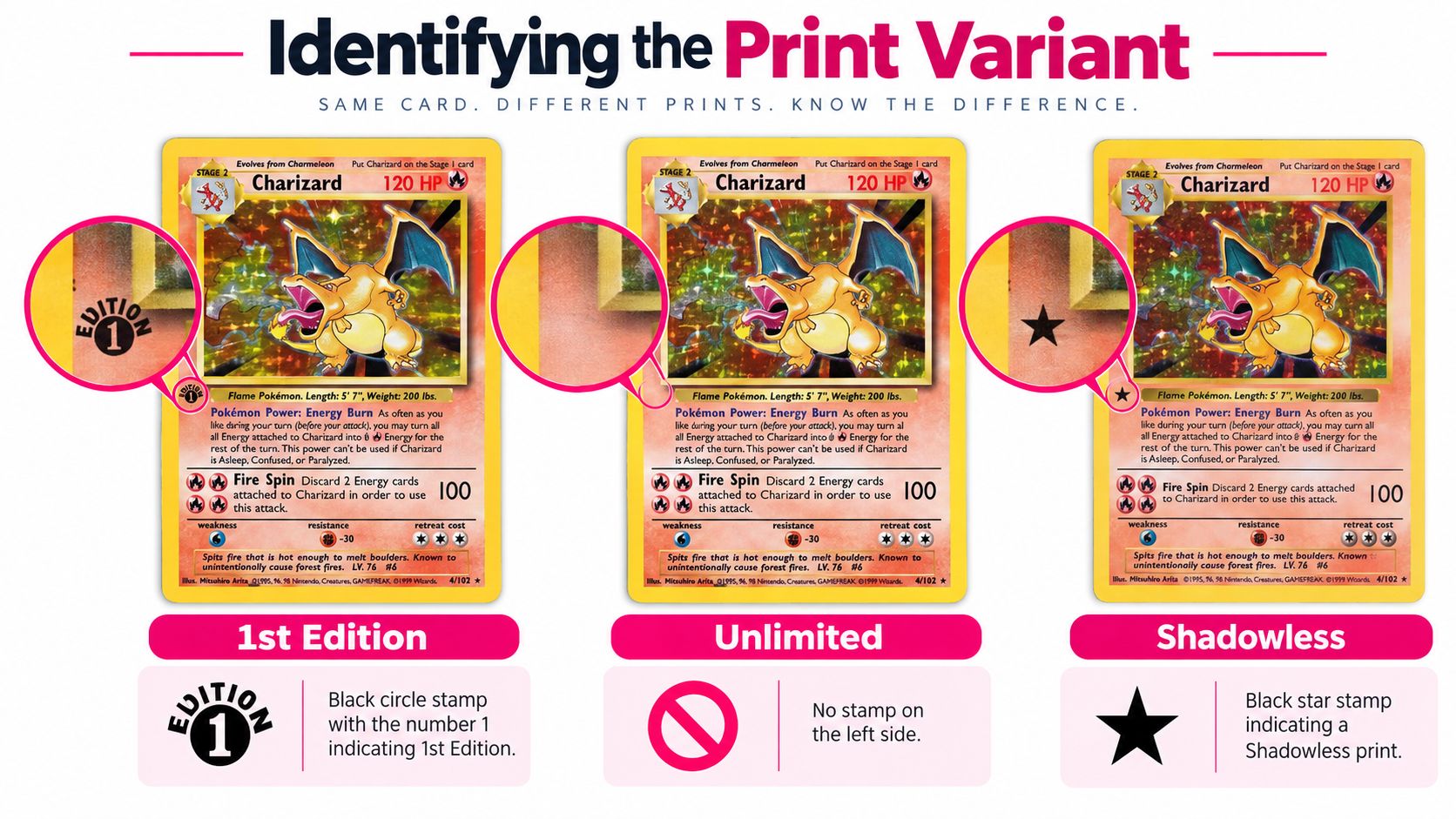
The market separates Base Set holo Charizard into distinct buckets with very different ceilings. A 1st Edition Shadowless copy sits in a different class from a Shadowless unstamped copy, and both sit far above Unlimited. Treating them as one card is how buyers overpay and sellers misprice strong inventory.
Check these markers in order
Start with the easiest tell and work down.
- 1st Edition stamp. A true 1st Edition Base Set Charizard has the black “Edition 1” stamp on the left side of the card face. No stamp, no 1st Edition premium.
- Shadow around the artwork box. Shadowless copies do not have the darker drop shadow that appears on Unlimited cards.
- Copyright and print details at the bottom. You confirm what weak seller photos often blur. If the first two checks are unclear, the bottom text can settle it.
That sequence cuts out a lot of bad assumptions. Sellers regularly label Unlimited copies as Shadowless because they know the term gets clicks. Buyers who cannot verify the print markers end up paying for a story instead of a card.
The three versions that drive the market
Use this shorthand:
1st Edition Shadowless holo
Top tier. This is the version high-end collectors fight over.Shadowless holo without 1st Edition stamp
Serious card, serious money, but still a clear step below 1st Edition.Unlimited holo
The most common Base Set holo Charizard version on the market.
This print-first mindset applies to other vintage cards too. Lucardio's write-up on Arcanine 23/102 print and value context makes the same point clearly. Character name alone does not set value. Print run does.
Later, this visual walkthrough helps:
Buyers pay for the exact print run. They pay for proof, not confidence.
Why print ID changes the whole valuation tier
The spread between variants is massive. Earlier in the article, the top-tier 1st Edition Shadowless pricing already showed how extreme that gap gets once grade enters the equation. Unlimited copies live in a completely different value bracket, even when the card presents well.
That is the point many guides skip. “Holographic Charizard” is not a price category. It is a family of variants. Identify the exact print first, then place it into the right value tier, then worry about condition and grading. If you skip step one, you are guessing with expensive cardboard.
Grading Condition by Eye
Raw holographic Charizards get overpriced every day because sellers grade with hope instead of standards. If you want a number that means anything, sort the card into the right condition tier first.
A quick eye test will not give you an exact PSA grade. It will tell you whether the card belongs in a premium raw tier, a strong collector tier, or a binder-level tier. That is the part that matters before you spend grading fees or pay near-slab prices for a raw copy.
The four things that decide the tier
PSA looks at the same basics every time:
- centering
- edges
- corners
- surface, especially the holo foil
For Base Set Charizard, surface usually does the damage. A card can look sharp in a sleeve, then fall apart under direct light. Holo scratching, print lines, dimples, scuffs, and wipe marks drop the card out of top-tier contention fast.
The back matters too. Buyers fixate on the front because Charizard carries the eye appeal, but graders punish back whitening hard. One tiny white nick on the blue border can be the difference between a card that sells like a high-end raw copy and one that gets treated as an obvious mid-grade candidate.
Use a tier filter, not wishful grading
This table works as a blunt screening tool.
| Defect | PSA 10 Standard | PSA 9 Standard | PSA 8 or Lower |
|---|---|---|---|
| Centering | Strong visual balance with no obvious drift | Slightly off-center but still attractive | Noticeable drift that hurts eye appeal |
| Edges | Clean edges with no visible whitening | Minor touch of whitening | Visible whitening or multiple edge spots |
| Corners | Sharp to the naked eye | Very slight softness | Soft, frayed, or visibly worn corners |
| Holo surface | No visible scratches or major surface flaws | Light flaw possible on close inspection | Scratches, dimples, scuffs, or obvious wear |
As noted earlier, the grading standard is harsh for cards chasing top-dollar tiers. Visible scratching, edge wear, corner wear, or weak centering pushes the card down. Quickly.
A raw sorting system that actually saves money
Do not self-grade to the decimal in your head. Bucket the card.
- Premium raw or PSA 9 candidate if the card is clean overall and you only find minor issues under strong light
- Mid-tier raw or PSA 7 to 8 candidate if whitening, holo scratching, or corner wear shows up without much effort
- Top-tier PSA 10 candidate only if the card stays clean under direct light, close inspection, and multiple angles
If the flaw shows up in your first ten seconds, price it as a lower tier.
That rule will save you money.
Collectors get burned when they price a raw card by the best-case outcome. Traders price by the likely outcome. If the holo has a scratch, if the back has edge whitening, or if a corner is soft, stop fantasizing about gem mint value and move the card into the correct bracket. That is how you avoid overpaying for raw Charizards and how you keep your own sale listings from looking foolish.
How PSA Grades and Population Drive Value
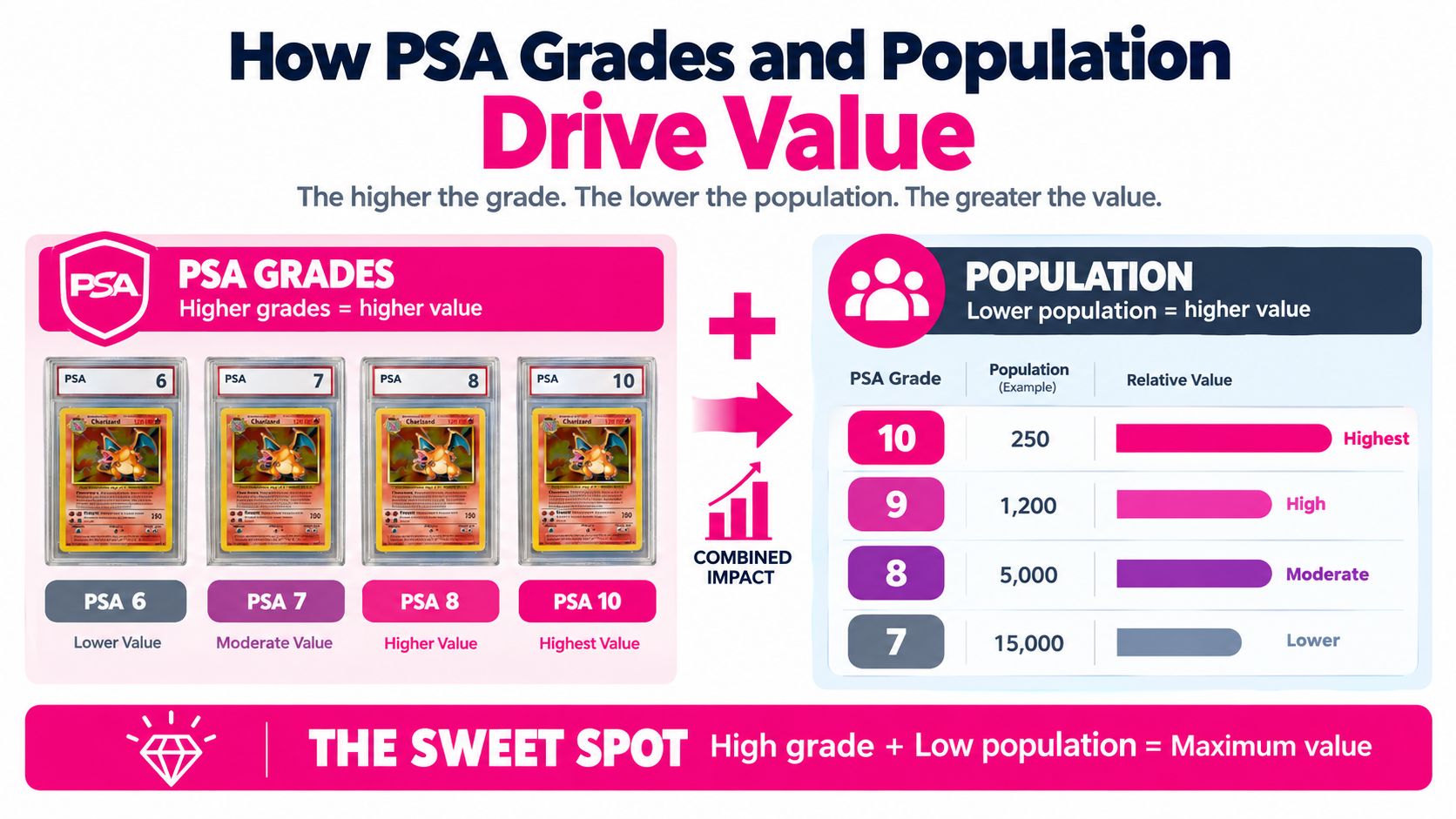
A one-point grade jump can add tens of thousands of dollars to a holographic Charizard. Sometimes far more. That is why asking for one “Charizard holo price” is lazy. Grade and variant decide the lane first. Price comes after.
Grade creates separate markets
A PSA 10, PSA 9, and PSA 8 of the same holographic Charizard are not close substitutes. They are different assets with different buyer pools.
For 1st Edition Base Set holo Charizard, the top tier has sold in the hundreds of thousands. PSA 9 lives much lower. PSA 8 drops again. As noted earlier, the spread is not linear. It is a cliff. The same rule applies to less expensive variants too. A Base Set Unlimited holo in PSA 10 can command a serious premium over PSA 8 or raw near-mint, even though the card itself is the same print.
That is the market you need to respect. If you price a raw card by dreaming about a 10, you overpay. If you treat all slabs of the same variant as roughly equal, you misread the premium the market puts on elite condition.
Population decides whether the premium holds
Grade alone is not enough. Population matters because scarcity at the top grade is what keeps the spread wide.
Analysts at this population-focused Charizard analysis pointed to an extremely small PSA 10 count for 1st Edition Shadowless Charizard relative to the huge number of graded Base Set Charizards overall. That is why registry-level copies behave differently from merely strong copies. Buyers at the top are paying for two things at once. Condition and how hard that condition is to find on the label.
A high population PSA 10 can still be expensive. A low population PSA 10 gets meaner price jumps and harsher buyer standards.
Use a tiered grading framework, not one number
Here is the practical read:
- PSA 10 is the trophy tier. Only pay trophy money for the right variant and real eye appeal.
- PSA 9 is the collector-investor tier. Strong card, lower ceiling, much easier entry.
- PSA 8 and below is where nostalgia demand is still strong, but rarity-driven pricing starts to fade unless the variant itself is elite.
That framework keeps you from blending unlike assets into one fake average.
If you are comparing slab inventory, check cert details, scans, and presentation quality before you touch the price. A marketplace focused on authenticated slabs, such as these PSA-graded card listings and buying guidance, makes that easier because you can compare verified examples instead of seller fantasy.
High-end Charizard pricing is a population and grade business first. Condition alone does not explain the gap.
The top sale headlines prove the point. The best copy of the best print can trade like trophy inventory. Lower grades and weaker variants cannot. That is exactly why this article uses a tiered valuation system instead of one big number.
Comparing Major Holographic Charizard Variants
A holographic Charizard can sit in a three-figure lane or a six-figure lane. If you compare those cards as if they are one market, your price target is junk from the start.
The variant decides the lane first. Grade only matters after that. Collectors who skip this step keep asking for one number for "charizard card worth holographic," and that is how they overpay for ordinary copies or undersell elite ones.
Start with the only split that really changes everything
Base Set 1st Edition Shadowless holo and Base Set Unlimited holo are not close substitutes. They share the same character, same set family, and similar nostalgia pull. They do not share the same scarcity tier, buyer pool, or ceiling.
Use this table as a market map, not a fake universal price list:
| Variant | Raw NM Range | PSA 10 Range | What it means |
|---|---|---|---|
| Base Set Unlimited holo | About $80 to $150 | About $8,000 to $12,000 | Entry point for vintage holo Charizard. Broad demand, far less scarcity pressure. |
| Base Set 1st Edition Shadowless holo | About $4,000 to $8,000 | About $300,000 to $550,000 | Apex English vintage Charizard. Trophy buyers set this market. |
Those ranges reflect the same broad pricing gap noted earlier in the article. The point is simple. "Holographic Charizard" is not a usable valuation category by itself.
Shadowless matters. Unlimited matters. Do not blend them.
A clean Unlimited holo can still be expensive, especially in a top slab. But it trades as a high-demand collector card. A 1st Edition Shadowless trades as trophy inventory.
That difference changes how buyers behave. Unlimited buyers compare alternatives. Trophy buyers compete for access.
There is another practical split inside vintage Charizard collecting. Shadowless unlimited-era style cards sit above standard Unlimited, but below 1st Edition Shadowless. If you lump all three together, you flatten the middle and misread the top.
Use a tiered valuation system instead of asking for one price
This is the framework I would use:
- Trophy tier: 1st Edition Shadowless in elite grade
- High-end vintage tier: 1st Edition Shadowless in lower grades, plus standout Shadowless examples
- Collector vintage tier: Unlimited holo in strong raw condition or mid-to-high slabs
- Nostalgia tier: Played Unlimited copies bought for binder appeal, not rarity status
That structure forces the right question. Which market tier is this card in?
Once you answer that, the numbers get tighter and the mistakes get smaller. If you skip the tiering and jump straight to comps, you end up comparing a mainstream vintage card to a true scarcity piece, which is how bad Charizard deals happen.
Reading Comparable Sales Without Getting Fooled
Bad comps wreck more Charizard deals than bad cards do.
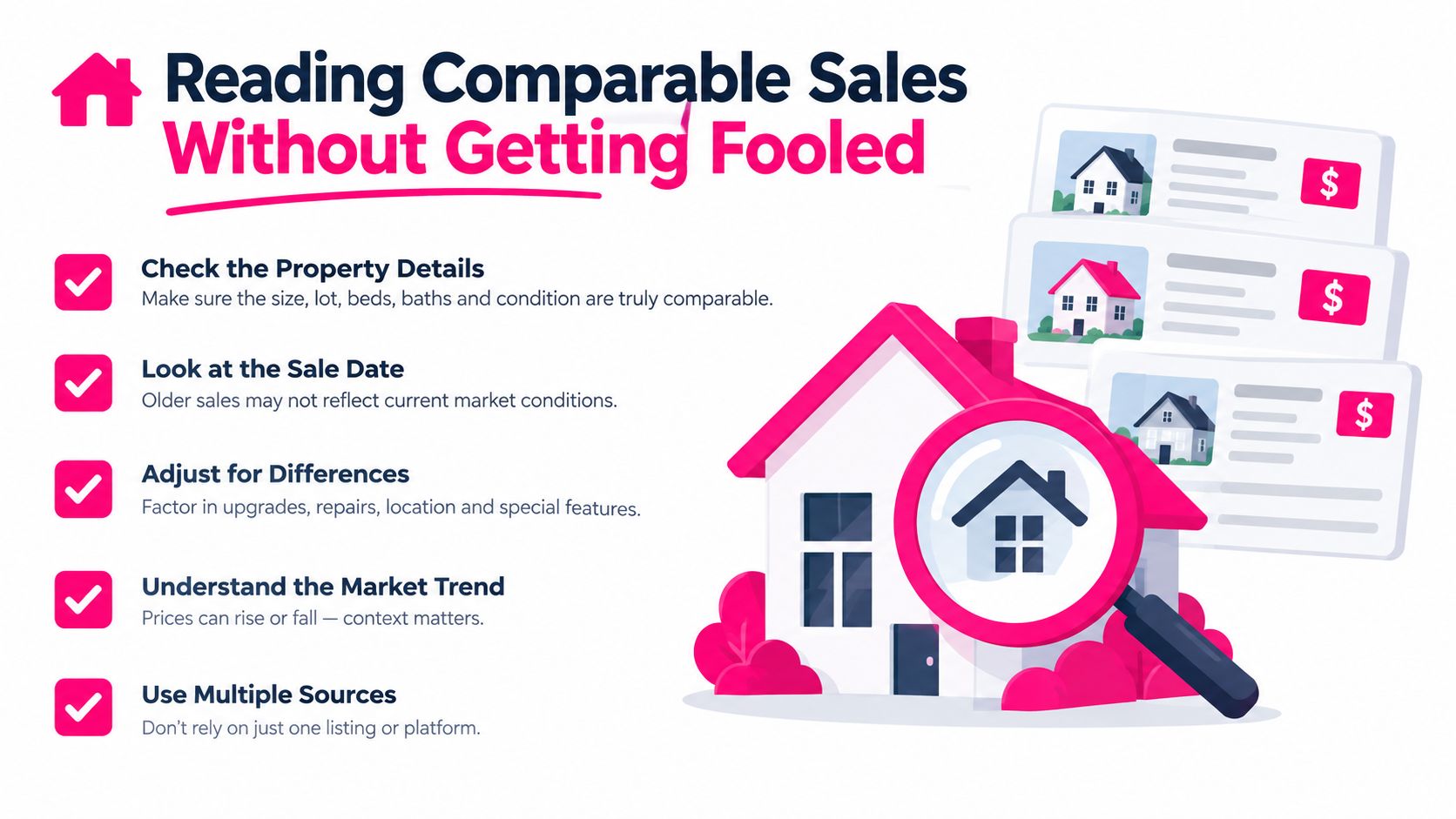
A sold listing is only useful if it belongs to the same market tier as your card. That means the exact print variant, the same grade, the same grading company, and similar eye appeal. Miss one of those and you are no longer comping. You are cherry-picking.
What makes a comp worth using
Start strict.
- Same variant
- Same grade
- Same grading company
- Similar eye appeal
- Recent sale date
- Real sale, not an asking price
That last point matters more than new collectors admit. Sellers can ask anything. The market only cares what somebody paid.
Two PSA 9 Charizards can sell far apart if one has clean holo, strong centering, and a sharp front, while the other has visible scratching or ugly whitening. The slab sets the broad price band. The photos decide where inside that band the card lands.
Stop anchoring to peak sales
Earlier sale history already made the point. Charizard prices can spike hard and then cool off just as fast. If you anchor to the headline comp from a hotter moment, you will overpay for an average copy or overlist a card that is not special enough to pull that result.
Use the comp cluster, not the single sexy outlier.
A tight group of recent sales tells you more than one record result ever will. If four copies sold in one range and one copy sold way above it, assume the outlier had something extra, or the bidders got emotional.
How to read sold listings like a trader
Run through the listing in this order:
- Verify the exact card first. If the variant is wrong, discard the sale immediately.
- Read the grade and grader. PSA, BGS, and CGC do not command the same prices at the top.
- Study the photos. Check holo scratching, edge wear, centering, print lines, and stain or silvering issues.
- Check timing. A stale comp from a different part of the market can mislead you.
- Compare several venues. One weird auction should not reset your number.
- Treat best-offer sales carefully. The displayed price is not always the number paid.
Collectors get lazy. They see “holographic Charizard,” see the right year, and stop there. That shortcut burns money because Charizard has too many price tiers for loose comping to work.
If a sale looks dramatically higher than the rest, assume there is a reason. Strong subgrade appeal, better-than-average centering, a major auction house audience, or plain bidder ego can all push a result above the pack. Unless your card matches that setup, do not borrow that price.
Hidden Risks That Quietly Destroy Value
A holographic Charizard does not lose value all at once. It bleeds value in tiers. A copy that looks like a PSA 10 candidate can slide into PSA 8 or lower from one centering miss, one overlooked scratch, or one fake slab, and each tier drop changes the price conversation fast.
That is the part casual guides skip. They act like “holo Charizard” has a price. It does not. The wrong defect on the wrong variant can knock a card out of the premium tier before you even start talking numbers.
Centering ruins premium outcomes fast
Collectors chasing a gem mint result often stare at corners and forget the front layout. That is a mistake.
On a holographic Charizard, centering affects both eye appeal and grade ceiling. If the border balance looks off at a glance, or the artwork is visibly pulled to one side, stop pricing it like a top-tier copy. A card can have sharp corners, a clean back, and a strong holo, then still miss the grade that matters because the front was never good enough.
That mistake gets expensive on higher-end variants. The spread between a strong mid-grade copy and a true top-grade copy is where people get punished for optimism.
Fake slabs cost more than fake raw cards
Raw counterfeits are common. Slab fraud is worse because the holder gives weak buyers false confidence.
Check the same four things every time:
- Label quality that matches the grader's normal font, spacing, and layout
- Certification number verified in the grading company's database
- Holder condition and fit, including odd seams, excess movement, or plastic that feels wrong
- Card details inside the slab, especially holo pattern, print quality, color, and alignment
If you buy graded Charizards often, build a photo library of genuine slabs from each grading company. If you do not trust your own eye yet, read this guide on how to spot a fake PSA slab before sending money.
A fake slab only needs one buyer.
Storage damage turns strong cards into average cards
A lot of Charizards were damaged after they became expensive. That is why “old collection fresh” means almost nothing by itself.
Watch for these value killers:
- Micro-scratches and sleeve rub from sloppy handling
- Back whitening from loose storage or repeated movement
- UV fade that dulls color and weakens eye appeal
- Cloudy, cracked, or scuffed holders that make buyers assume the card was treated badly
Presentation matters because buyers price risk immediately. If the slab looks abused, they start discounting the card, even before they decide whether the card itself is clean.
A simple defensive checklist
Use this before you buy, list, or submit:
- Confirm the exact print variant first
- Check front centering under neutral light
- Tilt the holo and look for surface scratching
- Inspect the back for whitening and edge wear
- Verify the cert if the card is graded
- Check the holder for tampering, cracks, or haze
- Place the card into the right value tier, not your favorite tier
That last point matters most. A 1st Edition Shadowless holo with obvious flaws still sits in a different market tier than an unlimited base holo. A clean unlimited holo still sits below elite copies of scarcer variants. If you ignore that tier structure, you will misprice the card before condition even enters the discussion.
My blunt advice for buyers, sellers, and long-term holders
If you are selling, grade only the copies that can realistically reach a tier where the slab premium justifies the cost and delay. If the card has visible holo scratching, back whitening, or weak centering, list it transparently and price it in the correct lane.
If you are buying, I would rather own a strong graded copy than a “mint raw” Charizard described by an optimistic seller. Graded cards give you a clearer resale lane, especially when the variant already has established buyer demand.
If you are holding long term, separate collector appeal from investment appeal. Top-tier examples of the most important variants deserve blue-chip treatment. Average copies of common holo prints do not. Lucardio Collectibles can help you track authenticated singles, PSA-graded items, auctions, and your own collection in one place, which makes it easier to compare real inventory instead of guessing from screenshots.
If you want a clean answer to charizard card worth holographic, stop asking for one number. Identify the exact variant. Judge the card brutally. Then place it in the right price tier. That is how you avoid getting burned.