

PSA reported that counterfeit Pokémon TCG card submissions increased by 125% year over year in 2025, according to PokeSats' coverage of PSA's fraud report. That measures submissions to PSA, not every card for sale, but it gives buyers a reason to demand more than a clean listing photo.
Learning how to tell if a Pokémon card is fake means comparing manufacturing details, not judging whether the artwork looks convincing. For remote buyers, there's another problem: a real-looking card and a real-looking PSA slab need separate checks.
Table of Contents
- Red Flags That Separate Real Cards From Fakes
- How to Check Size Light and Edges
- Reading Print Dots Holo and UV
- Verifying a PSA Slab Apart From the Card
- When to Quarantine and What to Do Before You Pay
Red Flags That Separate Real Cards From Fakes
Flag a card only when at least two independent checks disagree with a matched authentic reference. Quarantine means setting it aside for review, not declaring it counterfeit. A printing defect, worn surface, or unusual factory cut can explain an isolated oddity.
Independence matters. Blurry lettering and a blurry attack symbol in the same compressed photograph may share the same cause. Excessive light transmission and incorrect print structure are more useful together because they test different manufacturing features.
Genuine signs versus counterfeit clues
Use this table with the card in hand. The weight column describes a clue's usefulness, not permission to make a verdict from that clue alone.
| Check | Genuine card | Counterfeit clue | Weight alone |
|---|---|---|---|
| Size | Standard dimensions; sits flush against a matched reference | Short, wide, or corners that won't stack | Strong with a reference |
| Light test | Opaque core; borders remain comparatively dark | Easy to see through, especially at the borders | Screen only |
| Edges and corners | Even factory rounding | Uneven radii, fuzzy or freshly cut edges | Strong for trims |
| Centering | Border layout consistent with the printing, allowing factory miscuts | One border much wider | Supporting only |
| Card back | Consistent blue field and swirl for that printing | Wrong blue, soft swirl, or spelling errors | Strong |
| Typography and symbols | Sharp set fonts and attack costs | Wrong font, muddy symbols, bad punctuation | Strong |
| Holofoil | Directional shift and expected set-specific texture | Flat, overly uniform, or smeared rainbow | Strong on holo cards |
| Print under magnification | Organized CMYK dots or rosettes in offset artwork | Spray, toner speckle, or flat solid color | Strong |
| UV light | Fluorescence consistent with matched era, language, and stock | Unexpected glow or lack of glow | Weak; not a pass or fail |
| Thickness and feel | Matches comparable reference stock | Waxy, wavy, or obviously thin | Supporting |
Run the checks in buying order
Start with dimensions, light transmission, and the cut. Those checks can reveal stock or alteration problems before you spend time studying tiny print details. Note centering, but don't confuse poor condition or a genuine miscut with counterfeit manufacture.
Then compare the back's blue field and swirl, followed by lettering, attack symbols, and foil behavior. Magnification helps resolve doubts about printing; UV belongs near the end because its interpretation is less reliable. Finish by comparing thickness and surface feel without flexing the card.
A pretty front photograph is evidence of appearance, not evidence of paper stock, factory cutting, or authentic encapsulation.
For slabbed cards, keep the card assessment separate from the holder assessment. A reassuring label must never cancel an unexplained discrepancy in the card itself.
How to Check Size Light and Edges
A verified comparison card is more useful than a remembered shade of blue. Choose one from the same era and language, with comparable construction and finish; an unrelated foil card makes a poor reference for ordinary nonfoil stock.
Work on a clean, uncluttered surface with a ruler, a loupe, and diffuse lighting. Keep grit away from the cards, handle them by their edges, and avoid squeezing them with measuring tools.
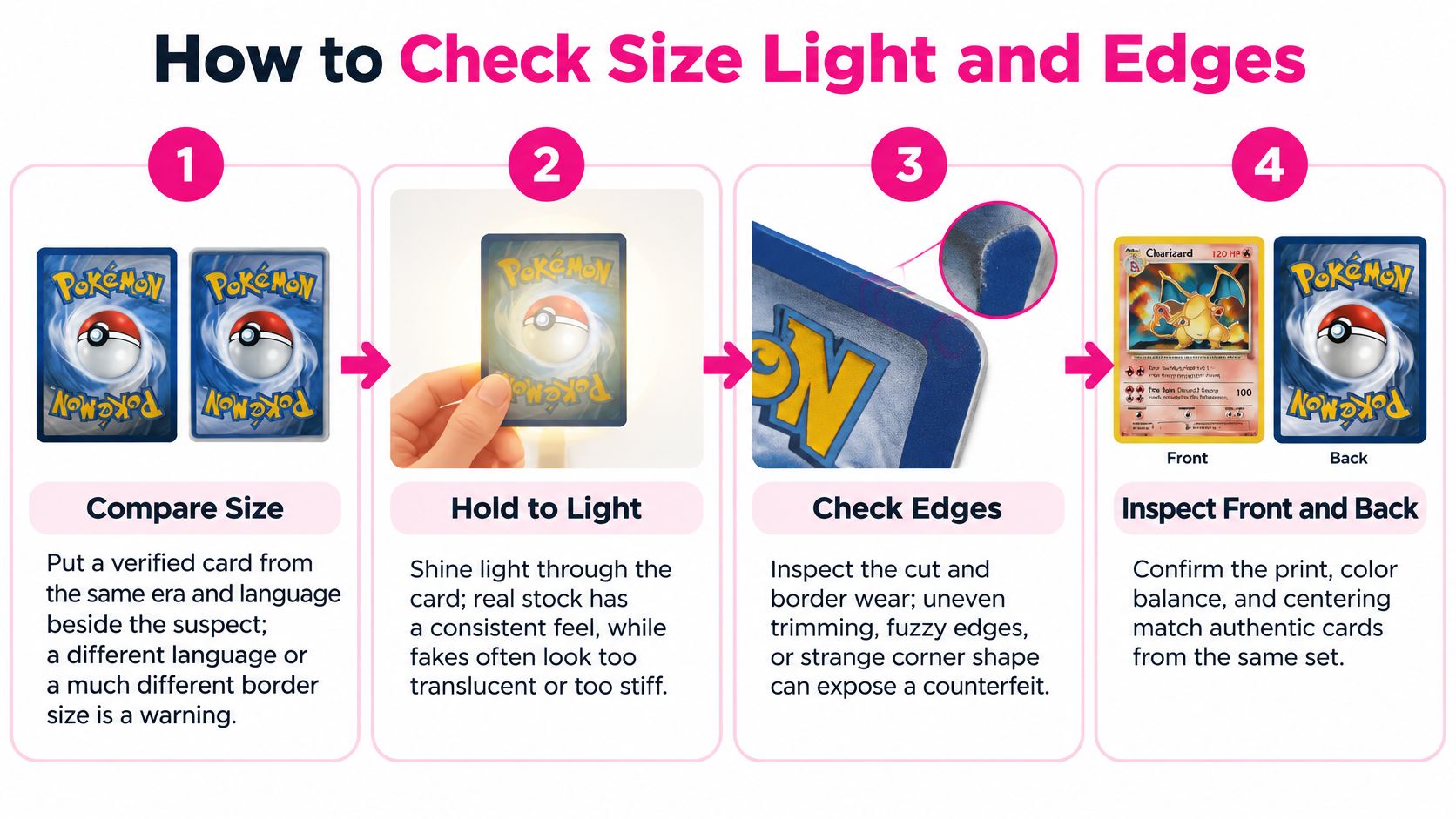
Establish the reference and inspect the cut
Choose a meaningful reference. Put the verified card beside the suspect with both facing the same direction. Match the production context rather than choosing another Pokémon card. A language difference or substantially different manufacturing era can create misleading comparisons.
Measure both axes, then align the cards. Standard Pokémon cards are approximately 63 millimeters wide by 88 millimeters tall, or about 2.5 by 3.5 inches, as described in Wargamer's fake Pokémon card guide. Read the ruler straight on, then gently align the cards and check whether the edges remain flush around every corner. Measuring only the height can miss an unusually narrow card.
Inspect the edge and corner profile. Look for inconsistent corner rounding, abrupt changes in edge texture, or a cut that looks different from the reference under magnification. A genuine card can be altered by trimming, so the question isn't always whether the printing is fake. Don't scrape an edge to expose its layers or mistake ordinary wear for a fresh cut.
A short card with suspicious edge finishing deserves more attention than an off-center card with otherwise consistent construction. Home measurements are screening evidence, though, not a substitute for professional alteration review. Photograph the alignment before moving the cards.
Compare stock without stressing it
Use the same bright, indirect light. Hold the reference and suspect in equivalent positions, maintaining the same distance and angle to the light. Compare transmission rather than asking whether any light passes through at all. Different exposure settings can make separate phone photographs look dramatically different.
Compare side thickness and surface feel. View the cards edge-on and look for obvious differences in stock, waviness, or surface coating. Handle lightly instead of rubbing across the artwork. Wear, moisture exposure, and finish differences can affect feel, so a waxy surface or thin-looking edge needs corroboration.
Record centering without treating it as authentication. Compare the border layout with the correct printing, then note any unusually wide border. Factory cutting can produce genuine off-center cards. The common mistake is promoting a condition issue into proof of counterfeiting.
Keep a short inspection record: reference identity, measurements, ruler resolution, lighting setup, and photographs of the aligned edges. That record makes a later expert review more useful than a message saying the card feels wrong.
Older production differences and normal tolerances mean size alone isn't conclusive. Don't force a card into an exact-size assumption, and don't press calipers hard enough to compress or mark its edges.
Reading Print Dots Holo and UV
A convincing card image can still hide a mismatch in its printing. Under magnification, compare the suspect card with a reference of the same printing. Organized CMYK halftone dots or repeating rosettes are typical of genuine offset-printed artwork, as described in Hardcore Collectors' authentication guide. UV screening is less decisive: fluorescence varies, so it should carry less weight than a matched print comparison.
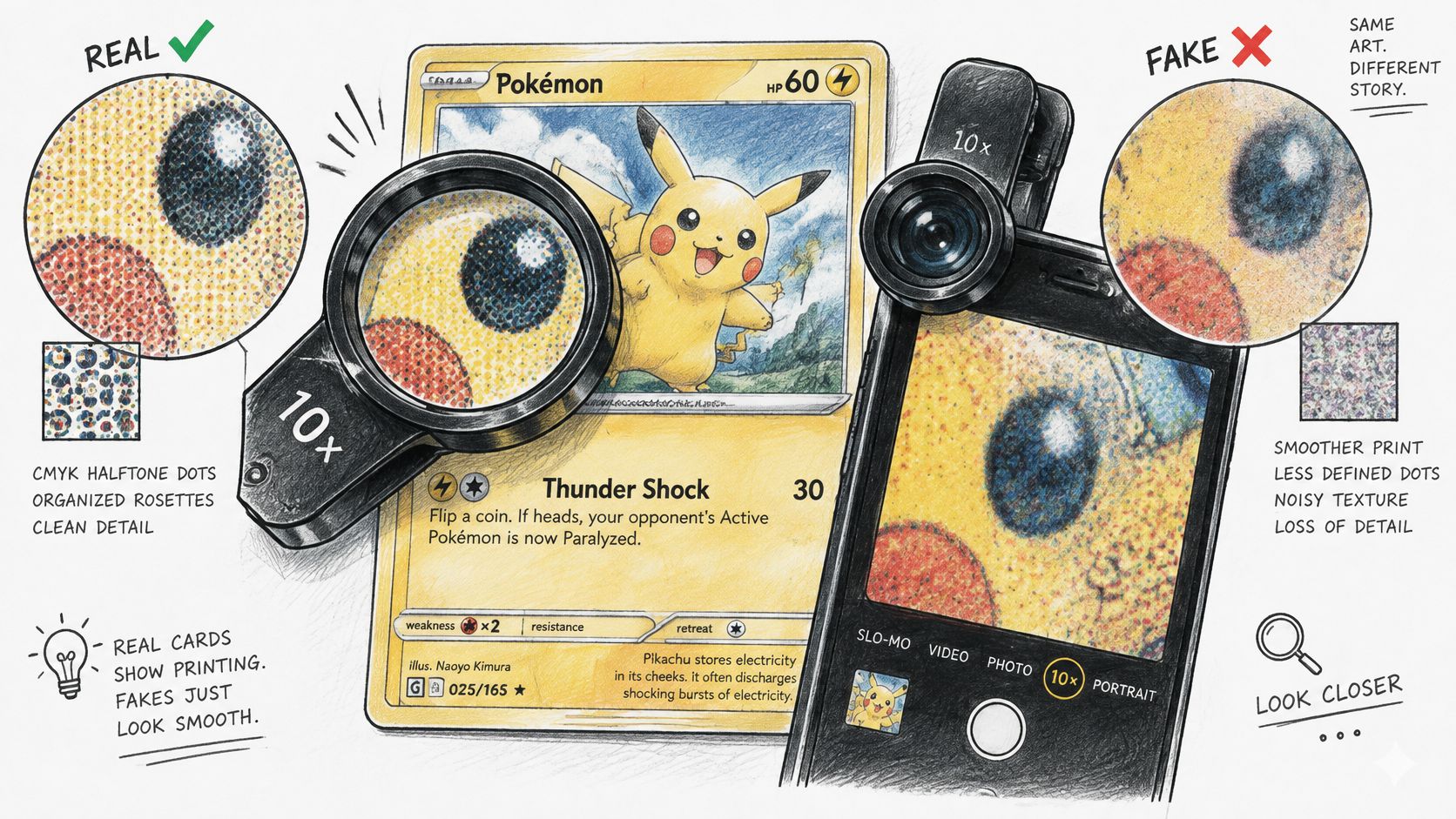
Look for structure rather than sharpness
Use a jeweler's loupe or phone macro attachment with stable focus. Digital zoom enlarges existing pixels, so a heavily cropped listing image may show compression artifacts rather than ink.
Compare the same kinds of details on the suspect and reference:
- Colored artwork. Look for organized halftone structure. Irregular speckling, coarse lines, or unexpectedly flat color are reasons to check more closely, not proof by themselves.
- Black text. Compare letter shapes, spacing, punctuation, and boundaries. Colored rosettes need not appear inside every black character.
- Attack-cost symbols. Check each symbol's shape and placement, not just its color.
- Back design. Compare the swirl's fine detail and transitions using images captured under similar lighting.
A convincing illustration does not excuse incorrect small type. A soft macro photo does not prove a printing defect either. Refocus, adjust the angle, and inspect the physical card before treating a visual mismatch as a failed check.
Make the foil move
Tilt the card under diffuse light and watch how the reflection travels. Compare the expected pattern, texture, and directional response with the exact printing. Genuine cards can have smooth or textured finishes, so texture matters only when that specific printing should have it. The foil trading card guide can help you distinguish finishes when making that comparison.
Useful distinction: A repeated photograph of the same flat reflection is not a new test. A controlled tilt that reveals the wrong foil behavior is additional evidence.
For a remote purchase, ask the seller for a slow tilt video rather than another flash photograph. Bright glare can hide fine texture; an underexposed image can make genuine foil look lifeless. Neither shows how the foil behaves as the card moves.
Keep UV in its place
Cardstock, language, printing era, and optical brighteners can all affect fluorescence. Compare like with like rather than assuming genuine cards must glow or stay dark.
Treat a card as flagged when two independent checks disagree with a matched reference. For example, print structure and foil behavior that both differ from the correct printing give you a stronger reason to pause than a single uncertain UV result. Record the light source, magnification, comparison card, and original images so another reviewer can repeat the inspection.
Verifying a PSA Slab Apart From the Card
The card inside and the slab around it can fail independently. A convincing holder doesn't establish that its contents are correct, and a convincing card doesn't establish that its certification is attached to the right physical item.
PSA's communication guidance says buyers can use its certification-verification page and app to scan an item's barcode, and suspected counterfeits can be raised through its customer-request process for item verification. A matching certification number establishes that the record exists. It doesn't establish that the object in a seller's photographs is the object associated with that record.
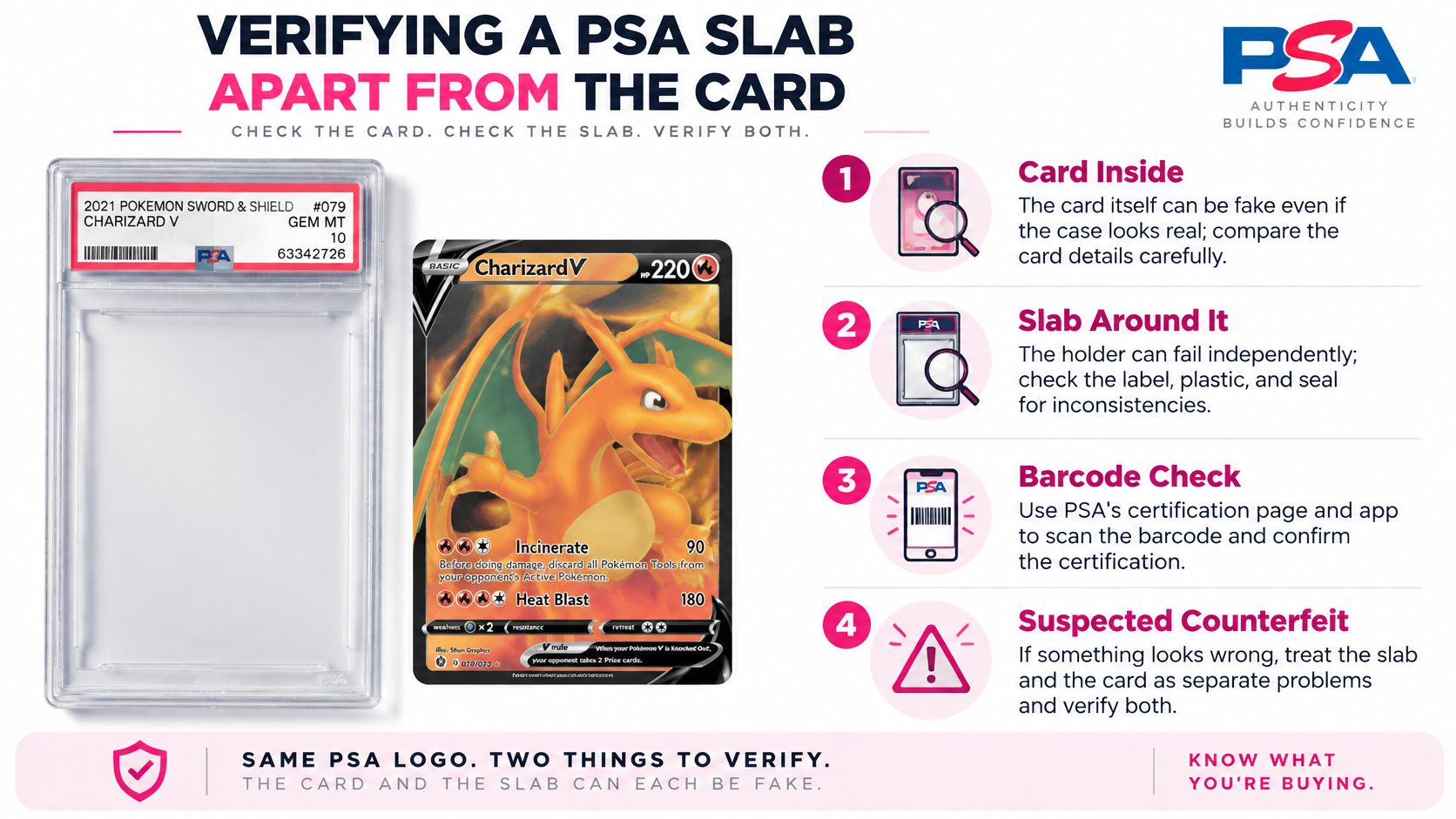
Build a connected photo record
Ask for photographs of the front, back, label, barcode, and case edges taken in the same sitting. Consistent surroundings and lighting help connect the images, although they still aren't proof of authenticity. A continuous video showing the seller turning the holder can reduce uncertainty about disconnected photographs.
Follow a deliberate review order:
- Read the physical label. Write down the Pokémon name, set, card identity, grade, and certification number before opening the lookup record.
- Compare the certification details. Check each field against the label, then compare the actual card with the stated identity and variant.
- Inspect the holder. Examine seams, plastic clarity, label printing, and security features against authentic slabs of a comparable holder generation.
- Resolve contradictions. Request clearer evidence when reflections obscure a seam or label detail. Don't reinterpret a visible identity mismatch as harmless because the barcode scans.
A holder may be altered, reused, or paired with a counterfeit card. A genuine holder can also carry a label discrepancy that requires review. Those possibilities lead to different explanations, but they lead to the same purchase decision while unresolved: don't pay.
Separate suspicion from a buying decision
Case scratches aren't automatically evidence of tampering. A suspicious-looking seam in a blurry photograph also needs better documentation before you label the slab counterfeit. Our guide to spotting a fake PSA slab provides a holder-focused companion to the card inspection.
A remote buyer can't directly feel the card's texture or compare its bare stock thickness through the plastic. Reflections can also obscure print and foil, which makes certification and identity checks especially important. Don't crack a holder merely to complete a home screening routine.
Keep separate notes for card identity, visible card manufacture, certification details, and holder condition. That prevents a successful barcode scan from becoming an overall pass by default.
You don't need to prove fraud to decline a purchase. Unresolved inconsistencies are enough reason to keep your money.
The multi-signal rule governs whether you flag the card as suspicious; it doesn't oblige you to buy when evidence is incomplete. If the label and card identity disagree, stop the transaction and pursue item verification rather than accepting the seller's explanation without confirmation.
When to Quarantine and What to Do Before You Pay
Ambiguous results and when to quarantine
| What you see | Can still be genuine | Quarantine when |
|---|---|---|
| See-through borders | Bad photo or thin, worn genuine stock | Print, fonts, or the back also fail |
| Short on both axes | Rarely a normal tolerance explanation | Edges look freshly cut or corners won't stack |
| Holo looks flat | Flash glare in a photograph | It stays flat under diffuse light at several angles and another independent check fails |
| UV glow differs | Era, language, or optical brighteners | A second independent signal also fails |
| Cert number matches | The PSA record exists | The card in the slab doesn't match the label |
| One border is wide | Genuine miscut | Fonts, back, and texture are also wrong |
Treat a translucent border as a prompt to control the test, not an instant verdict. Pokémon Support's counterfeit-card guidance says counterfeit cards are often easy to see through under bright light and recommends familiarity with official products and packaging. If the suspect looks normal beside a matched reference under identical illumination, the original photograph may have been misleading; if the back or print also disagrees, isolate it.
A card that's short in both directions needs careful edge review. Fresh-looking cuts alongside abnormal dimensions support an alteration concern, even if the underlying card is genuine. Record it as potentially trimmed rather than assuming all suspicious cards are reproductions.
Resolve the odd reading before assigning a verdict
Flat-looking foil needs a movement test. If it behaves normally under diffuse illumination, the original image didn't capture enough information. If the expected effect remains absent, inspect a different manufacturing feature before flagging the card itself.
Unexpected UV behavior belongs in the notes, not at the top of the verdict. A fluorescence difference without another independent mismatch can reflect legitimate stock differences. Don't keep changing lamps until you get the result you expected.
A valid certification record doesn't resolve a card-to-label mismatch, and a wide border doesn't resolve anything about authenticity by itself. For the former, stop payment and seek verification; for the latter, inspect the remaining features without treating centering as a decisive clue.
Buying threshold: Missing evidence is a reason to pause or pass, even when there isn't enough evidence to call a card fake.
Never bend, soak, tear, or peel a collectible to settle uncertainty. Destructive tests can destroy an authentic card and still leave you without a reliable explanation of what you found.
Finish the raw-card evidence pack
Before paying for a raw card, request a compact set of photographs that answer different questions. The seller doesn't need elaborate equipment, but the images must show the actual item clearly.
- Measurement view. Ask for the card beside a readable ruler, photographed straight on. Keep the full perimeter visible rather than cropping away the corners.
- Controlled light comparison. Request the suspect and a verified reference under the same indirect illumination. Separate photographs with automatic exposure changes aren't equivalent.
- Text macro. Obtain a focused close-up of black lettering and adjacent colored printing. A screenshot of a screenshot usually won't resolve print structure.
- Surface movement. For a foil card, request angled photographs or a slow tilt video that shows the relevant finish without a flash hotspot.
Keep the original files where possible. Save the listing description, seller messages, and any statements about authenticity or alteration alongside your inspection notes. Provenance supports review, but a convincing ownership story can't repair a physical mismatch.
For a valuable raw card that passes screening, professional authentication or grading may be the sensible next expense. Agree on how that review will happen before committing, rather than buying an uncertain item and hoping the grading result fixes the risk.
Set a higher evidence standard online
Stock photographs can identify a product, but they can't establish the condition or authenticity of the specific card you'll receive. Ask for item-specific front and back images, visible corners, and the additional views needed for its finish or holder.
A price far below comparable recent completed sales should prompt investigation, not excitement alone. Check that the comparison involves the same language, printing, condition, and grading status. An asking price isn't evidence of market value, and a discount isn't proof of counterfeiting.
Use seller behavior as a transaction filter:
- Refused photographs. Pass when a seller won't provide views needed to resolve a material concern.
- Changing explanations. Pause if the stated printing, condition, or ownership story changes after you identify a discrepancy.
- Pressure to pay. Don't shorten the inspection because another buyer supposedly wants the card.
- Unclear remedies. Read the marketplace's authenticity and dispute terms before sending payment, and retain the transaction record.
For slabbed purchases, complete the physical-label-to-record comparison before payment. A mismatch is a stop condition even if you can't determine whether the cause is a counterfeit, an altered holder, or a labeling problem.
Choose certainty rather than a reassuring story
Use our Pokémon singles buying guide to organize purchasing decisions around the exact card and condition you want. At Lucardio Collectibles, all cards we sell are guaranteed to be authentic, and we offer secure shipping with insured delivery. Authentication and delivery protection address different risks, so neither should be mistaken for the other.
Keep the final decision simple: buy only when the available evidence supports the item being offered, quarantine independently conflicting results, and pass when a seller won't resolve material uncertainty. A missed purchase costs less than paying for a card whose identity you still can't establish.
We sell trading cards, sealed booster boxes, and PSA-graded cards, with all cards guaranteed authentic and secure shipping with insured delivery. Visit Lucardio Collectibles to explore authenticated inventory while keeping the same careful card-and-holder checks part of your buying routine.