
The graded Pokémon card you've been watching is finally up. You're still bidding, even though the price has passed what you meant to spend, because another collector keeps answering. Only after the hammer falls do you see the premium, tax, and delivery charge together.
A sound live auction bidding strategy starts before that moment. Work out what the card is worth to you, translate that into a maximum bid after costs, and choose your timing around the auction's actual closing rules. Winning matters only when the purchase still makes sense.
Table of Contents
- Set Your All-In Ceiling Before the Auction
- Match Your Timing to the Closing Rules
- Real-Time Bidding Tactics That Hold Up
- Resisting Momentum and Stopping at Your Limit
- Protect Your Win From Payment to Delivery
- Confirm Your Ceiling Before You Raise a Paddle
Set Your All-In Ceiling Before the Auction
A graded card gives bidders something concrete to assess, but it doesn't give everyone the same valuation. Collectors can agree on the certification and still disagree about centering, scarcity, resale demand, and how quickly they could find another copy.
That's where the common-value problem becomes useful. When bidders share uncertainty about an item's underlying worth, the most optimistic estimate can win, creating the winner's curse, as explained in the experimental auction paper hosted by PubMed Central. Your protection is a conservative valuation, not a stronger determination to beat the room.
Build the worksheet from sold prices
Start with completed sales for the exact card, language, edition, grading company, and grade. Note centering and population context rather than treating every slab with the same label as interchangeable. Exclude obvious mismatches, and distinguish an actual sold price from a seller's asking price.
Use the trading-card valuation guide to organize those comparisons before opening the bidding screen. If the evidence is thin, leave more room for uncertainty instead of letting the auction's opening estimate become your valuation.
The following is a hypothetical worksheet, not a statement of any auction house's charges.
All-in cost worksheet for a 400 dollar hammer price
| Component | How to estimate it | Example value |
|---|---|---|
| Comparable sales | Median recent sold price for the same grade, with population context noted | About $380, an assumed example median |
| Hammer price (your max bid) | Bid amount before fees | $400, the proposed bid being tested |
| Buyer's premium | Percentage stated in the auction terms | Assumed 20%, adding $80 |
| Sales tax | Applicable local rate applied to the taxable amount specified in the terms | Local rate multiplied by $480 if hammer plus premium is taxable |
| Insured shipping and handling | Quoted rate for tracked, insured delivery | Assumed $25 |
| All-in cost and ceiling | Hammer plus premium, shipping, and tax, kept below expected resale minus margin | $505 plus applicable tax, to compare against your ceiling |
The example exposes a bad purchase before you make it. A proposed hammer price can look close to comparable sales while the delivered cost is substantially higher. The all-in cost isn't automatically your ceiling. It's the amount you test against that ceiling.
Work backward to the bid button
For a resale purchase, begin with conservative expected proceeds, subtract selling expenses and your required margin, and use the remainder as your acquisition ceiling. For a personal collection, decide what the enjoyment is worth without pretending that personal attachment guarantees resale value.
Then deduct fixed delivery costs and account for percentage charges. Where tax applies to hammer plus premium, the calculation is:
Maximum hammer = (all-in ceiling minus fixed shipping) ÷ [(1 + premium rate) × (1 + tax rate)]
Adjust the calculation if the terms tax other charges or add payment fees. Round down to a permitted bid increment, and write that maximum beside the lot number before the sale opens.
Stop rule: If the next accepted bid would put the delivered total above your written ceiling, don't place it.
Match Your Timing to the Closing Rules
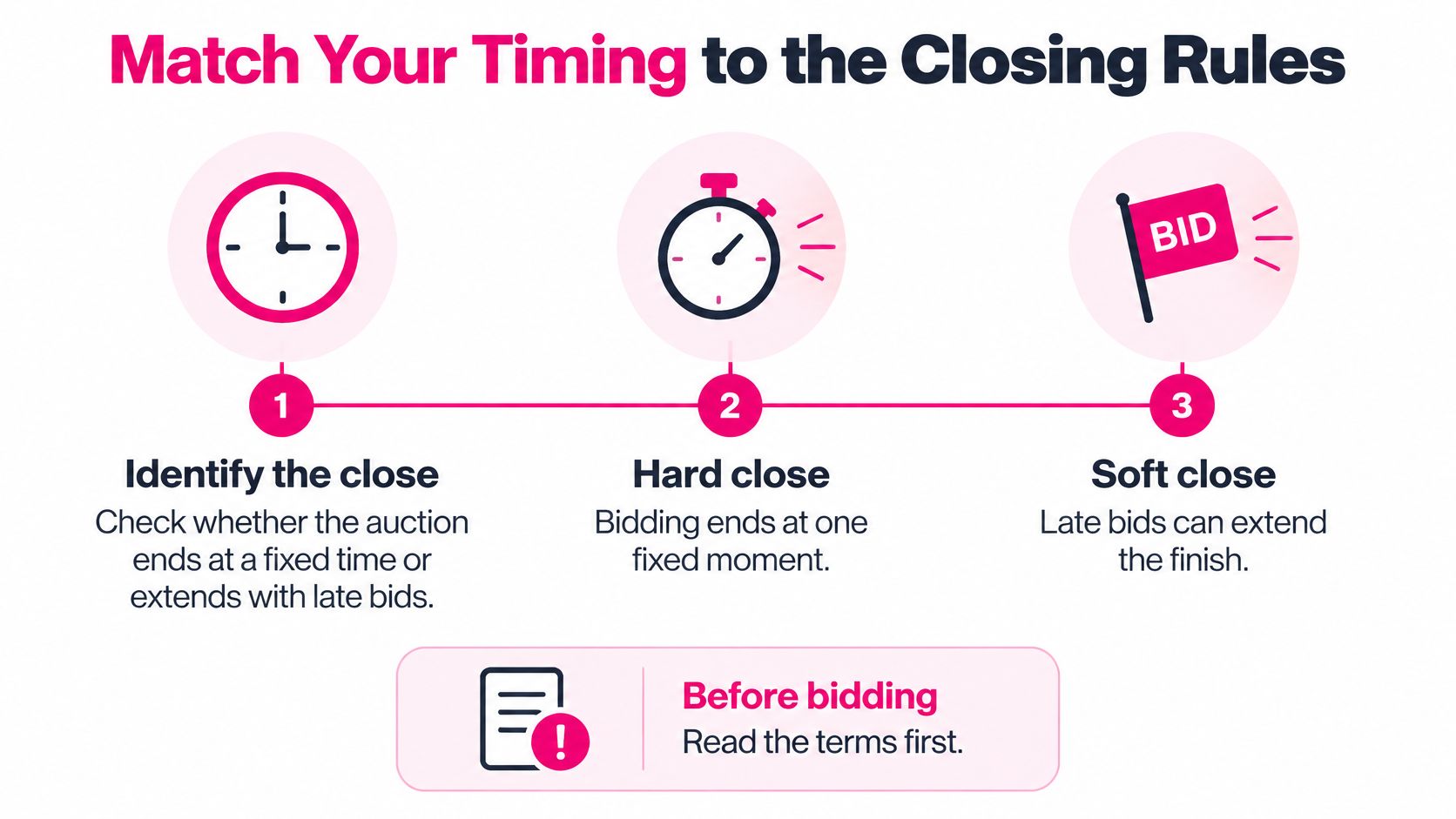
The closing format decides the timing. A late bid can shorten a rival's response window in a fixed-end auction, but it can restart the clock in an extension-based sale. Proxy bidding is a separate feature that may operate alongside either format.
Check the terms for the closing trigger, extension window, minimum increment, and treatment of matching maximum bids. Don't infer the rules from a countdown graphic or from how the previous marketplace worked.
Use this visual as a prompt to identify the mechanism before choosing a tactic.
What happens near the finish
In a hard close, bidding ends at the stated deadline. A late maximum can leave incremental bidders little time to respond, but transmission delays can also leave you without an accepted bid. Leave a connection buffer rather than trying to submit at the final possible instant.
In a soft close, a qualifying bid extends the sale. Watch the extension trigger and the revised finish time. Entering late may announce your interest and give everyone another opportunity to compete.
In a live-hosted room, follow the accepted-bid display and auctioneer's closing signals. Don't assume the video feed and bidding interface are perfectly synchronized, or that the auctioneer will pause for your connection.
Bidding approach by closing format
| Format | Closing rule | How late bids behave | Approach that fits |
|---|---|---|---|
| Fixed-end hard close | Lot ends at a set time | Late bids can beat incremental bidders who cannot react in time | One maximum bid late, with a connection buffer |
| Soft close with extensions | A qualifying bid extends the clock | A late bid can draw more bids before the new end | Enter early or respond to the extension clock |
| Live-hosted room | Auctioneer controls pace | Bidding follows the room, not a guaranteed deadline | Set the ceiling first and bid only up to it |
| Proxy maximum bids | Platform bids up to your cap under the auction's closing rules | Timing still follows the underlying close | Enter the maximum once and avoid probing |
Timing isn't a discount
The Electronic Markets analysis of eBay bidding behavior found an 81% success rate for users relying exclusively on proxy maximum bids, compared with 13% for incremental bidders in its sample. Those are outcomes in that study, not a promise that submitting a maximum will secure your next slab or produce a bargain.
Don't interpret extensive late bidding as proof of lower prices, either. Several collectors can arrive with aggressive limits, and the winner can still pay too much. A well-timed bid changes who can respond and potentially what you pay. It doesn't change what the card is worth.
Real-Time Bidding Tactics That Hold Up
Repeated minimum raises tell rivals that you're still interested. A controlled proxy maximum, where supported, lets the platform answer within your limit without publishing that exact limit in advance. It doesn't make your interest invisible, but it removes the need to make a fresh emotional decision after every counterbid.
The distinction is between executing a valuation and negotiating with yourself while the room watches.
Use the comparison below to recognize which behavior you're choosing.
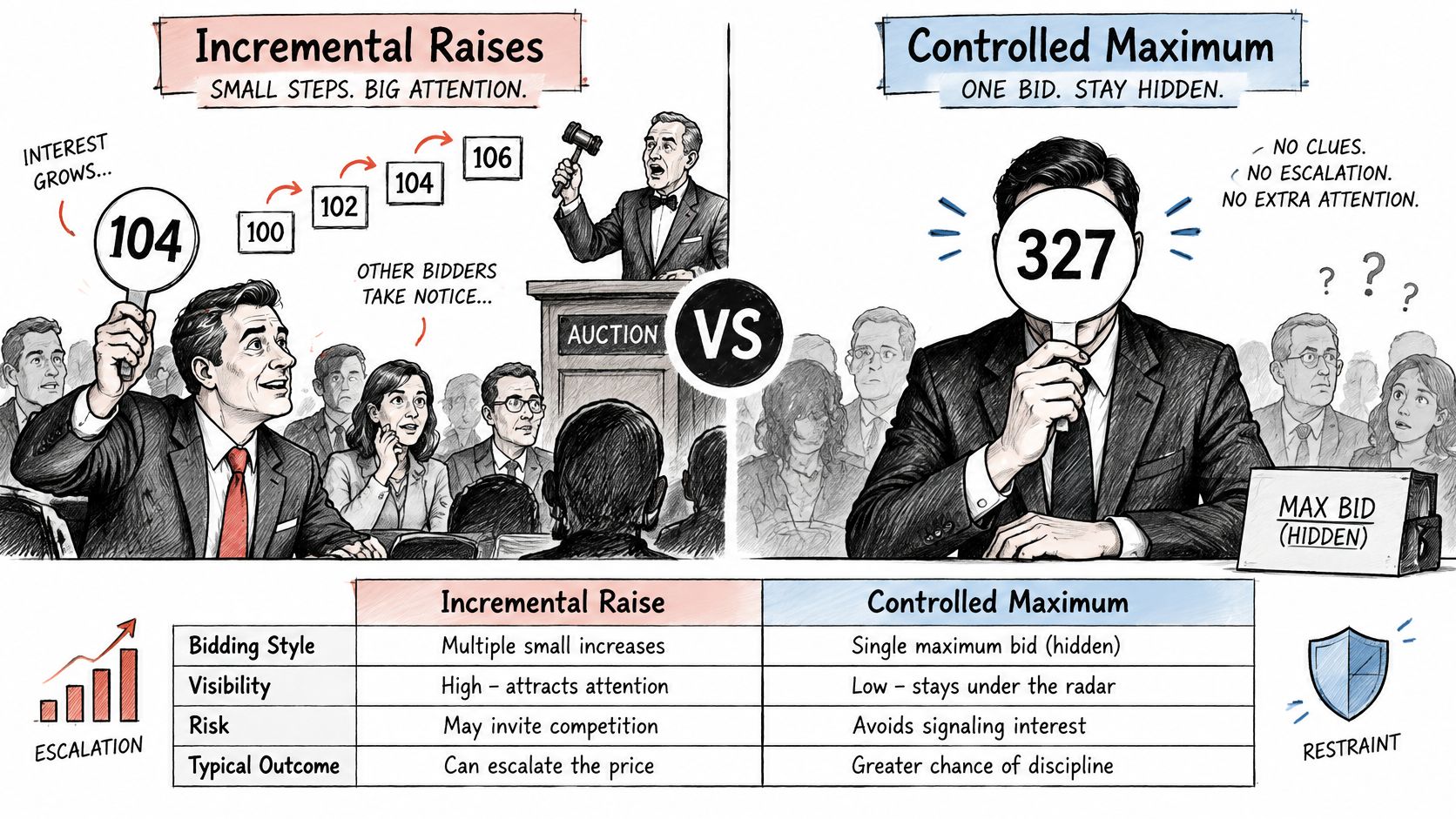
Bidding methods and the signal each sends
| Method | How it works | Signal to rivals | Best use |
|---|---|---|---|
| Incremental bidding | Raise by the minimum step each time | Shows continuing demand and gives rivals opportunities to answer | Limited price discovery on a thin lot, only when every bid is acceptable |
| Proxy maximum bid | Platform bids up to your cap | Keeps the exact cap undisclosed while showing accepted bids | Default when supported and your ceiling is settled |
| Probing | Small bids intended to find a rival's maximum | Signals interest without establishing fair value | Avoid as a competitive habit |
| Single late maximum | One entry near a hard close | Limits response time without publishing the cap beforehand | Hard-close lots, with allowance for transmission |
Learn the card category, not just the interface
The ACM-listed study of collectible-auction behavior found that category-specific experience was more useful than general auction experience for making winner's-curse adjustments. Knowing how to use a bidding screen isn't the same as knowing which sales compare with the lot in front of you.
For a Pokémon slab, examine the exact printing, language, grade, and visible presentation. Compare alternatives through the Pokémon singles buying guide, then investigate the sales evidence for your specific target. A collector who understands that card's alternatives has a stronger reason to stop than someone relying on the host's enthusiasm.
Treat probing cautiously. A rival's willingness to answer tells you about that rival's behavior, not whether the card will support your purchase price. Every exploratory bid is still a possible commitment to buy.
Apply the ceiling during a chase
Suppose a hypothetical slab opens at $300, then competing bids push it toward $450. Your worksheet permits the opening bid but not the later price after charges. Nothing about being the previous high bidder creates a reason to stretch.
When outbid, compare the next permitted bid with your worksheet, not with the amount you've already participated. If you discover a genuine listing error or new condition information, reassess conservatively. Another paddle going up isn't new information about the slab.
For a video companion, keep your own worksheet beside the bidding screen while reviewing the bidding process.
Submit deliberately, wait for acceptance, and check your status before clicking again. If the interface doesn't support proxy bids, use controlled manual bids without turning each response into permission to increase your limit.
Resisting Momentum and Stopping at Your Limit
The countdown resets, the chat gets louder, and a rival raises again. You're no longer comparing the card with recent sales. You're thinking about how frustrating it would be to lose something that felt almost yours.
That feeling isn't ownership. You haven't acquired an asset, and you haven't lost an investment when someone else wins. The danger is paying extra to end an uncomfortable competition.
A rival's enthusiasm is a reason to check your judgment, not increase your budget.
Recognize pressure without treating it as evidence
In the auction-behavior paper hosted by Berkeley Haas, approximately 28% of bids were classified as probing, while probing bidders achieved a 39% success rate. Repeated small increases can create plenty of activity without giving you a reliable valuation advantage.
Format matters too. An Experimental Economics clock-auction study reported that around 40% of bids in one clock format exceeded bidders' stated values by more than €1, while the rate remained below 20% in the other formats. That experiment doesn't predict your behavior, but it's a reason to take the bidding environment seriously rather than relying on willpower.
Keep these pressure signals visible while you participate.
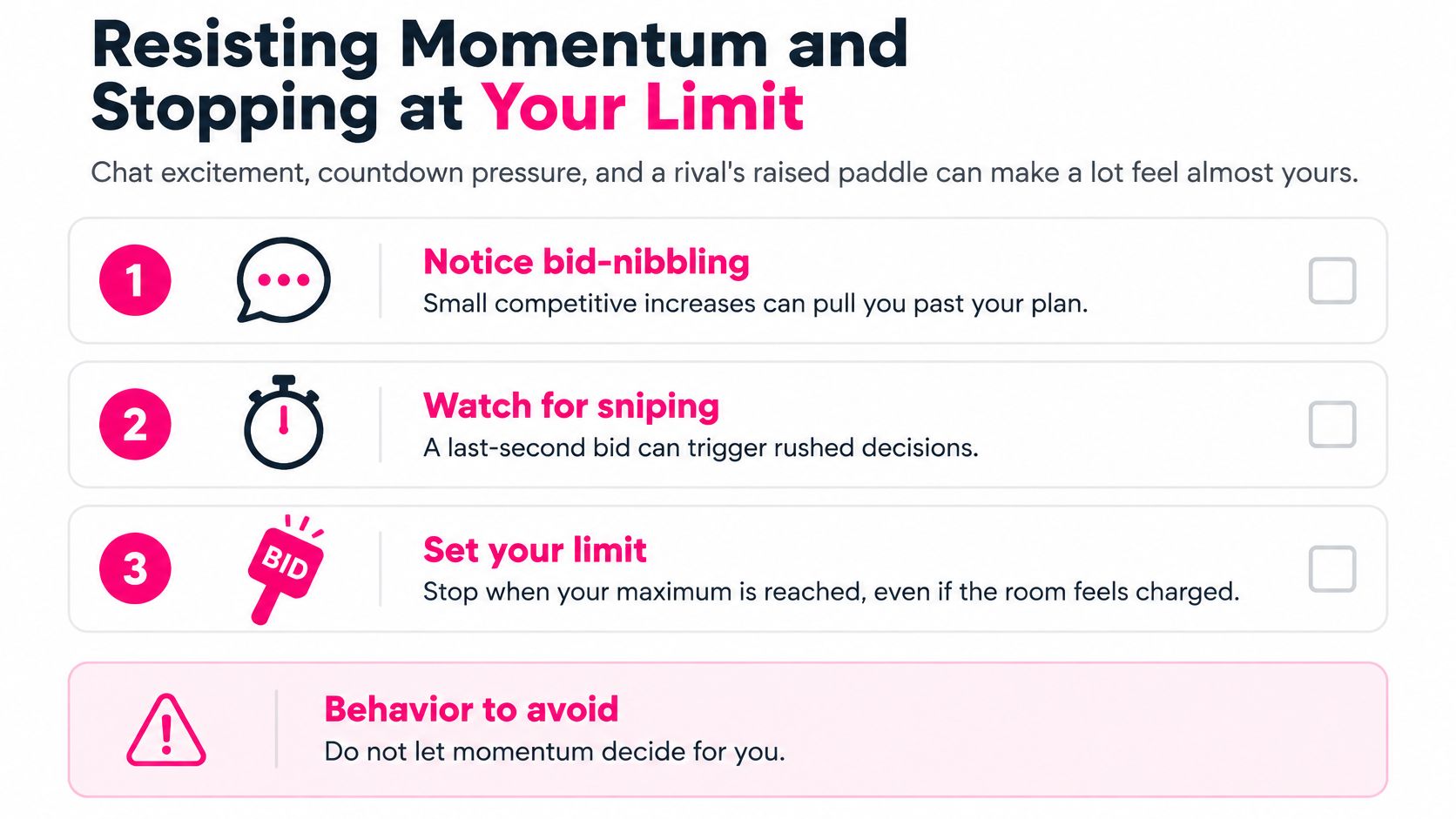
Make stopping an action, not an intention
Use a short procedure that leaves little room for bargaining with yourself:
- Write the lot limit on paper. Keep the maximum hammer and delivered ceiling visible, separate from the chat.
- Set a session budget. Include outstanding proxy bids as possible purchases, not just completed wins.
- Rank fallback lots. Choose alternatives you want and assign each its own limit.
- Exit when the next bid fails the test. Close the bidding panel or switch to the next watched lot rather than hovering over the button.
- Take a cooling-off pause. Let a full lot pass after a frustrating loss before considering another bid.
The pause is a practical recommendation, not a scientifically established waiting period. Its purpose is to stop you from using the next purchase to compensate for the previous result.
Keep a simple log with the lot, planned maximum, actual delivered cost or stopping price, outcome, and reason for bidding. Add a note when urgency came from chat, repeated extensions, or a familiar rival. Review whether your decisions followed the plan, not merely whether you won.
Protect Your Win From Payment to Delivery
The hammer settles the bidding, not the entire transaction. Your remaining job is to confirm that the invoice matches the terms, the card matches the lot, and the delivery arrangements protect the purchase.
Register payment and shipping details before the sale where the auction requires them. Read the payment deadline and accepted methods in advance so you aren't searching for bank details after winning.
Reconcile the invoice and the slab
Compare the invoice with the accepted hammer price, published premium, applicable tax, delivery charge, and any disclosed payment fee. If a line item doesn't match the terms, save the invoice and request clarification promptly. Don't assume that an unexpected charge is correct just because checkout calculated it.
Before paying, match the card name, grade, certification number, and label details with the listing. For a PSA slab, use PSA's certification lookup and compare the returned description with the actual photographs. A matching record is a useful check, not a substitute for inspecting the slab and seller's images.
All cards sold by Lucardio Collectibles are guaranteed to be authentic. Authentication addresses whether the card is genuine; it doesn't guarantee future resale proceeds or remove differences in centering, population, and buyer demand.
Keep a transaction folder containing:
- Listing evidence: Save the description, condition disclosures, and photographs.
- Identity details: Record the certification number and visible label information.
- Purchase records: Retain the accepted bid confirmation, terms, invoice, and payment receipt.
- Delivery records: Save dispatch notices, tracking details, and coverage documentation.
Confirm coverage before dispatch
We offer secure shipping with insured delivery. Review the insured-shipping guidance, and confirm what the coverage includes rather than assuming every invoice component is automatically reimbursable.
Compare the insured amount with the purchase documentation, including premium and fees where relevant to the coverage. Tracking shows movement through the delivery network; it doesn't by itself establish the insured value.
On arrival: Photograph the parcel before opening, preserve the packaging, and compare the delivered certification number with your purchase record.
If the outer packaging is damaged, document that before disturbing it. Photograph the slab's front, back, label, and any visible damage, then contact customer service promptly if the item doesn't match its description or appears damaged. Don't discard packing materials while a delivery issue is unresolved.
Finally, revisit current comparable sales before choosing to hold or resell. Your purchase price records what you paid, not what the next buyer must offer. Include future selling expenses and the time your money may remain tied up when deciding what to do next.
Confirm Your Ceiling Before You Raise a Paddle
Run a go-or-no-go check before committing. It should be short enough to use during a live room, but complete enough to catch a purchase that only looks affordable.
- Confirm the delivered total. Combine the proposed hammer, premium, applicable tax, and insured shipping. Compare that total with your written ceiling, leaving room for any unresolved charge.
- Confirm the closing format. Identify a hard close, extensions, auctioneer-controlled pacing, and any proxy-bidding option. Choose a submission method that fits those rules.
- Confirm the fallback. Name the alternative lot you'll pursue if this bid becomes too expensive, and check its separate limit.
If the purchase fits comfortably, bid. If winning requires exceeding your limit, leave it to someone else. An unspent budget preserves your ability to buy a better-priced alternative.
Practice the calculation on a listing you can inspect now, without submitting a bid. Record your decision and its reason, then compare it with the eventual result where available. Our Live Auctions feature, where users will bid live on rare collectibles, is listed as Coming Soon, so don't mistake preparation for an invitation to bid today.
The best bid is often the one you decide not to place.
Visit Lucardio Collectibles to explore authenticated cards and graded collectibles while building your own valuation shortlist. Subscribe for free to access free giveaways, early access to new drops, and collector updates, and bring a written ceiling when you're ready for a future auction.