

You've got a Pokémon card under a desk lamp, a Near Mint listing open on your phone, and a small white mark on the back edge that won't disappear when you change the angle. Is it ordinary wear, a factory flaw, or enough to make grading a poor bet?
A useful Pokémon card condition guide starts with the defect, not the price you hope to get. Inspect the card, describe what you can prove, and only then choose a marketplace label or consider professional grading.
Table of Contents
- Pokémon Card Condition Grades at a Glance
- How to Inspect a Card in Four Passes
- PSA Grades and the Criteria Behind Them
- Manufacturing Defects Versus Handling Damage
- Deciding With Borderline Cards
- Pitfalls That Cost Money and a Pre-Deal Routine
Pokémon Card Condition Grades at a Glance
| Condition label | Typical visible signs | Structural problems |
|---|---|---|
| Near Mint | Nearly unmarked surface, crisp corners, clean edges | None |
| Lightly Played | Minor edge wear, scuffs or scratches | No significant structural problems |
| Moderately Played | Noticeable edge and surface wear, scratching, bends or creases | Bends and creases possible |
| Heavily Played | Major wear, often with whitening, creasing and other faults | Multiple faults combined |
| Damaged | Tears, splitting, substantial border wear, foreign substances | Yes, affects structural integrity |
The TCGplayer conditioning overview distinguishes these marketplace labels through visible wear and structural condition. Defect-specific descriptions supplement the labels, rather than acting as a universal extra grade.
Near Mint doesn't mean flawless. It describes a card with minimal wear, not a promise that a professional grader will award the highest numerical grade. Start by checking whether the corners remain crisp and whether the surface is nearly unmarked, rather than asking whether the artwork looks attractive.
Lightly Played allows minor wear without significant structural trouble. Moderately Played moves beyond isolated marks into more noticeable wear, potentially including bends or creases. Don't use the same vague “played” description for both, because a buyer needs to know whether they're accepting a small cosmetic compromise or a clearly worn copy.
Heavily Played describes substantial wear, often across several areas. Damaged signals more serious problems, such as splitting or tears, that affect the card's integrity.
Marketplace labels aren't professional grades
A raw-card label is a condition description assigned by a seller. A PSA grade is a third-party numerical assessment attached to an encapsulated card. There isn't a reliable shortcut that converts one system directly into the other.
For selling, use the marketplace's own standards and support the label with photographs. For buying, read the description as a claim to verify, not a substitute for inspection.
Practical rule: Let the worst meaningful defect govern the description, not the card's most flattering angle.
Location matters. “Minor edge wear” leaves the buyer guessing; “whitening along the upper back edge, concentrated near the right corner” tells them exactly where to look.
How to Inspect a Card in Four Passes
Set up a clean, uncluttered work surface with a bright directional lamp, a magnifier, and a transparent ruler or calibrated image overlay. Keep food, drinks, abrasive cloths, and cleaning products away from the card.
Before taking it out for inspection, photograph its current presentation. Then document the unobstructed front, back, corners, and reflective angles as handling permits, so you retain a clear record of its condition.
The inspection sequence below separates measurement from surface examination.
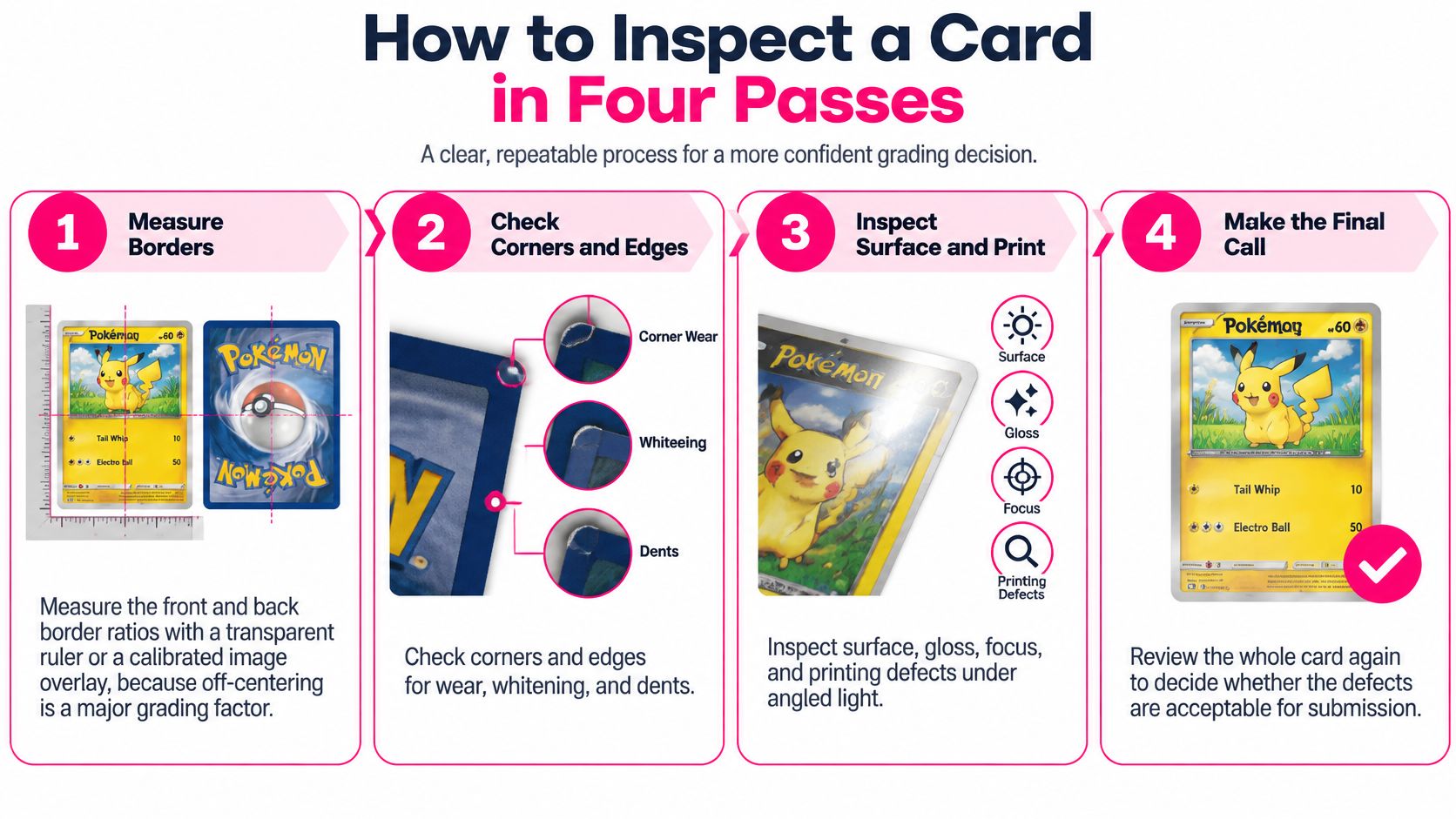
Follow the same inspection order
Measure centering. Compare opposing border widths on both faces using a transparent ruler held above the card or an image overlay calibrated to a straight photograph. Keep the camera square to the card, because perspective can make an even border appear tapered.
Inspect corners and edges. Use approximately 5–10× magnification, checking for whitening, chipping, rough cuts, and rounding; PSA's grading standards identify these areas alongside centering and surface as core condition attributes. Look at each corner from the face and edge rather than relying on the silhouette alone.
Move the reflection across the surface. Tilt the card slowly beneath a single bright light to reveal holo scratches, print lines, dents, indentations, stains, and interrupted gloss. Move the card through different orientations, because a mark can disappear when it aligns with the reflection.
Review the reverse and overall appearance. Examine the back independently before looking at the card as a whole. Decide whether you're seeing isolated defects or a broader pattern of wear, and check whether an attractive front has distracted you from a weaker reverse.
Don't average away a serious defect
A card with excellent centering and sharp corners can still have a submission-limiting indentation. Treat the most severe defect as a ceiling on your estimate, not a small deduction that stronger attributes can cancel.
An informal estimate is useful for screening, but it isn't a professional grade prediction. If you can't distinguish a reflection from a dent, record the uncertainty instead of assigning an optimistic number.
Don't clean, press, trim, or otherwise alter the card. Trying to improve its appearance can introduce damage, conceal its original condition, or create an altered-card problem.
Finish with a defect log that another person could follow. Write “back, lower edge, whitening near left corner” rather than “some whitening,” and retain the image that demonstrates it. Consistent orientation prevents confusion when you later compare photographs or prepare a listing.
PSA Grades and the Criteria Behind Them
Gem Mint sits at the top of the scale, not at the center of what sellers call clean. PSA assesses centering, corners, edges, surface, focus, gloss, and printing defects on its 1-to-10 scale, according to PSA's getting-started guidance.
Use this visual alongside the selected grade descriptions below.
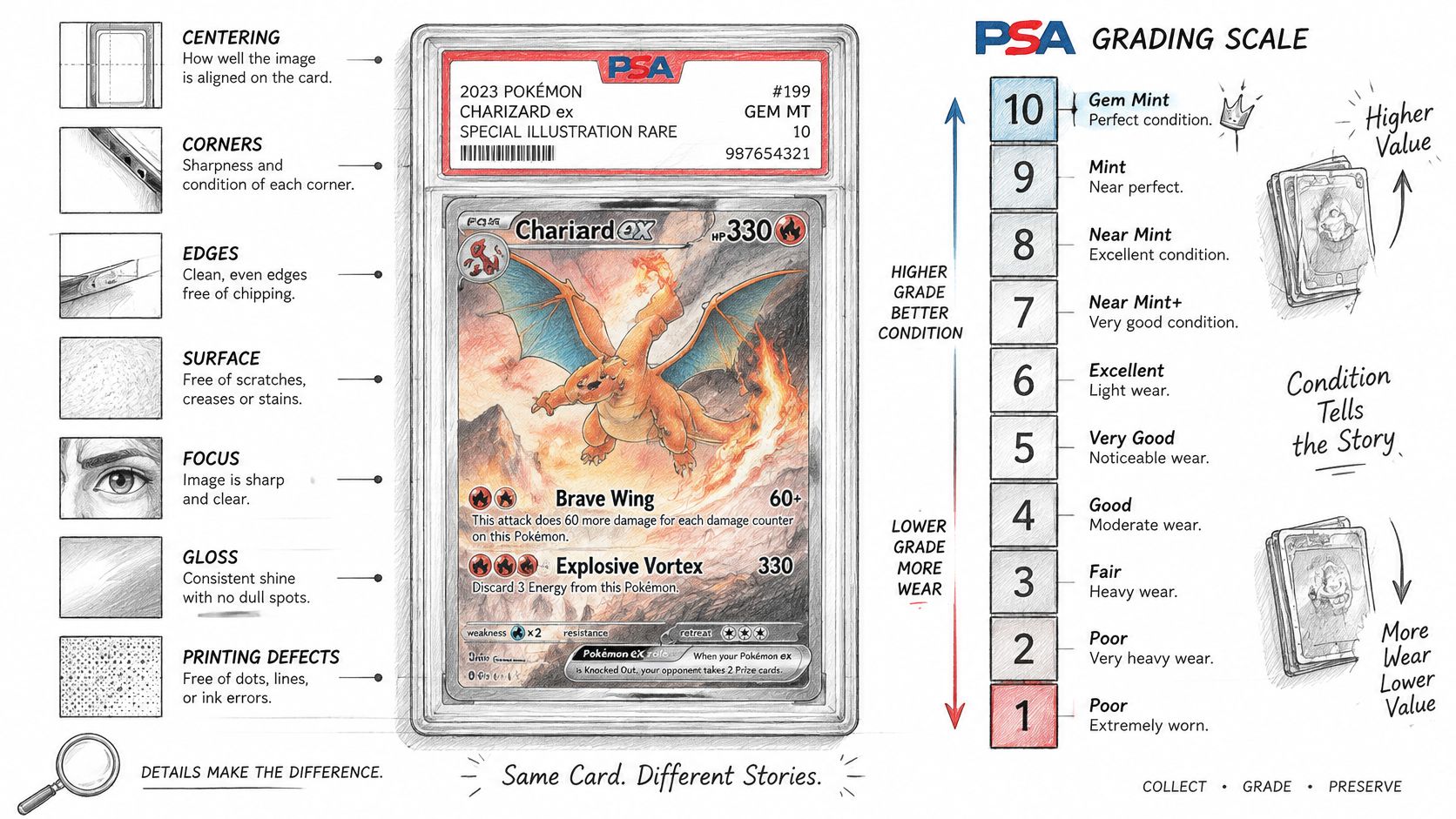
| PSA grade | What the card shows | Typical flaws allowed |
|---|---|---|
| PSA 10 (Gem Mint) | Essentially perfect, strong centering, pristine corners | Slight printing imperfection that doesn't reduce appeal |
| PSA 9 | Nearly perfect | One minor flaw, such as slight off-centering or a small printing imperfection |
| PSA 8 | Subtle fraying and slightly weaker centering | Minor printing defects |
| PSA 6 | Light scratches and more apparent fraying | Visible wear across the card |
| PSA 4 | Several scratches and noticeable off-centering | Multiple visible defects |
| PSA 1 | Severe, obvious damage | Major creasing, missing pieces, extreme discoloration or warping |
These are selected descriptions from PSA's guidance, not a points calculator. A listed flaw isn't an automatic entitlement to that grade, and the table shouldn't be read as permission to ignore the rest of the card.
Why apparently similar cards separate
The distinction near the top is often about the combination of defects and overall appeal. A slight printing imperfection may be acceptable at the highest level if it doesn't detract from the card, while another copy may have a small but more distracting issue.
Lower down, you're assessing increasingly visible deterioration rather than searching only for tiny imperfections. Scratches, fraying, and structural damage affect both the appearance and the likely condition range.
A clean-looking card is a candidate for closer examination, not a guaranteed grade.
Centering also requires context. PSA's historical guidance has used different front and reverse tolerances for different grades, so check the live, grade-specific standard before quoting a threshold. Don't apply a tolerance from a lower grade to a Gem Mint submission, or treat acceptable centering as proof that the surface qualifies.
For an additional visual explanation, watch the grading overview.
Two cards can look equally clean in a listing yet separate under examination because of reverse wear, focus, gloss, or a subtle surface fault. That's why a buyer should inspect the actual copy rather than assume all freshly opened cards have equivalent condition.
Manufacturing Defects Versus Handling Damage
A straight print line and a shallow dent can appear in the same photograph, but they require different descriptions. The first may originate in production; the second may involve physical deformation from handling or storage.
The GrailCharts Pokémon card condition guide emphasizes angled-light inspection for print lines and the importance of reverse-side whitening, scuffs, and indentations. Factory origin doesn't erase a visible flaw, and a seller shouldn't use it as a blanket exemption from condition assessment.
| Defect | Likely origin | Effect on condition | How to describe it |
|---|---|---|---|
| Print lines | Production, visible in the moving reflection under angled light | Minor examples may be tolerated; prominence matters | Identify suspected factory variance, location, and viewing angle |
| Factory roller marks | Production | Manufacturing surface flaw that still needs assessment | Note manufacturing variance rather than calling it wear |
| Dents and indentations | Handling or storage | Surface deformation that can lower the grade | State apparent depth, location, and whether the surface is broken |
| Back whitening and scuffs | Handling and sleeving friction | Must be assessed alongside front defects | Photograph the reverse and identify each affected area |
| Creases and bends | Handling or bending | Major limit on grade | Describe as structural damage, not merely surface wear |
| Edge chips and rough cuts | Handling or cutting | Affect edge and corner condition | Photograph under magnification and identify the location |
Use origin as a classification aid, not a diagnosis you force onto every mark.
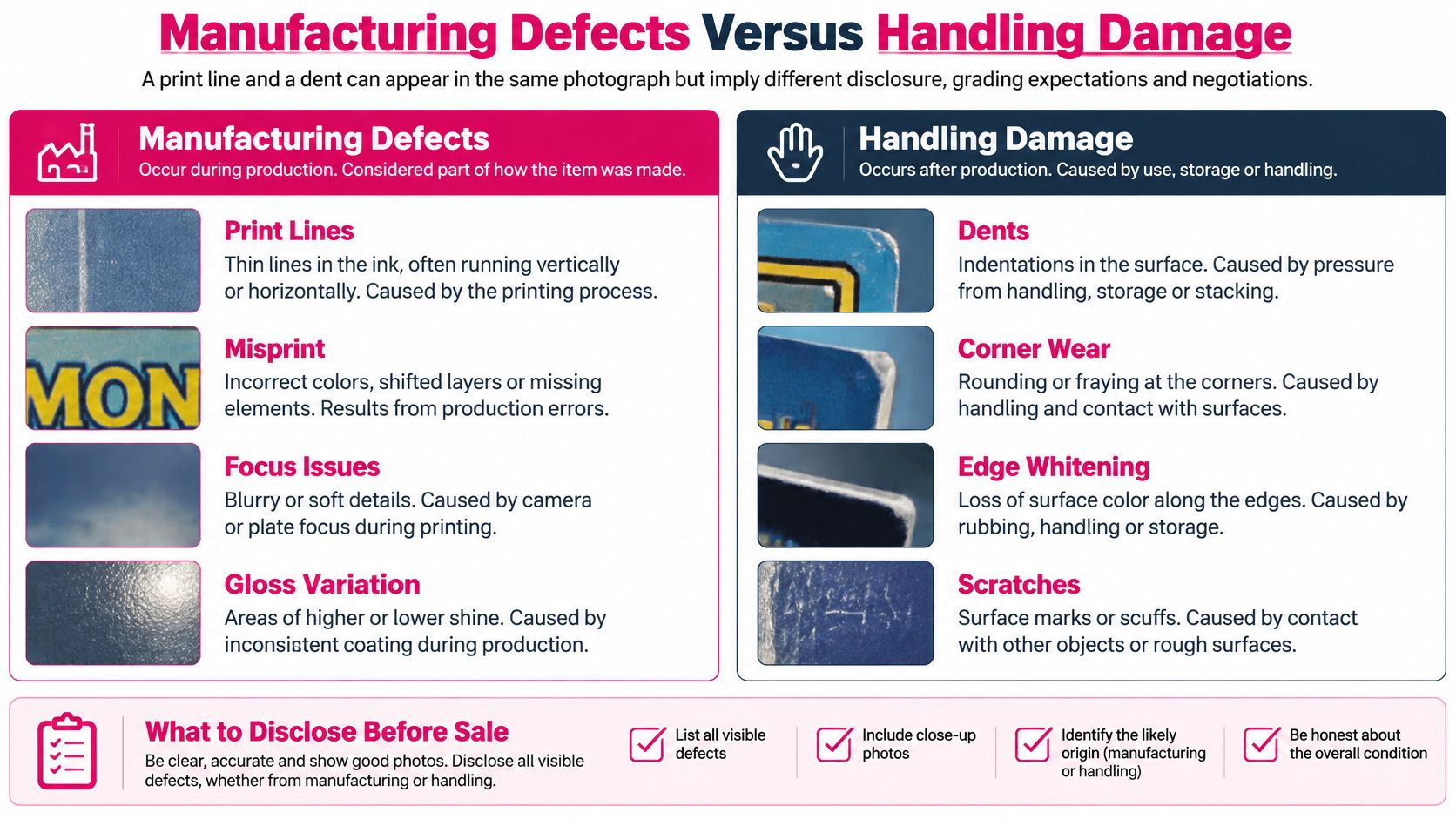
Classify what you can establish
- Manufacturing variance: Production-related features such as a print line or confidently identified roller mark.
- Handling wear: Abrasion, corner wear, scuffing, or edge whitening consistent with use and storage.
- Structural damage: Creases, splitting, dents, or other deformation of the card itself.
- Uncertainty: A visible anomaly whose origin or physical extent you can't establish.
A useful listing description combines defect, location, surface status, and confidence. For example: a fine line crosses the lower-left front and appears under angled light; no surface break is visible, but its origin remains uncertain pending another photograph.
That wording separates observation from inference. Don't call an ambiguous line a factory defect because that explanation sounds less serious.
Once documented, protect the card without trying to flatten or correct it. Choose suitable protection using our rigid card holder guide, and avoid repeatedly removing the card just to recreate the same photograph.
Deciding With Borderline Cards
Grading has expanded quickly: Licensing International's account of GemRate's figures reports more than 26.8 million cards graded in 2025, up 32% year over year, with Pokémon the largest category. That activity makes submission discipline important, but it doesn't establish that your particular card will sell profitably after grading.
Grade for a defensible outcome, not the best imaginable outcome. Compare the likely graded sale proceeds with the raw alternative after grading fees, shipping, insurance, selling costs, and the time your money will be tied up.
Use the decision factors below before choosing a submission.
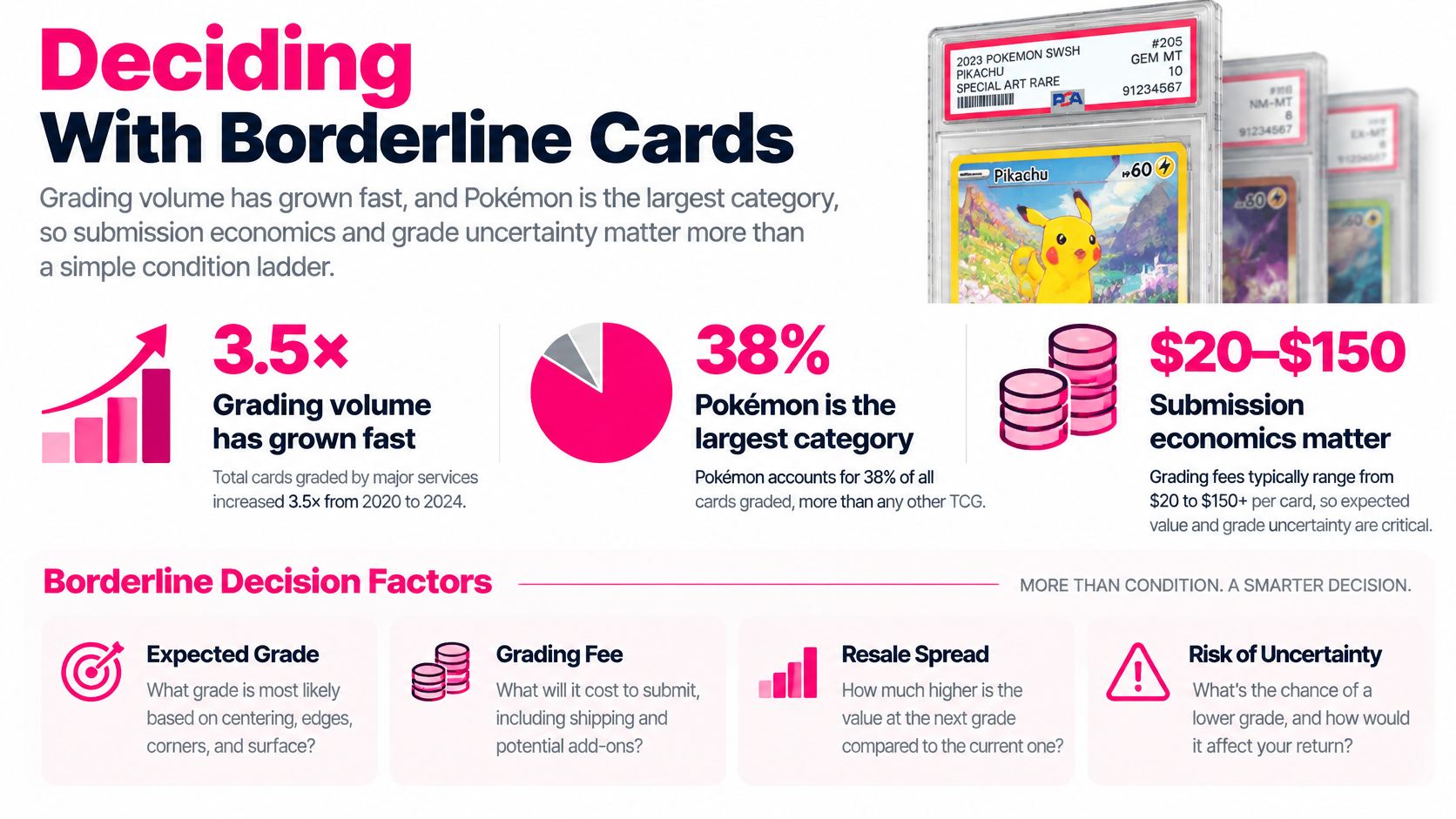
| Situation | Likely decision | Why |
|---|---|---|
| Clean-looking card, strong centering, high value | Grade it if conservative economics support it | The expected premium may cover fees and turnaround |
| Clean-looking card, low value | Sell raw with clear photos | Fees may exceed the premium |
| Visible print line only | Sell raw and disclose factory variance | Disclosure preserves accuracy without overstating the flaw |
| Dent, crease or back whitening | Sell raw and disclose the location | The defect can limit the grade and submission upside |
| Angled-light scratch you can't confirm | Document as uncertain before deciding | Ordinary photos or sleeves may conceal its extent |
These are financial screening defaults, not bans on grading. You might still encapsulate a worn card for authentication, preservation, or personal collecting, but that's a different objective from maximizing resale profit.
Make the lower outcome affordable
Say a card looks excellent in ordinary photographs but shows a faint scratch under directional light. Compare actual sold copies at plausible lower grades with raw copies that disclose comparable wear, rather than using only the highest-grade asking price.
If the submission only works financially when everything goes right, sell raw or keep it. If a conservative outcome still supports the costs, grading becomes more reasonable; our guide to whether PSA grading is worth it helps frame that comparison.
Before committing, write a single decision line: suspected surface scratch, front lower-left, sell raw with angled-light photographs. That statement keeps the decision tied to the card you possess.
Pitfalls That Cost Money and a Pre-Deal Routine
Money usually leaks at the decision point: a premium paid for a hoped-for grade, a listing priced from one front photo, a submission sent before the defect is classified.
A seller can be honest and still underspecify the card. A buyer can be careful and still compare the wrong copies. Put the evidence in writing before anyone relies on adjectives.
Mistakes to fix before money changes hands
Treating “looks mint” as submission advice. A clean listing photograph can show lighting, angle, and sleeve gloss rather than surface condition. Ask for an unobstructed angled-light view and a full reverse image before paying for the grade you hope exists.
Pricing Lightly Played as Near Mint. Two cards can look close in a casual photo and still belong in different wear bands once corners, edges, back whitening, and surface marks are counted. Use CardTrack's condition guide to keep the labels honest, then confirm value against sold copies of the same card rather than confident asking prices.
Writing “light play” without a defect map. Name the place and the behavior: front lower-left scratch visible at an angle, top-edge whitening on the back, small dent near the right border. If a line might be factory print or handling damage, say the origin is uncertain instead of letting “lightly played” sound safer than the card is.
Photographing only the front. Show front, back, all four corners, and both long edges. Keep orientation consistent across the set so a buyer can tell which edge belongs to which side without guessing from crops.
Matching the wrong comparison copy. Set, card number, language, variant, holo pattern, and condition all have to align before another sale means anything. Our trading card valuation guide keeps that comparison anchored to the card in front of you.
A wide gap between two prices does not prove either seller is wrong. First decide whether the copies are equivalent. Then decide whether the photographs support the stated condition.
The safest purchase is the card whose description you can verify.
Use a pre-deal record
Keep the record short enough that you will fill it in. One photograph without a location is weak; one location without a photograph invites argument later.
- Capture the card: Save front, back, corner, edge, and angled-light photographs before extra handling.
- Inspect in the same order: Centering, perimeter, surface, then overall impression.
- Separate factory variance from wear: Mark print lines, roller marks, and cutting quirks as uncertain until the light test supports a firmer call.
- Choose the label: Apply the marketplace standard to the most serious defect, not the average of the nicer areas.
- Record the evidence: Give each meaningful flaw a location, visibility note, and image reference.
- Choose the route: Weigh a disclosed raw sale against a conservative graded outcome after fees and waiting time.
- Reconcile the listing: Check that title, description, label, and photographs tell the same story.
Authenticity and condition answer different questions. Lucardio Collectibles guarantees the authenticity of the cards it sells and ships securely with insured delivery, but neither point chooses the condition label for you. That still comes down to what the photos prove.
Before your next bid, listing, or submission, pick one card and write its marketplace label, tentative grade range, and every defect location. If the sentence feels uncomfortable to publish, the deal is not ready.
We offer trading cards, sealed booster boxes, and PSA-graded cards, with authenticity guaranteed and secure, insured delivery. Visit Lucardio Collectibles to explore available cards, and use the inspection record to choose a copy that matches your condition standard and budget.