
You're standing in front of a shrink-wrapped booster box, wondering whether to open it for the chase card or leave it untouched. The box looks simple, but that plastic, the seams beneath it, the seller's history, and the product's supply all affect what you're buying. A careful collector doesn't treat every unopened box as an investment. They ask a more useful question: what kind of sealed product is this, and what risks come with holding it?
“Seal pack” is also a confusing search term. It can mean a single unopened foil pack, a sealed booster box, a factory case, or a tin with fixed contents. Those formats may share an unopened appearance, but they don't carry the same scarcity, liquidity, authentication challenges, or storage needs.
Table of Contents
- What “Seal Pack” Actually Means in the Card Hobby
- How Sealed Product Became a Collectible Asset
- Why Sealed Packs Hold and Sometimes Lose Value
- Verifying a Sealed Pack and Spotting Tampering
- Buying Sealed Packs Versus Singles and Live Breaks
- Common Misconceptions About Sealed Product
- A Practical Checklist Before You Buy or Break
What “Seal Pack” Actually Means in the Card Hobby
A sealed product is merchandise still protected by its original manufacturer packaging, with no contents removed, replaced, or accessed. That can apply at several levels, from one foil wrapper to a distributor case. The important claim isn't just “nobody opened this box.” It's that the original packaging and factory seal remain intact, with a credible chain of custody behind them. TCG Econ's explanation of sealed product describes this distinction clearly, because even a small breach or third-party reseal can change how the item is treated during resale or authentication.
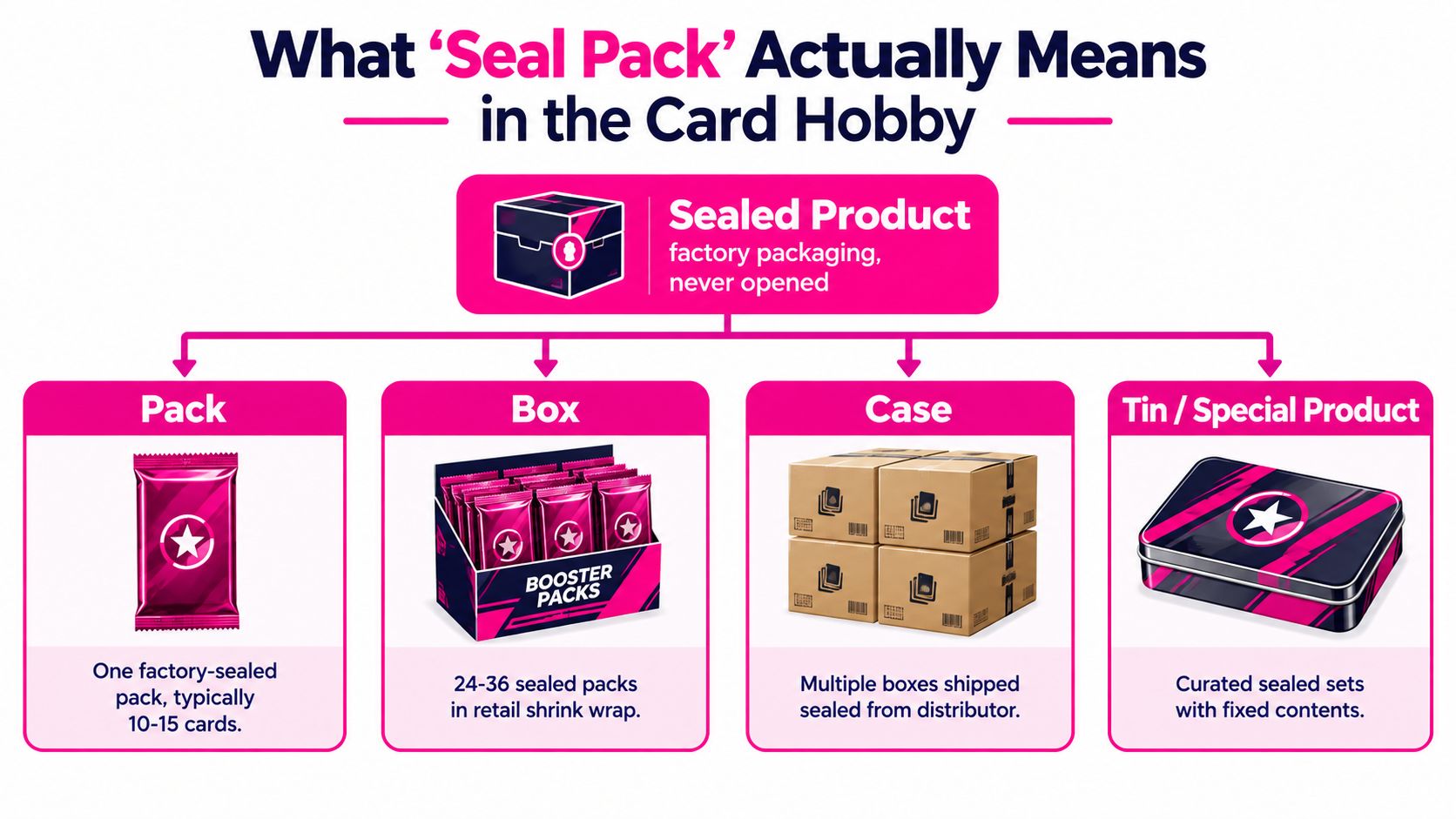
Four formats buyers commonly meet
- Single pack: One factory-sealed wrapper containing the original cards and inserts. Older wax, cello, and modern foil packs each have their own construction and tampering risks.
- Booster box: A factory-sealed retail or hobby box containing multiple packs. Hobby and retail versions may differ in configuration, distribution, and expected contents, so “sealed” doesn't make them interchangeable.
- Factory case: Several boxes shipped together in distributor packaging. A sealed case can offer stronger provenance, but its size also raises shipping, storage, and resale considerations.
- Tin or special product: A sealed container with a defined assortment, such as packs, promotional cards, or accessories. A tin may be factory sealed even though its contents aren't identical to a loose booster pack.
Most buyers searching for a seal pack are comparing boxes. That's where confusion starts. A sealed booster box preserves the original product configuration, but it doesn't guarantee a particular card, grade, or future selling price. It preserves the opportunity to open the product under its original packaging conditions.
Practical rule: Treat “sealed” as a condition statement, not a value guarantee.
The factory wrapper matters because opening, searching, weighing, or resealing can destroy confidence in the original odds. If you're comparing Pokémon products, a guide such as Lucardio's overview of Pokémon partner packs can help you understand why packaging format and product identity should be checked before price.
How Sealed Product Became a Collectible Asset
For much of the card hobby's early history, packs were designed to be opened. The wrapper protected the cards during retail handling and then became rubbish. That changed as packaging itself became more durable and collectors began to understand that an untouched pack could preserve something an opened card could not: the original uncertainty of the product.
The late 1980s and early 1990s were a key transition. The hobby moved from wax-coated paper packs toward chromium foil packaging, with one exhibit identifying 1989 as the material-change point and describing the era as effectively finished by 1993. The Junk Wax Museum's account of the end of the wax pack also identifies Upper Deck's March 1989 launch as a major milestone. Its packaging emphasized tighter production control and tamper resistance, helping collectors see the wrapper as part of the product rather than disposable protection.
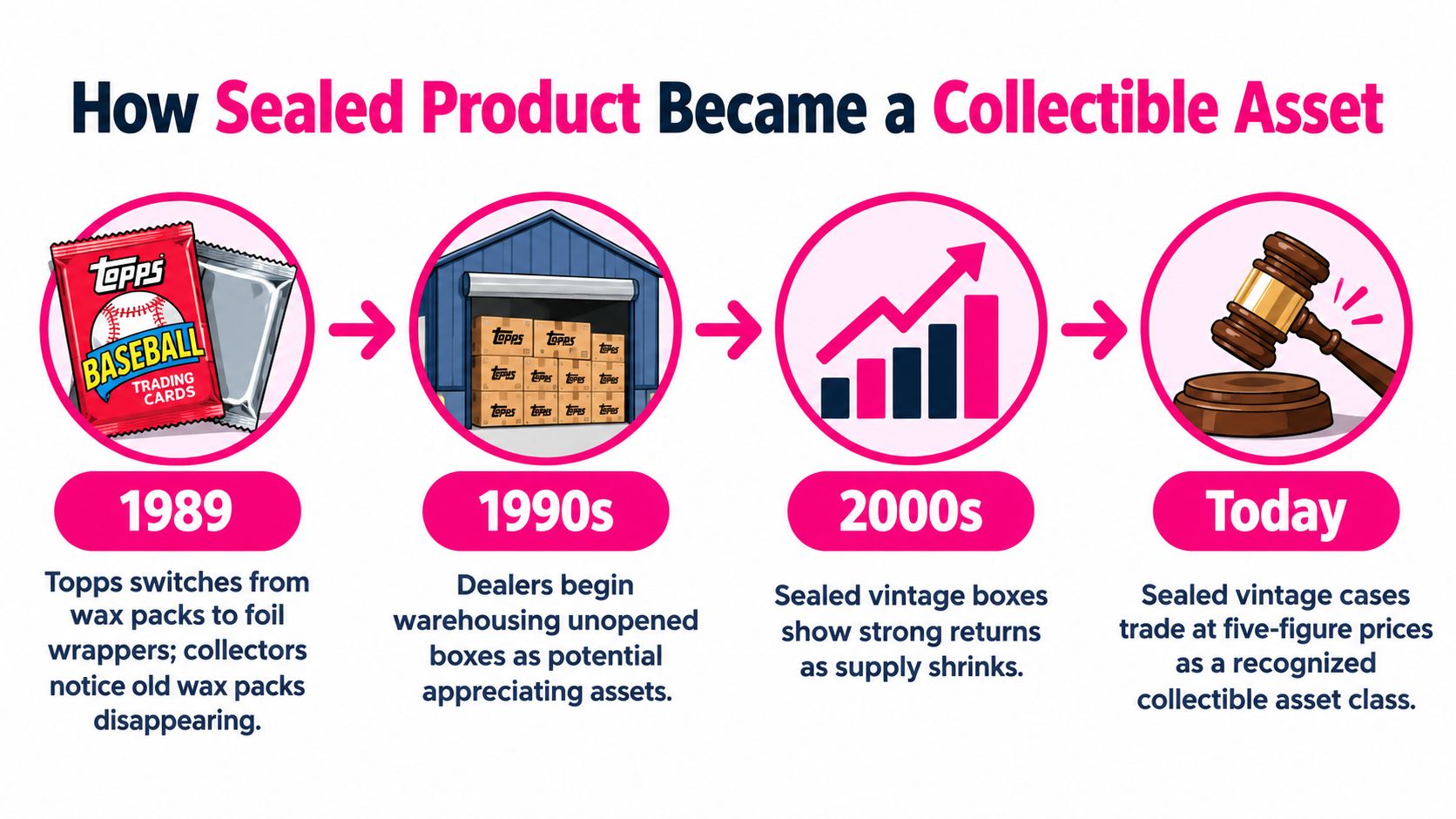
Scarcity often begins with ordinary behavior
The most dramatic examples are older packs that survived only because someone forgot to open them. Packs from the 1950s were usually opened immediately, so very few remained sealed by accident. That creates a different scarcity profile from a modern product that was printed, distributed, and stored in quantity.
The secondary market shows how far this can go. Sports Illustrated reported that a sealed 1952 Topps pack graded PSA 7 sold for $91,000 in September 2024, while another sold for $105,000 in 2021. A bundle of eight sealed packs sold for $873,000 in 2023. Those figures describe exceptional vintage material, not a normal expectation for every unopened box. Sports Illustrated's sealed-pack market coverage also contrasted original retail prices with later bids, including 1978 Topps football packs that originally sold for 20 cents and later traded for $80 to $90.
The same report illustrates why sealed scarcity can exceed card scarcity. PSA population data cited there showed 394 graded 1986 Topps wax packs compared with 68,404 graded 1986 Topps baseball cards. For 1952 Topps, it cited 30 PSA-graded wax packs against 317,524 card submissions. The wrapper survives in far smaller numbers because collectors normally destroyed it by opening the pack.
A modern sealed box can still become desirable, but age alone isn't enough. Product identity, demand, print quantity, condition, and the number of unopened examples that remain available all matter. The long-term story is compelling, but it leads to a less comfortable question: which sealed products deserve that treatment, and which merely remain unopened inventory?
Why Sealed Packs Hold and Sometimes Lose Value
Sealed product value comes from several forces working together, not from age by itself. The first is survivorship. Every box someone opens removes one unopened example from the available supply, while collectors who continue holding reduce the number available to buyers.
The second is demand depth. A product linked to a durable character, sport, franchise, or player has more potential buyers than a set remembered only by a narrow group. The third is optionality. An unopened product offers a future opening experience, a chance at a chase card, or a resale asset, while an opened product has already resolved that uncertainty.
The market shows wide dispersion
The historical evidence is striking, but it doesn't describe a uniform asset class. Sports Illustrated reported that 1978 Topps football packs, originally priced at 20 cents, later traded for $80 to $90. It also reported bids of $35 for an unopened 1986 Topps baseball cello pack that had cost 59 cents, and $70 for the football version that had cost 69 cents. These examples show substantial price movement, but they don't establish a standard return for sealed products.
Recent hobby reporting makes the dispersion even more important. A 2026 mid-year hobby report stated that sealed product was up 37% year to date, ahead of graded cards at 32%. Another 2026 guide described multi-year outcomes ranging from products that barely outperformed cash to an example set returning about 5% annualized over five years, while Evolving Skies rose dramatically. The figures come from the State of the Hobby 2026 mid-year report, and the contrast is the key lesson: category-level strength can hide major product-level differences.
| Sealed Product | Era | Approx. Print Run | Long-Term Price Behavior |
|---|---|---|---|
| 1952 Topps sealed packs | Vintage | Not provided | Exceptional auction prices, with very few graded examples |
| 1978 Topps football packs | Vintage | Not provided | Rose from an original 20-cent retail price to later trades of $80 to $90 |
| 1986 Topps cello packs | Modern vintage | Not provided | Rose from sub-dollar original prices to later bids of $35 and $70 |
| Evolving Skies sealed product | Modern | Not provided | Described in 2026 guidance as having surged dramatically |
| A multi-year example cited in 2026 guidance | Modern | Not provided | Returned about 5% annualized over five years |
Why some products lag
Reprint risk can interrupt a scarcity story. If a manufacturer adds supply after collectors have begun treating a product as scarce, the expected balance between demand and inventory changes. Overproduction creates a similar problem. The 1990s produced enormous quantities of some cards and packs, leaving many unopened examples available long after initial excitement faded.
Liquidity creates another risk. A product can have a high asking price without having a deep group of ready buyers. A collector may need to accept a lower price, wait longer, or sell through a channel with fees and shipping exposure.
The sensible ranking is therefore not “sealed versus opened.” It is blue-chip sealed, established but sensitive sealed, and speculative sealed. A buyer should assess print-run risk, reprint risk, demand depth, packaging integrity, and likely exit routes before calling any product an investment.
Verifying a Sealed Pack and Spotting Tampering
A seller's description is only one part of the evidence. Authenticity rests on the physical package and the product's history, so inspect both whenever the price justifies the effort.
Start with the outer wrap. On a modern booster box, look for clear shrink, consistent tension, clean folds, and factory-placed seams. Wrinkling concentrated around an edge, a cloudy or uneven heat mark, puckering, a second layer of plastic, or adhesive residue deserves closer attention. None of these signs proves tampering alone, but several together should stop an impulse purchase.
Older products require different checks. Cello strips should have consistent factory perforations. Wax packs should show even crimping rather than disturbed or reconstructed edges. Vintage packaging may naturally show age, so the question isn't whether the item looks new. It's whether the wear is consistent with genuine storage rather than selective manipulation.
Compare the whole package, not one detail
| Feature | Intact Factory Seal | Tampered or Resealed |
|---|---|---|
| Shrink wrap | Even tension, consistent folds, clean factory seams | Wrinkles, puckering, loose areas, or overlapping layers |
| Perforations | Regular spacing and undisturbed cuts | Cut, re-glued, or irregular sections |
| Crimp seams | Consistent pressure and pattern | Flattened, reopened, or mismatched crimping |
| Box surface | Normal storage wear distributed across the package | Damage concentrated near an opening or repair |
| Stickers and labels | Original placement and clean adhesion | Lifted edges, replacement stickers, or residue |
| Provenance | Receipt, known seller history, or sealed-case origin | Vague history and refusal to provide close photos |
A case label, UPC, or SKU can help you compare the product with manufacturer and distributor records, but matching information doesn't prove the contents remained untouched. Chain-of-custody evidence is stronger when it includes an original sealed-case receipt, a credible breaker designation, or a tamper-evident security sticker with a traceable source.
Before you buy: Ask for close photos of every seam, corner, label, and opening. If the seller won't provide them, treat that refusal as information.
Packaging damage also affects returns and resale. A buyer should understand whether the marketplace defines the item as a sealed pack, sealed box, or another unopened product category. Lucardio's guide to a box of Pokémon cards is one useful reference point for examining shrink, seal lines, and visible tampering before committing to a purchase.
Buying Sealed Packs Versus Singles and Live Breaks
The right format depends on what you want from the purchase. A sealed box suits a collector who values delayed optionality, storage, and the possibility of selling the unopened product later. A single suits someone who wants a particular card now. A live break suits someone paying for participation and immediate entertainment rather than retaining sealed upside.
Consider a $100 hobby box. Opening it may produce cards worth more or less than the purchase price, but the result depends on the set, the hit distribution, and the condition of what you pull. Spending that same amount on targeted singles can secure a specific chase card without paying for unwanted cards, though singles require closer attention to centering, surface, corners, seller reputation, and current demand.
Match the format to the objective
| Factor | Sealed Packs | Singles | Live Breaks |
|---|---|---|---|
| Main purpose | Hold, collect, or open later | Own a specific card | Participate in an opening event |
| Capital use | Money remains tied up in unopened inventory | Money targets known cards | Lower entry can buy a share of an opening |
| Liquidity | Depends on product demand and buyer confidence | Often clearer for desirable cards | Usually ends with the break result |
| Storage | Requires protected, stable storage | Smaller footprint | Depends on the cards received |
| Risk | Reseals, reprints, supply, and slow exits | Condition, authenticity, and market timing | Outcome variance and limited control |
| Experience | Delayed anticipation or future opening | Immediate ownership | Immediate action and community engagement |
Sealed product also requires patience. A single can be listed when you're ready to sell, while a box may need careful packaging, a buyer who trusts the seal, and a price that leaves room for fees and shipping.
For collectors focused on Pokémon products, Lucardio's Pokémon Crown Zenith ETB resource can help frame the difference between a sealed special product and buying individual cards from its contents. The decision isn't about which format is universally superior. It's about whether your goal is ownership, access, entertainment, or a future exit.
Common Misconceptions About Sealed Product
The most expensive mistake is treating the word “sealed” as a complete investment thesis. It only tells you that the packaging is presented as unopened. It doesn't tell you whether supply is scarce, demand is durable, the product can be resold easily, or the seal is authentic.
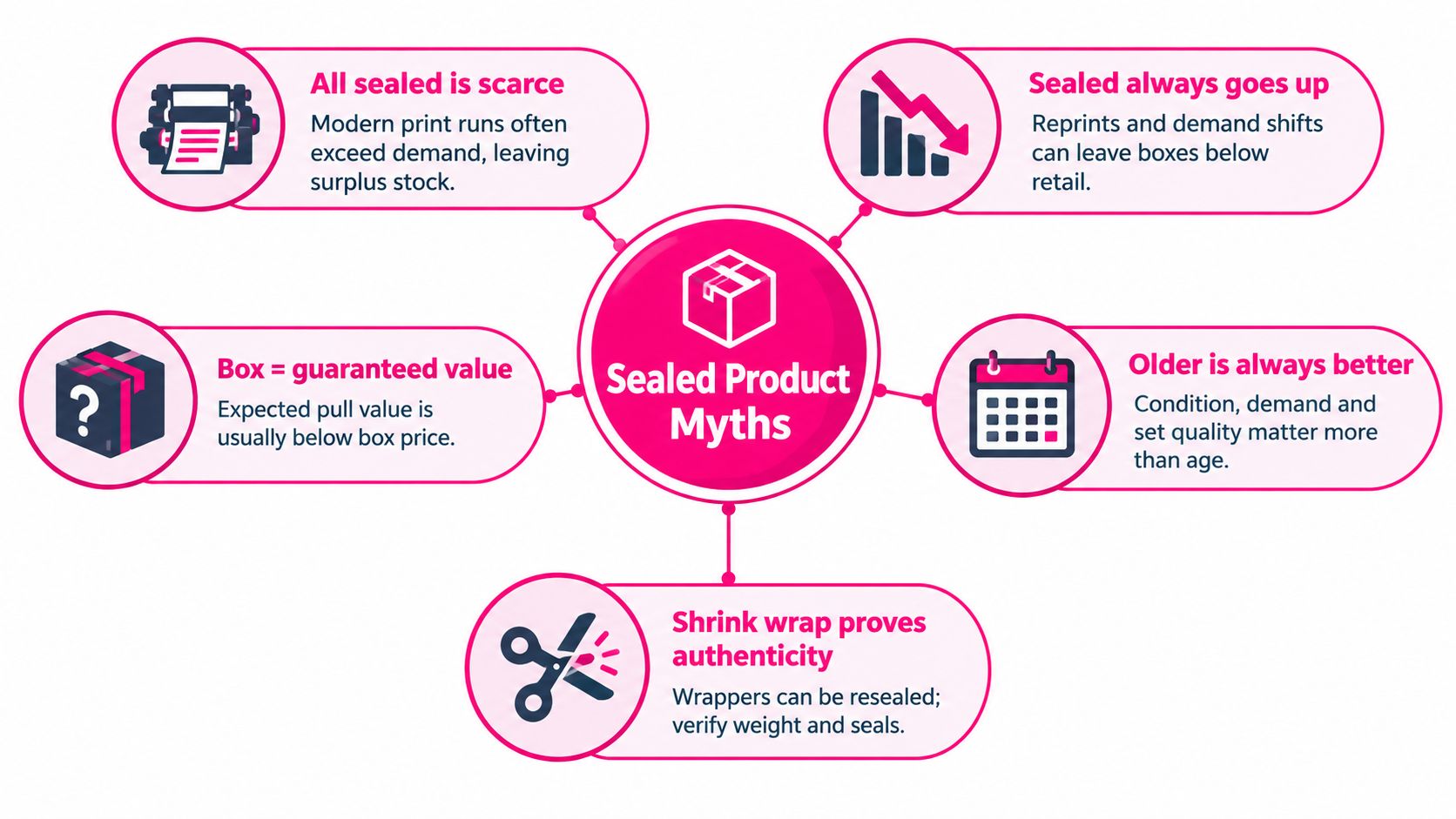
Myth one, all sealed product is scarce
Modern products can remain widely available for a long time. If manufacturers print more than collectors want to hold, unopened inventory may sit below retail or fail to appreciate. Scarcity is a relationship between surviving supply and active demand, not a reward automatically granted by shrink wrap.
Myth two, older always means better
Age helps only when the product also has demand, recognizable cards, and acceptable condition. A damaged or resealed older box may be less attractive than a newer product with strong demand and excellent provenance. Vintage status increases the need for inspection rather than removing it.
Myth three, sealed means fraud-proof
A factory-looking wrapper can still be manipulated. Reseal risk is particularly important for products where valuable cards can be searched, removed, or replaced. Buyers should compare seams, crimping, wrap tension, labels, and seller history rather than relying on a single visual cue.
Myth four, break-even is a stable number
Your original purchase price is only one reference point. Reprint rumors, changes in player or franchise demand, marketplace fees, insurance, and shipping can all affect the price required to leave with a profit. A box that looks above cost on a listing page may not produce that result after a real sale.
Myth five, storage is free
Storage protects the asset, but it takes space and discipline. Pressure, moisture, sunlight, and rough handling can damage the box or seal, while a larger collection creates more insurance and inventory-management exposure.
A sealed product deserves a ranking, not a reflex. Ask whether it has durable demand, constrained supply, trustworthy packaging, and a realistic exit path.
Before buying, write down the holding period you can tolerate and the condition that would make you sell. If you can't explain why demand might remain strong, why supply may tighten, and who your future buyer could be, you're speculating rather than managing a collectible position.
A Practical Checklist Before You Buy or Break
Use a repeatable routine before you click “buy,” hand over cash at a card show, or decide to open a box you've held for years. The routine can't eliminate risk, but it can stop excitement from replacing evidence.
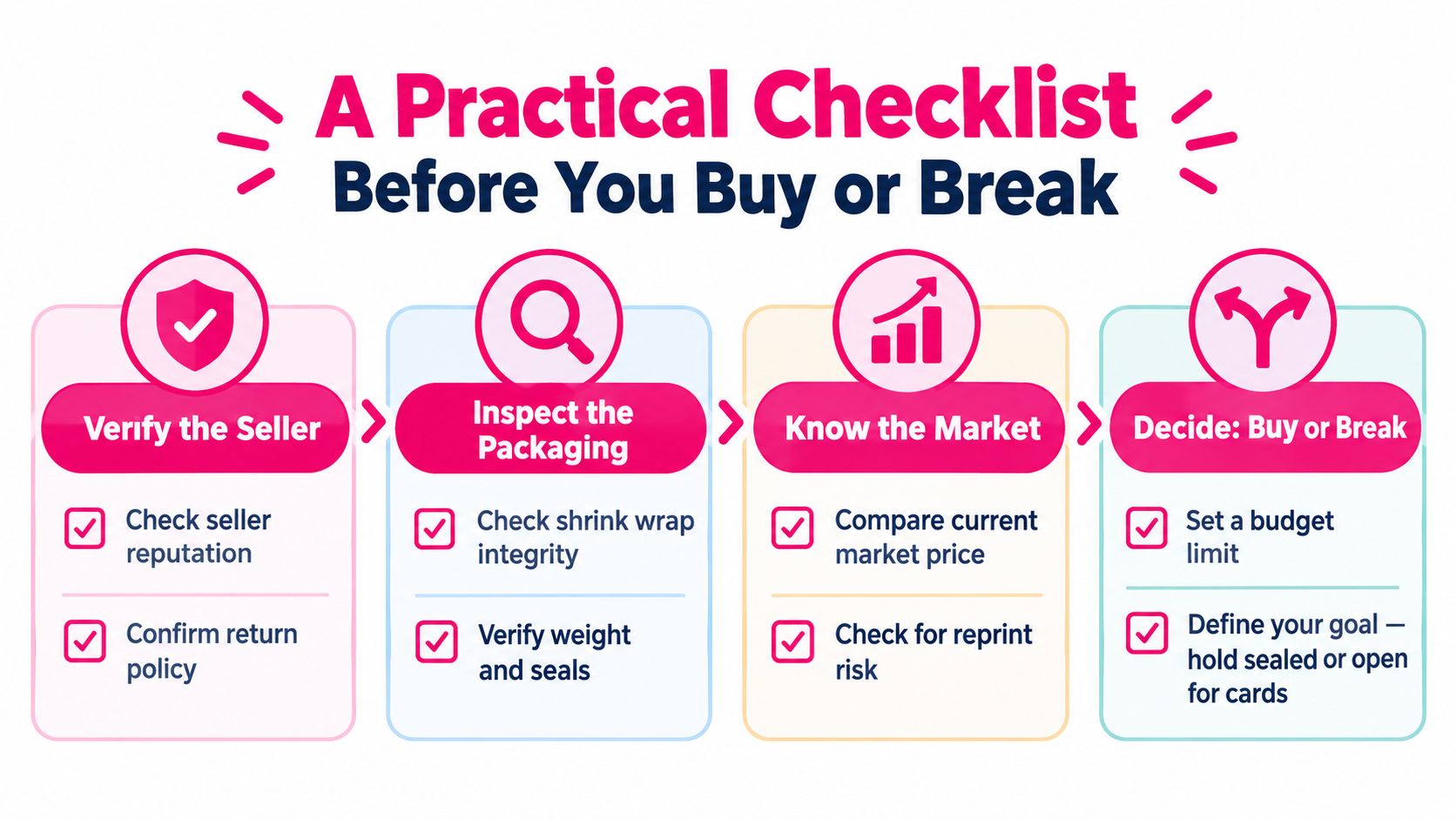
Verify the seller and history
Check feedback, transaction history, return terms, and whether the seller answers specific questions about provenance. Ask where the product came from and request photos rather than accepting a generic stock image. For higher-value inventory, look for documentation connecting the item to a distributor, sealed case, established breaker, or prior authenticated sale.
Inspect before money changes hands
Review every edge and corner. Compare the UPC, SKU, product name, and configuration across available manufacturer records. When feasible, weigh the box as one signal among several. Weight alone can't authenticate a product, but an unusual result can justify deeper inspection.
Don't ignore the shipping plan. High-value sealed products should be immobilized inside a box-in-box package with roughly 1 to 2 inches of clearance filled by cushioning, and the contents shouldn't move during a shake test, according to TCG Unite's handling and packaging guidance. Store the product in a dry, stable place away from pressure and direct sunlight. Excess heat can warp foil and plastic, while moisture can compromise the packaging and collectible condition.
Decide whether you're buying or breaking
Set a budget limit before the product arrives. Then write down your objective:
- Hold sealed: Define the condition you'll preserve and the price or event that would make you sell.
- Open for cards: Accept that the sealed premium disappears once you break the factory packaging.
- Sell quickly: Estimate fees, packing materials, insurance, and the time required to find a buyer.
- Use a live break: Treat the purchase as entertainment and participation, not as retained sealed inventory.
A final check is simple: if you can't explain the product's demand, provenance, condition, and exit route in a few sentences, pause. Careful collectors don't need certainty before buying, but they do need to know which uncertainty they're accepting.
Lucardio Collectibles offers authenticated singles, sealed products, PSA-graded items, live breaks, auctions, and insured fulfillment for collectors comparing different ways to buy and manage inventory. Visit Lucardio Collectibles to review the platform and consider whether its sealed and authenticated options fit your buying plan.