
The gap between total production and a record-setting sale is stark: one PSA 10 Pikachu Illustrator sold at auction for approximately $16.5 million, a record for any trading card as of 2026, while Pokémon cards have been printed by the billion. Most individual cards are far less valuable.
That gap helps explain why broad claims about popularity or underprinting fall short. Prices depend on the supply of a particular card in a particular condition, alongside the number of buyers competing for it. Overall production can be enormous while a specific chase card remains scarce.
Table of Contents
- The Short Answer Behind Pokemon Card Prices
- How Demand Surged Past Supply
- Why Abundant Cards Still Feel Scarce
- How Condition and Grading Multiply Value
- Why Landmark Cards Sell for Millions
- Telling Durable Scarcity From Hype
- Protect Your Purchase Before You Pay a Premium
The Short Answer Behind Pokemon Card Prices
Pokemon cards are expensive because a large, global buyer pool competes for a small set of specific cards whose supply can't expand. Total production isn't the constraint. What's scarce is a contest promo from the late 1990s, a base set card that survived two decades without a scratch, or a modern chase card from a print run that ended before demand peaked.
Five forces separate the handful of cards that cost thousands from the ones that cost cents. The table below sets out each force with the headline number that shows its scale.
| Price Driver | What It Does to Price | Headline Evidence |
|---|---|---|
| Demand surge | Many motivated buyers compete for the same copies | eBay Pokemon card GMV up 536% in H1 2021; fastest-growing toy property in eight European markets, +106% from 2020 |
| Structural scarcity | Restricted originals and promos cap high-value supply | 1998 Pikachu Illustrator: only a few dozen believed to exist; PSA 10 auction about $16.5 million |
| Condition premium | Only top grades command top prices | 1st Edition Charizard: PSA 9 about $64,001 vs PSA 10 about $1.38 million; 123 PSA 10 copies |
| Landmark provenance | Contest and promo history sets record benchmarks | PSA 10 Pikachu Illustrator private sale of $5,275,000 on July 22, 2021 |
| Speculation and attention | Online hype can lift short-term prices without making the hobby scarce | Of 2,137 cards from 12 English sets (Jan 2025 to Sep 2026), only 45 had a raw median of at least $100; median standalone card $2.93 |
How the Five Drivers Stack
The drivers stack rather than compete. Structural scarcity sets the ceiling on what any copy of a card can be worth. Demand decides how close to that ceiling the market trades. Condition then sorts individual copies of the same card into wildly different prices, which is why two 1999 Charizards can be listed within a day of each other and be worth four figures apart.
Attention and speculation sit on top, and they move fastest in both directions. A price driven by a viral clip can retreat once the clip is forgotten. A price driven by a fixed supply of authenticated copies doesn't retreat, because nothing about the supply changed.
Read any row alone and the logic breaks. A rare card nobody wants is cheap. A common card everyone wants is only briefly expensive, because supply catches up. Only a card that combines restricted supply, sustained demand, and verified condition holds a premium through a full market cycle.
Every figure in that table traces to a published record and is unpacked with its citation where each driver is examined. The order runs from market-wide forces, to the supply structure underneath them, to the condition and provenance that price an individual slab, and finally to the checks that keep a premium from becoming a loss.
How Demand Surged Past Supply
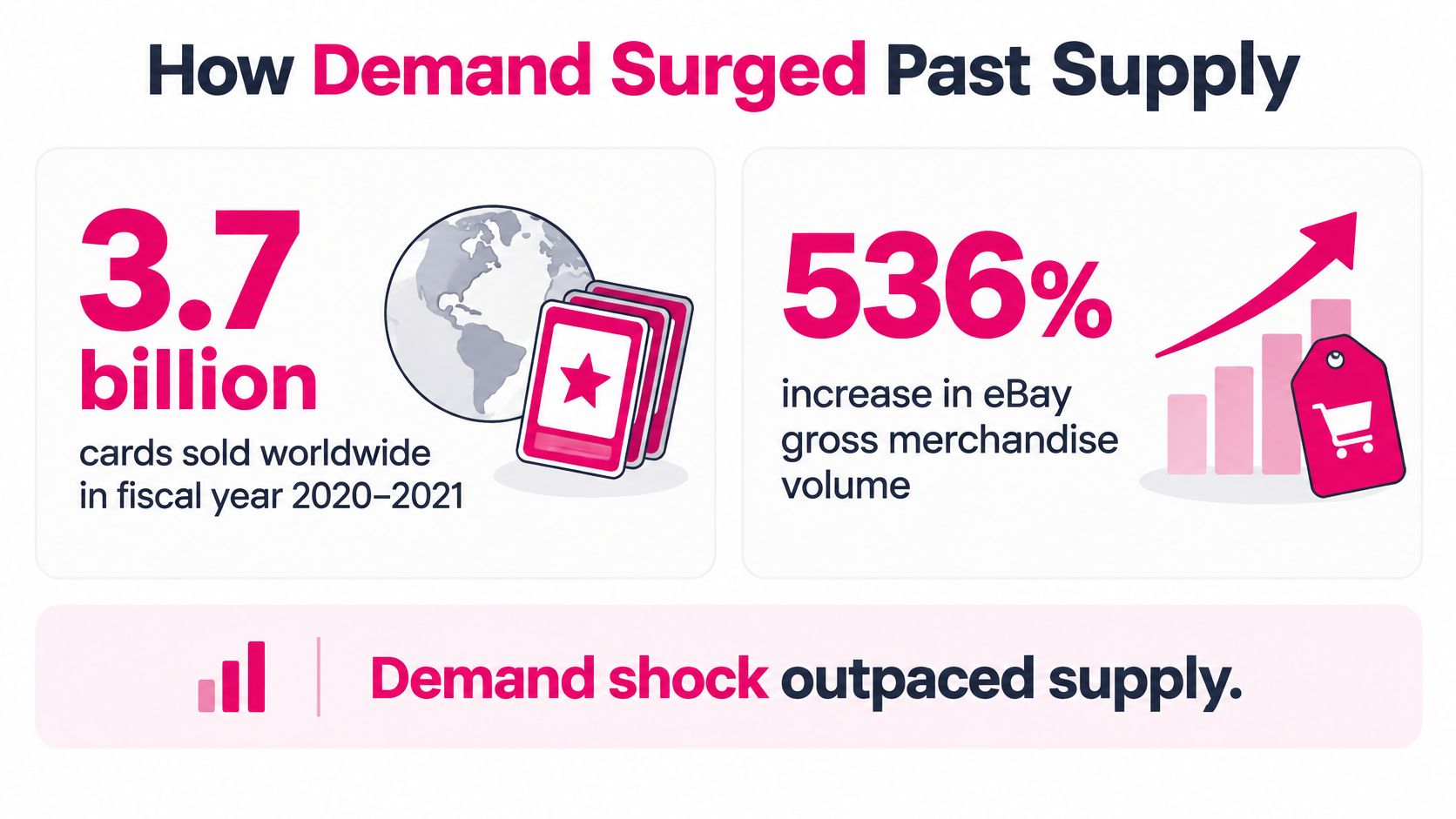
The Pokemon Company reported selling 3.7 billion cards worldwide during fiscal year 2020 to 2021, ending March 2021, bringing lifetime production above 34.1 billion cards, according to Pokeguardian's summary of the sales figures. Yet high total output did not prevent a shortage of particular cards when demand rose sharply.
Pokemon sales surged through 2020 and 2021 during the pandemic-era boom. More buyers entered the market at once, while new print runs could not immediately meet demand for specific products and chase cards.
Three Buyer Groups Arrived at Once
The surge brought together three overlapping audiences:
- Returning fans from the late 1990s. Adults with disposable income sought cards they could not afford as children.
- Younger collectors entering fresh. New players discovered the game through current sets, then looked for older printings.
- Online investors. Some buyers treated graded cards as investments, focusing on price movements rather than the artwork.
Lockdowns pushed more discovery and trading online. Livestream breaks brought cards to international audiences, while visible price increases drew speculative buyers. A card once sold at a local show could now attract bids from collectors in several countries.
The result depended on the card, not the total number of cards in circulation. If many new buyers pursue a limited number of copies of one promo, sellers can raise prices until enough buyers leave the market. Meanwhile, billions of ordinary cards can remain inexpensive because the new demand is concentrated on specific targets.
The question to ask about any rising price: did more buyers arrive, or did the supply of this specific card change? A demand-led increase can reverse when attention fades. A genuinely limited supply cannot expand to meet that demand.
Why Abundant Cards Still Feel Scarce
The number of cards printed overall does not determine the price of a specific chase card. The Pokemon Company has produced billions of cards, but supply is uneven: most are widely available, while certain promos and early printings have far fewer copies in circulation.
Value tends to concentrate in two kinds of scarcity. Some cards had restricted original distribution, such as tournament prizes, contest promos, and early printings that were not sold through normal retail channels. Others are difficult to find in strong condition, leaving fewer desirable copies available to collectors.
A 1998 Pikachu Illustrator, awarded through an illustration contest rather than pulled from a pack, is believed to exist in only a few dozen examples. That limited original distribution constrains the number available to buyers. A retail restock cannot add copies of a card that was never part of a retail set.
The Fixed-Copy Mechanism
When many collectors want a card and its available supply is nearly fixed, more demand cannot produce more copies. Prices rise until enough buyers decide not to pay the asking price.
A modern chase card can feel scarce while packs sell quickly. Yet if the card remains in print, additional packs, reprints, or distributor restocks can increase supply. A sharp price rise alone does not show whether scarcity will last.
Practical rule: If a card's scarcity rests only on current popularity, its price may reflect momentum rather than a lasting limit on supply.
To assess the difference, record provenance, edition, language, certification number, and population data together. These details help distinguish a card with constrained supply from one attracting temporary attention. The Pokemon card rarity guide explains how rarity factors affect value.
The market's key distinction is between total output and the supply of a specific card. A large overall print run can coexist with a small number of a particular promo or desirable copy.
How Condition and Grading Multiply Value
A card's grade can change its price sharply, even when the card itself is identical. The reason is that top grades represent a narrower supply: wear, print quality, and factory centering determine which surviving copies qualify.
The reported PSA census figures for Charizard list 123 PSA 10 copies of 1st Edition Charizard and 58 PSA 10 copies of Shadowless Charizard, alongside larger populations in lower grades. Those counts illustrate why total print numbers alone are a poor guide to the supply of pristine examples.
What Graders Actually Score
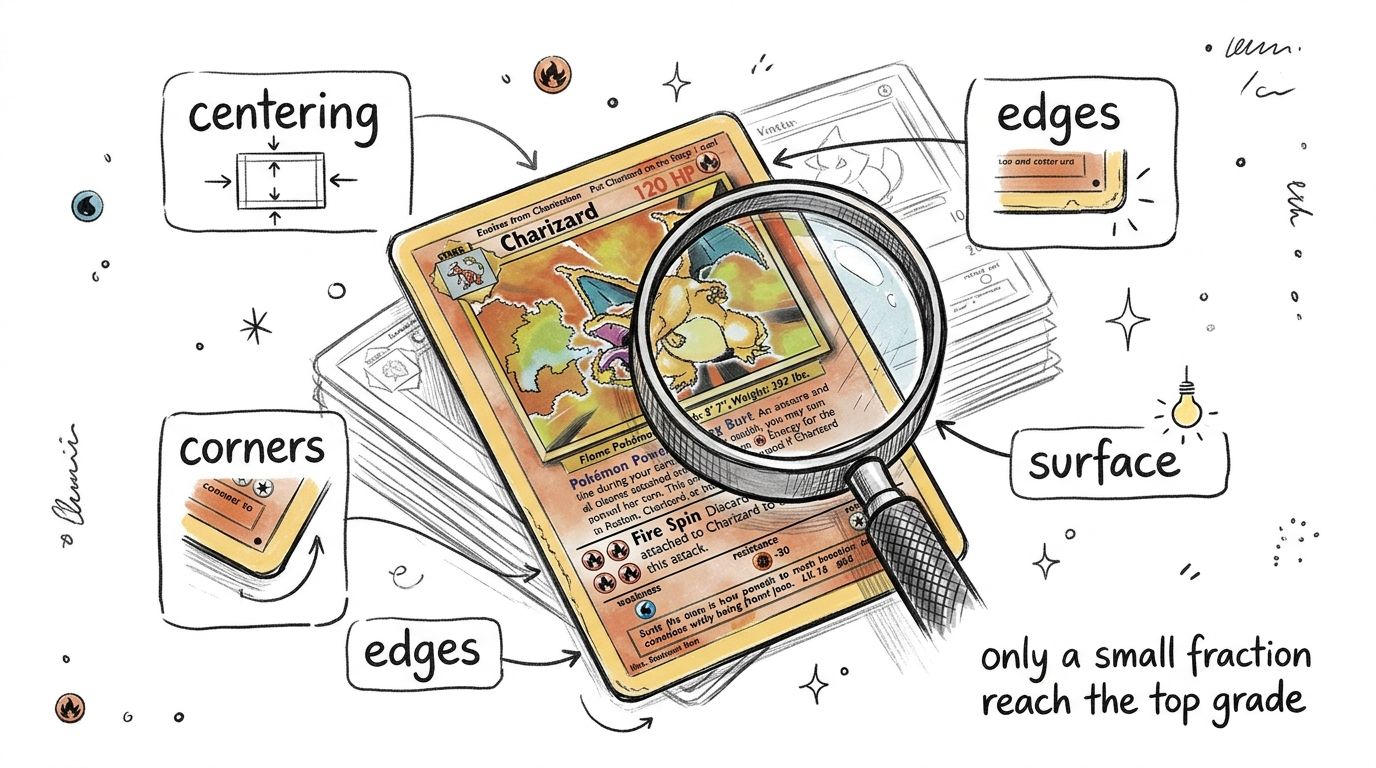
Professional graders assess four features that affect a card's condition:
- Centering. How evenly the printed border sits on the card, measured on both axes. Factory cutting determines this, and owners cannot change it.
- Corners. Their sharpness and consistency. Handling and play can leave corners rounded or soft.
- Edges. Whitening and wear along the border, which can result from handling or storage.
- Surface. Scratches, print lines, indentations, and gloss loss. Some flaws are difficult to see under ordinary light.
Among surviving vintage cards, only a fraction earn the highest grades. The meaningful comparison is therefore between high-grade populations, not the total number printed. Grading makes condition more legible to buyers, but it does not improve the card.
Why the Grade Gap Doesn't Close
Condition differences are often irreversible. Opening sealed product may reveal another card, but it cannot restore a worn surface, sharpen rounded corners, or correct off-center printing. A damaged copy does not return to the top-grade pool.
A slab label is a useful starting point, not a complete price assessment. Two cards with the same name, year, and grade can still differ in set, print variant, and population. The Pokemon card condition guide explains the factors to compare.
Before judging a premium, match the exact set, print variant, and grade, then consider the relevant population. A raw card is not an equivalent benchmark: its eventual grade is unknown, and that uncertainty affects what buyers are willing to pay.
Why Landmark Cards Sell for Millions
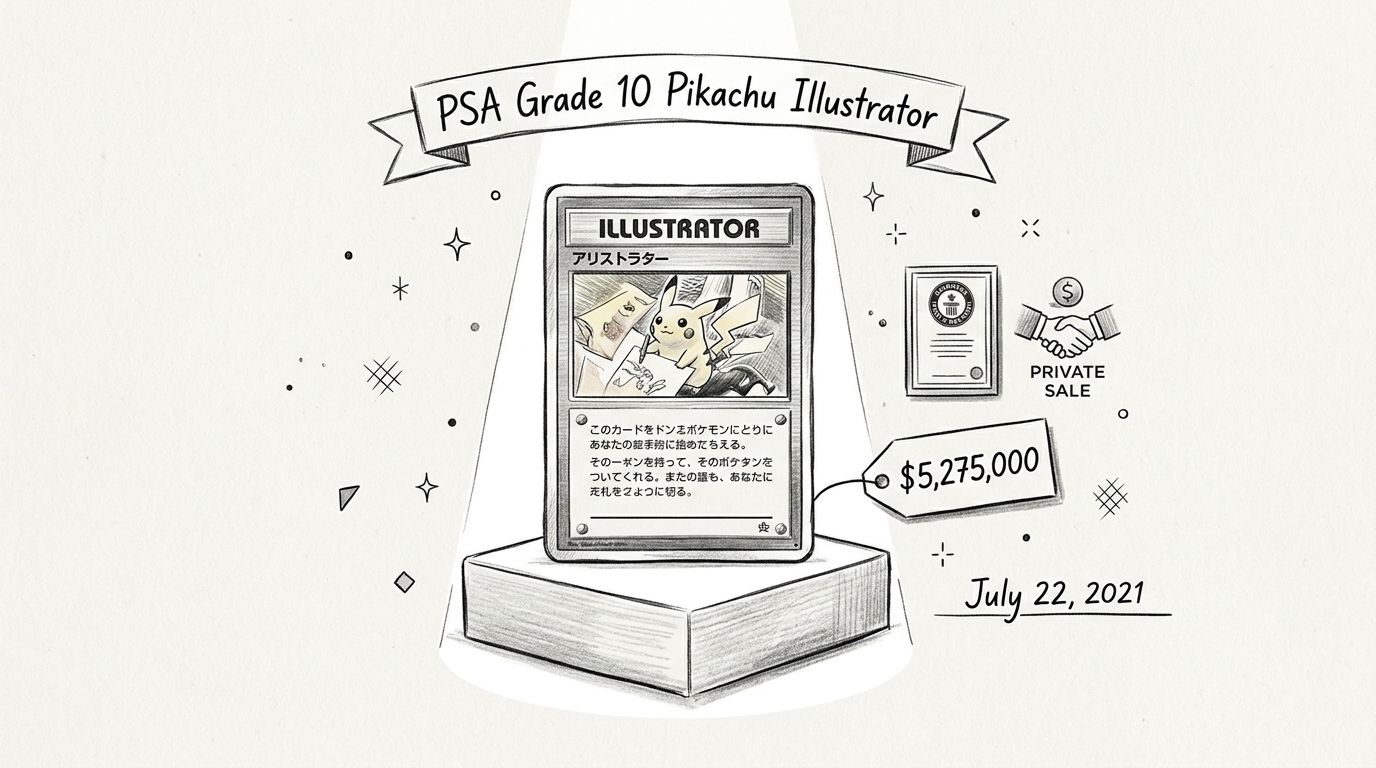
On July 22, 2021, a PSA Grade 10 Pikachu Illustrator sold privately for $5,275,000, setting a record for the most expensive Pokemon card sold in a private sale, according to Guinness World Records. The card was awarded through an illustration contest in Japan, giving it a documented place in the hobby's history.
Its price reflects three reinforcing features.
Provenance. The contest origin and connection to a specific era give the card a history that buyers can investigate. That context distinguishes a landmark promotional card from one whose value rests mainly on current demand.
Scarcity. The Illustrator was distributed to contest winners rather than through ordinary booster packs. Its supply is therefore tied to a specific event, not to a print run that could be replenished.
Condition. A PSA 10 copy occupies a narrower market than raw or lower-graded examples. The grade provides a shared reference for buyers assessing the card's condition, though it does not by itself explain the full price.
The $5,275,000 sale is evidence of what one buyer paid for one exceptionally scarce, documented card in a top grade. A later headline price cannot be attributed to this same sale record without separate evidence, and a record-setting result is not a typical market benchmark.
What Landmark Prices Don't Tell You
A landmark sale can distort expectations for cards that share only a character or a broad era. A played, unlimited-print Charizard from 1999 is not comparable to a first-edition card in top condition just because both feature Charizard. The specific version, condition, and evidence of scarcity determine whether the comparison holds.
For a high-priced listing, check whether its promotional origin is documented and whether the slab's certification number matches the grading company's record. Then compare completed sales for the same card variant and grade. Landmark prices show that buyers may pay a premium for a rare card with a verifiable history; they do not set the price of an ordinary single.
Telling Durable Scarcity From Hype
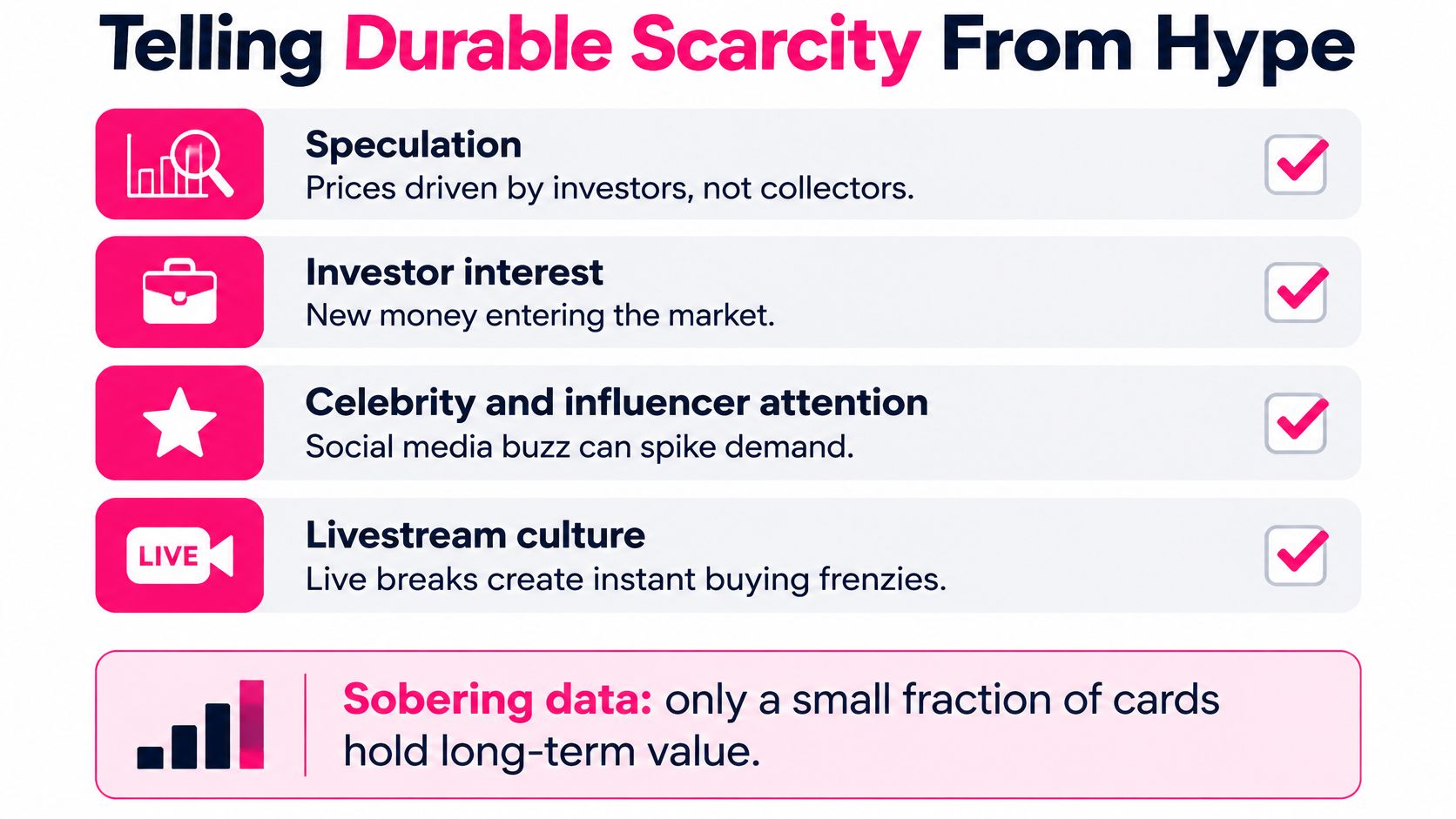
The common belief is that Pokemon cards are expensive because the publisher prints too few of them. The production data points the other way. More than 85 billion cards had reportedly been produced by March 2026, including roughly 10 billion during the preceding year, according to a market analysis of Pokemon card pricing data. That is not a constrained supply.
The expensive segment is narrow. It concentrates in particular combinations of character popularity, rarity, artwork, language, edition, and condition, and nowhere else. The same analysis estimated that only 45 of 2,137 cards from 12 English-language sets released between January 2025 and September 2026 had a raw median price of at least $100, while the median standalone card sold for $2.93.
The Test to Run on Any Price
Given those numbers, the useful question isn't whether Pokemon cards are expensive. It's whether a particular price reflects durable scarcity or a temporary shortage, and that question has a test.
- Pull rates. A card that appears in one of every few packs is a lottery ticket with a large winning pool. A card that was never in a pack has no pull rate at all, which is a stronger signal than any rarity symbol.
- Population reports. Check how many copies exist at the grade you're buying. A low top-grade population with a large lower-grade population means the premium is about survival, not print volume.
- Reprint likelihood. Cards from a set still in distribution can be restocked. Contest promos and tournament prizes cannot, and neither can a card whose scarcity comes from a distribution channel that closed decades ago.
- Completed sales. Sold prices show where a buyer and a seller agreed. Asking prices show only where a seller hopes to land.
Asking prices can stay high long after real sales slow, because nothing forces a hopeful seller to accept the market's answer. Completed sales are the only prices that were tested.
The distinction matters most at the two ends of the market. A graded vintage card may be scarce because few high-condition copies survived, which is durable. A modern sealed product may be expensive because demand outran distribution for one quarter, which is temporary. Treating the second as if it were the first is how buyers pay a scarcity premium for something that will be restocked.
Protect Your Purchase Before You Pay a Premium
A premium price buys you risk as well as a card. The four risks below account for most of the money lost in this hobby, and each has a specific check you can run before you pay.
| Risk | Protection | What to Check |
|---|---|---|
| Counterfeit cards | Authenticity guarantee on sold cards | Certification number and item details match the listing |
| Misgraded or mis-described slab | Certified PSA-graded inventory | Certification number, grade, set, and print variant |
| Shipping loss or damage | Insured, trackable delivery | Tracking and insurance confirmed before payment |
| Paying a hype premium | Completed sales and population data, not asking prices | Recent sold prices, known population, and reprint likelihood |
Counterfeits are the oldest problem in the hobby, and the modern version is convincing: correct card stock, plausible print quality, a copied slab label. Pull the certification number and compare it against the grading company's own record. If the card in the photos doesn't match the card in the database, the listing is finished regardless of how good the price looks.
Mis-description is subtler than forgery. A slab can be genuine and still be the wrong variant, the wrong language, or a lower grade than the headline implies. Every card sold by Lucardio Collectibles is guaranteed to be authentic, and we focus on PSA-graded inventory precisely so the grade, set, and variant arrive on a label you can verify rather than in a seller's description.
Shipping is where a correctly priced purchase turns into a dispute. Confirm tracking and insurance before payment clears, not after the parcel goes missing. Lucardio Collectibles ships with secure, insured delivery for exactly that reason.
The guide to spotting a fake Pokemon card covers the physical tells in more detail, from print dot patterns to label fonts.
Decision rule: pay the premium only when the scarcity is durable, the grade and certification are verified, and the delivery is insured. If one of those three is missing, the price isn't a premium. It's a bet.
Lucardio Collectibles sells authenticated Pokemon singles, sealed booster boxes, and PSA graded cards, runs live breaks and weekly prize draws, and ships every order insured. If you'd rather check a certification number and a population report than take a seller's word for it, that's the standard the platform is built around. Visit Lucardio Collectibles to see current drops and how authentication works.